
Why Do Stainless Steel Eyelets Fail Prematurely – and How Can Nuote Metals Prevent It?
A stainless steel eyelet should outlast the material it reinforces. But we regularly see failures: pitting around the barrel, cracked rolls, or galling during setting. These failures are not random. They follow predictable patterns. At Nuote Metals, we redesigned our specification process around these patterns. This guide shows you how to avoid them.
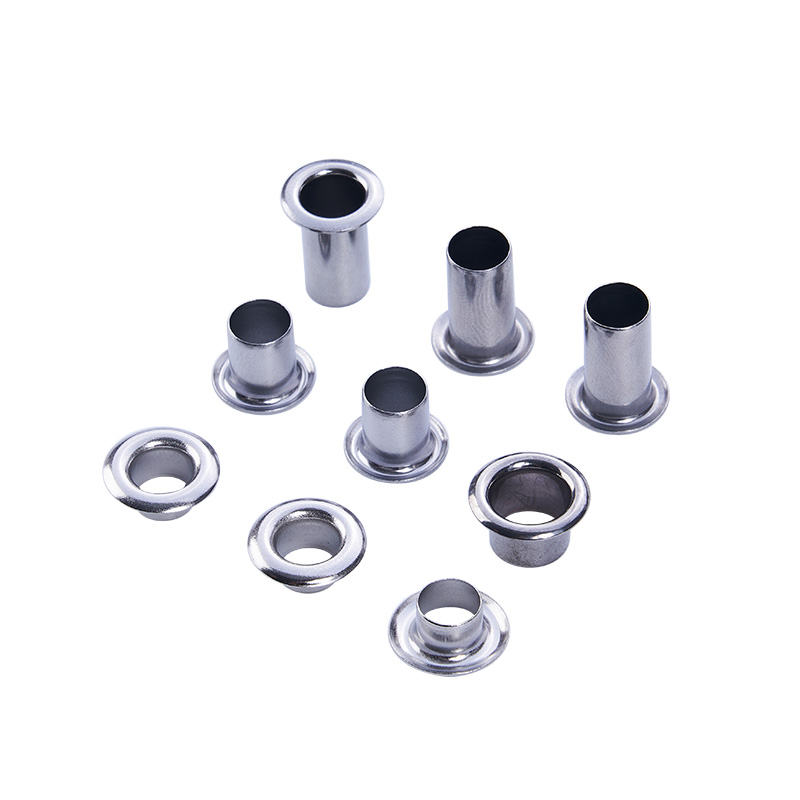
The Three Most Common Failure Modes of Stainless Steel Eyelets
Failure 1: Chloride Pitting (304 Grade in Marine Environments)
What happens: Small rust‑like pits appear on the flange and barrel after 6–12 months of coastal use.
Why: 304 stainless steel contains no molybdenum. Chloride ions from salt spray break down the passive oxide layer locally.
Our solution: For any application within 5 km of saltwater, we require 316 stainless steel (2–3% molybdenum). The pitting resistance equivalent number (PREN) increases from 18–20 (304) to 25–30 (316).
Failure 2: Cracked Rolls During Setting
What happens: The hollow barrel splits instead of curling smoothly.
Why: Work hardening from excessive setting force or a burred hole edge. Stainless steel work‑hardens faster than brass or aluminum.
Our solution: We provide setting force charts for each diameter. For a 5 mm stainless steel eyelet, optimal force is 1,800–2,200 N – 40% higher than brass but with a shorter stroke to avoid cold working.
Failure 3: Galvanic Corrosion Against Aluminum
What happens: Rapid corrosion of the aluminum sheet around the stainless steel eyelet.
Why: Stainless steel is cathodic (noble), aluminum is anodic (active). In wet conditions, the aluminum corrodes preferentially.
Our solution: We apply a nylon or PET insulating washer between the stainless steel eyelet and the aluminum surface. For high‑temperature environments, we supply tin‑plated stainless steel eyelets, which reduce the galvanic potential difference.
Grade Comparison – 304 vs. 316 Stainless Steel Eyelets
| Property | 304 Stainless | 316 Stainless (Marine Grade) |
|---|---|---|
| Chromium | 18–20% | 16–18% |
| Nickel | 8–10.5% | 10–14% |
| Molybdenum | 0% | 2–3% |
| PREN (pitting resistance) | 18–20 | 25–30 |
| Salt spray test (ASTM B117) | 200–400 hrs to pitting | 1,000+ hrs to pitting |
| Cost (relative) | 1x | 1.35x – 1.5x |
| Best for | Indoor, fresh water, mild outdoor | Saltwater, coastal, chemical exposure |
Our rule: If your product will never see salt, 304 is sufficient and economical. If there is any chance of chloride exposure (road de‑icing salts, coastal fog, swimming pool chemicals), upgrade to 316. The added cost pays for itself in avoided warranty claims.
Real Case Studies from Our Factory Records
Case 1: Coastal Awning Manufacturer (316 Solved Pitting)
Problem: A Florida awning maker was using 304 stainless steel eyelets on outdoor retractable awnings. After 8 months, orange pitting appeared around every eyelet. Customers demanded replacements.
Our intervention: We analyzed the failed eyelets under a microscope – classic chloride pitting. We requoted 316 stainless steel spur eyelets with passivated finish. Two years later, zero pitting. The customer switched all coastal products to 316.
Case 2: Medical Drape Assembly (Cracked Roll Elimination)
Problem: A German medical textile company was experiencing 3–5% cracked rolls during automated eyeleting of sterile drapes. Scrap rates were high, and cracked eyelets could not be used in operating rooms.
Our analysis: We reviewed their setting parameters. The automated press was using the same force and stroke as for brass eyelets. Stainless steel requires lower stroke speed and higher force. We provided new setting parameters and a modified anvil profile. Cracked rolls dropped to 0.2%.
Technical Specifications – Our Factory Standards
Dimensional Tolerances (All Stainless Steel Eyelets)
| Parameter | Range | Tolerance | Inspection Method |
|---|---|---|---|
| Shank OD | 1.5 – 12 mm | ±0.05 mm | Laser micrometer |
| Flange OD | 4 – 30 mm | ±0.10 mm | Optical comparator |
| Barrel length | 2 – 15 mm | ±0.10 mm | Digital caliper |
| Concentricity | – | ≤0.1 mm TIR | Dial gauge |
| Material hardness (304) | – | 150–200 HV | Vickers |
Passivation Process – What We Do Differently
Many suppliers skip passivation or use a weak citric acid bath. At Nuote Metals, all stainless steel eyelets shipped for outdoor, medical, or food applications undergo nitric acid passivation per ASTM A967. This removes free iron from the surface, maximizes chromium oxide layer thickness, and ensures consistent salt spray performance.
Verification: We perform copper sulfate testing on every passivation batch. No pink discoloration = pass.
Available Finishes and Their Applications
| Finish | Process | Corrosion Protection | Best For |
|---|---|---|---|
| Mill (as‑stamped) | None | Moderate (passive layer only) | Indoor, dry applications |
| Passivated | Nitric acid bath | High (maximized oxide) | Medical, food, outdoor |
| Electropolished | Reverse plating | Very high + ultra‑smooth | Pharmaceutical, semiconductor |
| Mechanical polish | Buffing | Moderate (cosmetic) | Architectural visible |
All finishes meet RoHS 2011/65/EU.
Quality Certifications and Transparent Documentation
- ISO 9001:2015 – Full Traceability
- Our certificate (available on request) covers the entire production chain: material receiving, stamping, annealing, passivation, and final inspection. Every box of stainless steel eyelets includes a lot number that traces back to:
- Raw material mill certificate (heat number)
- Production date and operator
- Passivation batch record
- Final inspection report
- RoHS and REACH Compliance
We maintain current declarations for all stainless steel alloys and finishes. No cadmium, no hexavalent chromium, no lead (except trace impurities).
Our Transparent Pricing Policy
- We do not use opaque formulas. For stainless steel eyelets, we quote:
- Base price per 1,000 pieces (material + stamping)
- Passivation surcharge (if required)
- Tooling amortization (only for custom sizes, amortized over 200,000 pieces)
- Packaging – bulk box (no charge), tape‑and‑reel (add $0.002/unit)
We provide an itemized quote within 24 hours.
Installation Parameters – By Eyelet Type and Thickness
Recommended Setting Force (Newtons, for 1.5 mm material stack)
| Eyelet Shank (mm) | 304 Stainless (N) | 316 Stainless (N) | Brass (N) – for reference |
|---|---|---|---|
| 3 mm | 1,100 – 1,300 | 1,200 – 1,400 | 700 – 900 |
| 5 mm | 1,800 – 2,200 | 2,000 – 2,400 | 1,100 – 1,400 |
| 8 mm | 2,800 – 3,400 | 3,000 – 3,600 | 1,800 – 2,200 |
Note: Use a single, firm stroke. Multiple strikes work‑harden stainless steel and cause cracking.
Hole Size Recommendations
- For rolled‑rim eyelets: Hole diameter = shank OD + 0.10 mm
- For spur eyelets (with washer): Hole diameter = shank OD + 0.15 mm (allows teeth to bite)
- Deburr both sides – A raised burr is the #1 cause of split barrels.
【stainless steel eyelets】FAQ – Three Technical Questions We Answer Daily
Q1: Can I use 304 stainless steel eyelets in a swimming pool environment (chlorinated water)?
A: Proceed with caution. Chlorinated pool water is surprisingly aggressive to stainless steel. Free chlorine (hypochlorous acid) can breach the passive layer of 304, especially in warm water and low pH conditions. We have seen 304 eyelets pit after just 6 months in indoor pool covers. Our recommendation: For continuous or frequent exposure to chlorinated water, upgrade to 316 stainless steel eyelets. The molybdenum content provides resistance to chlorine‑induced pitting. For infrequent exposure (e.g., a pool cover used only on weekends), 304 with passivation may suffice, but we still recommend 316 for any commercial or warranty‑sensitive application. We offer free salt spray and chlorinated water test coupons – request them with your sample order.
Q2: My stainless steel eyelets are galling and seizing in the setting tool. What am I doing wrong?
A: Galling is a common problem when setting stainless steel. It occurs when the eyelet material adheres to the tooling surface under pressure. Three solutions we recommend: First, ensure your setting punches and anvils are made of hardened tool steel (RC 58–62) with a polished surface finish. Rough or uncoated tools promote galling. Second, apply a thin film of stainless‑compatible lubricant (e.g., light mineral oil or a dry film lubricant like MoS₂) to the eyelet barrel or tool face. Avoid chlorine‑containing lubricants. Third, reduce the stroke speed – slower engagement reduces frictional heat. If galling persists, we can supply passivated stainless steel eyelets – the passive layer reduces surface adhesion. Contact our engineering team for a galling prevention checklist specific to your press model.
Q3: How do I choose between a plain flange, spur flange, or shoulder type stainless steel eyelet?
A: The choice depends entirely on your material and load direction. Plain flange (smooth underside) is best for soft, thick materials that compress during setting, such as foam, rubber, or multiple layers of fabric. The smooth flange distributes force evenly. Spur flange (with teeth) is best for thin, tough, or slippery materials – canvas, leather, plastic sheeting, or tarpaulins. The teeth penetrate the surface, preventing rotation and increasing pull‑out resistance by 40–60%. Shoulder type (stepped barrel) is for applications where you need a precise standoff or spacer between layers – for example, in PCB assemblies where the eyelet must not short against a trace, or in fabric assemblies where you want a fixed gap. Our recommendation: If you are unsure, start with spur flanges for textile and leather, plain flanges for soft composites, and shoulder types only when you need a controlled standoff. We can send free samples of all three for your testing.
Contact Nuote Metals for Your Stainless Steel Eyelets Project
Stop guessing. Tell us your material stack, environment, and annual volume. We will reply with a specific grade recommendation (304 or 316), a barrel length calculation based on your stack thickness, free samples of the recommended eyelet, and an itemized quote with passivation and tooling costs.
Send Inquiry



X
We use cookies to offer you a better browsing experience, analyze site traffic and personalize content. By using this site, you agree to our use of cookies.
Privacy Policy