
Why Do We Still Make Full Tubular Rivets?
When people hear "rivet," they usually think of the solid kind you hammer, or the pop rivets you pull with a gun. But there's an older style that's still around for good reasons: the full tubular rivets. These aren't just hollow at the tip—they're hollow almost all the way through, like a short piece of pipe with a solid head on one end.
So where are they used? Mainly where you need a smooth, strong pivot or a bushing. You set them by flaring out the entire hollow end, which creates a wide, rolled-over clinch that's very strong, especially in softer materials like leather, fabric, or wood. You'll see these tubular rivets in heavy-duty tarps, leather saddles, luggage, and even as pivots in some low-speed machinery. They're not for high-speed assembly, but for jobs where the joint needs to be tough and durable.
Drawing Out the Tube: A Rivet Maker's View
I'm Lao Chen, and I've been making tubular rivets on the deep draw presses for almost twenty years. My job is to turn a flat disk of metal into a perfect little tube.
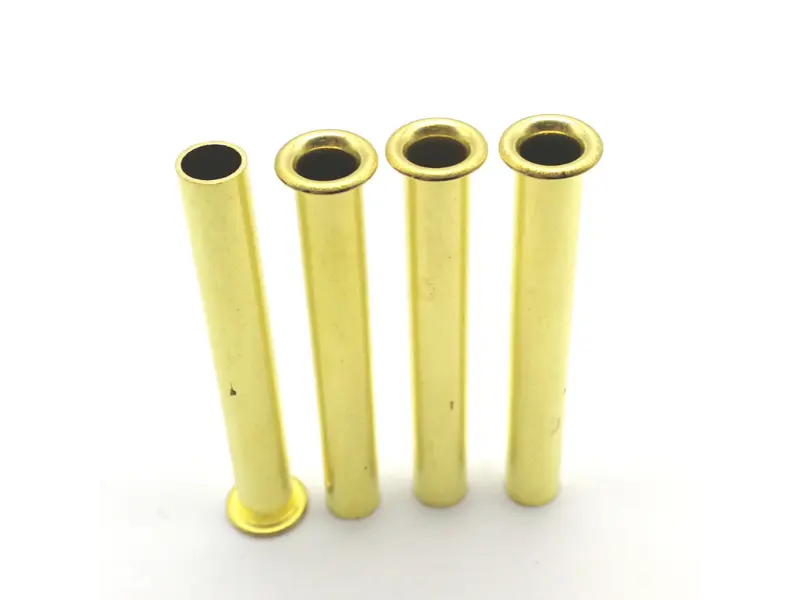
We start with a round blank, a disk cut from sheet metal. It gets fed into the press, over a die. A punch comes down and pushes the blank through the die. The metal doesn't get cut—it gets stretched and drawn upward, forming a deep cup. For a true full tubular rivet, we do this in several steps. After the first draw, we might anneal the metal (heat it to soften it) so it doesn't crack, then draw it again to make it longer and thinner. It's a slow, careful process of convincing the metal to become a tube.
The head is formed in a separate operation. We put the drawn cup into another die and press the solid end to form the head—round, flat, or countersunk. Getting the transition right between the solid head and the hollow shank is crucial. If it's weak, the rivet will snap there when you set it.
The trickiest part is the wall thickness. It has to be even all the way around. If it's too thin on one side, it will collapse when you flare it. I check this by cutting a sample rivet lengthwise with a hacksaw and looking at the cross-section. You can see it plain as day.
We make these tubular rivets in different metals. Mild steel is the most common—it's strong and cheap. Copper is softer and easier to draw, and it's used for electrical contacts or its looks. Brass is somewhere in between. Each metal "feels" different in the press. Steel fights you; copper flows.
Most folks don't think about how these full tubular rivets are made. They just buy them by the bag. But when you've spent years drawing them out, you know that a good one is more than just a part. It's a piece of metal that's been shaped with just the right amount of force, meant to hold things together for a long, long time. There's a simple satisfaction in that.
Previous:What's the Point of Brass Eyelets?
Send Inquiry



X
We use cookies to offer you a better browsing experience, analyze site traffic and personalize content. By using this site, you agree to our use of cookies.
Privacy Policy