
How Do You Choose the Right Eyelets for Applications from PCB to Leather Goods?
Eyelets vs. Grommets – The Distinction That Determines Performance
The two terms are often used interchangeably. They are not the same product. Specifying the wrong one leads to either over-engineering or premature failure.
A Structural Comparison
| Feature | Eyelets | Grommets |
|---|---|---|
| Construction | Single piece | Two pieces (body + washer) |
| Flange-to-hole ratio | Smaller flange, lower profile | Larger flange, greater grip area |
| Typical hole size | Up to ~12 mm | 12 mm and above, industry-standard sizing |
| Strength | Moderate—sufficient for light to medium loads | Higher—for heavy-duty reinforcement |
| Best for | Clothing, bags, footwear, electronics, paper | Tarpaulins, flags, heavy curtains, signage |
| Installation | Barrel rolled or flared | Body and washer compressed together |
The practical rule from our production floor: if the material is relatively thin and the load is light to moderate, use an eyelet. If the material is heavy canvas, vinyl, or a load-bearing tarp, use a grommet. For everything in between, the decision usually comes down to flange aesthetics and hole size.
Material Selection – Matching the Eyelet to the Environment
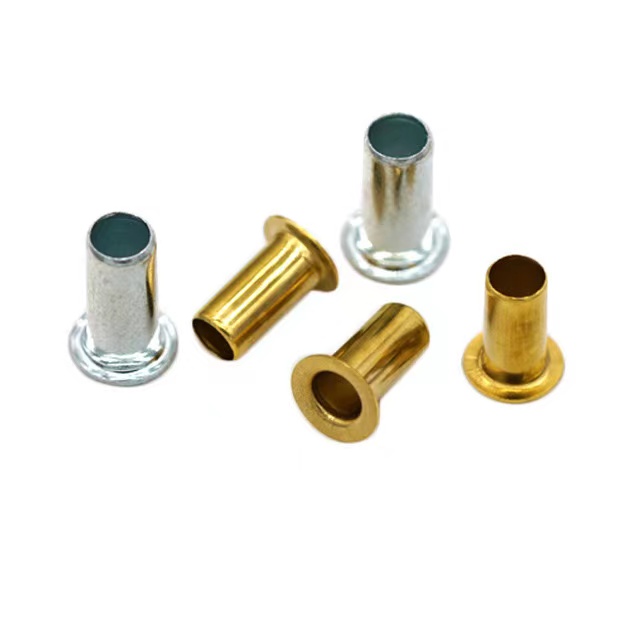
At Nuote Metals, eyelets are manufactured in five materials. Each solves a different problem.
Material Comparison
| Material | Corrosion Resistance | Conductivity | Typical Application | Notes |
|---|---|---|---|---|
| Brass | Good (indoor, fresh water) | 28% IACS | Leather goods, bags, footwear, PCB terminals | Most common; lacquered finish prevents tarnishing |
| Stainless Steel (304/316) | Excellent | Low | Marine fabric, outdoor gear, food equipment | 316 for chloride exposure |
| Aluminum | Very good (5056 marine grade) | 61% IACS | Lightweight assemblies, outdoor fabric, electronics | Lowest weight; anodized finishes available |
| Copper | Good (patina forms) | 100% IACS | Electrical grounding, roofing, heritage restoration | Softest; requires careful setting |
| Steel (low carbon) | Poor (needs plating) | Low | Cost-sensitive indoor applications | Zinc plating required for moisture exposure |
Our selection logic: Brass for electronics where conductivity and appearance matter. Stainless steel for marine and chemical environments. Aluminum when weight is the constraint. Copper only when maximum conductivity is non-negotiable. Steel when cost dominates and the environment is dry.
Two Applications from Our Records
PCB Through-Hole Reinforcement (Brass, Flat Flange)
Problem: An electronics manufacturer producing industrial control boards experienced copper pad lifting around through-holes after thermal cycling. The holes were used for transformer and connector legs, and the mechanical stress from assembly was transferring directly to the solder joint.
Our solution: We supplied brass eyelets with flat flanges, 2.4 mm outside diameter, 4 mm barrel length. The eyelets were inserted into the plated through-holes and rolled to create a mechanical sleeve. The brass body absorbed the assembly stress, protecting the copper foil from peeling. The inside diameter was specified 0.05 mm larger than the component lead to allow easy insertion without play.
Result: Pad lifting failures dropped to zero over 12 months of production. The manufacturer added the eyelet to their design standard for all heavy-component through-holes.
Portable Audio Device Hinge Assembly (Nickel-Plated Brass, Rolled Flange)
Problem: A manufacturer of portable Bluetooth speakers needed a durable, low-profile pivot point for the folding stand mechanism. The housing was ABS plastic, 1.8 mm thick. The original design used a small steel pin pressed into a plastic boss, but the boss cracked during drop testing and the pin corroded in humid environments.
Our solution: We supplied nickel-plated brass eyelets with a rolled flange, 2.0 mm inside diameter, 3.5 mm barrel length. The eyelet was set into the plastic housing to act as a reinforced bearing surface for the hinge pin. The rolled flange provided a smooth, low-profile surface that did not interfere with the folding action. Nickel plating prevented corrosion and matched the speaker’s metallic finish.
Result: Drop testing passed at 1.5 m onto concrete with zero boss cracking. After 18 months in production, the hinge assembly shows no wear or corrosion. The customer eliminated the steel pin entirely and now uses the eyelet as both reinforcement and bearing surface.
Technical Specifications – What We Hold
| Parameter | Standard Range | Tolerance |
|---|---|---|
| Shank (barrel) outside diameter | 1.0 mm – 10 mm | ±0.05 mm |
| Flange diameter | 3 mm – 16 mm | ±0.10 mm |
| Barrel length | 2 mm – 12 mm | ±0.10 mm |
| Material thickness | 0.3 mm – 1.2 mm | ±0.03 mm |
| Concentricity (barrel to flange) | — | ≤0.1 mm TIR |
For PCB applications, we can hold shank diameter to ±0.02 mm when the component lead tolerance requires it.
Eyelets – FAQ
Q1: When should I use an eyelet instead of a grommet?
A: Use an eyelet when the material is relatively thin, the load is light to moderate, and a low-profile finish is desired. Eyelets are single-piece fasteners with a smaller flange-to-hole ratio, making them suitable for clothing, leather goods, footwear, electronics, and paper products. Use a grommet when the material is heavy canvas, vinyl, or a load-bearing tarp, and the hole is larger than roughly 12 mm. Grommets are two-piece (body and washer) and provide greater reinforcement for heavy-duty applications. If your material is under 3 mm thick and the hole is under 12 mm, an eyelet is almost always the correct choice.
Q2: What tolerances matter most for PCB eyelets?
A: Two tolerances are critical. First, the inside diameter of the eyelet must be sized to the component lead—typically 0.05 mm to 0.20 mm larger than the lead diameter to allow insertion without binding. Second, the outside diameter must fit the board clearance hole, which is usually 0.03 mm to 0.10 mm larger than the eyelet’s outer diameter. If the eyelet is too loose in the board, it will not grip; if it is too tight, it can crack the board or deform during insertion. For critical through-hole reinforcement, specify these dimensions explicitly rather than relying on trade sizes.
Q3: Can eyelets be used in outdoor or marine applications?
Yes, with the right material. Stainless steel eyelets (304 for general outdoor, 316 for saltwater and chlorides) offer the highest corrosion resistance. 5056 aluminum eyelets provide good marine-grade corrosion resistance at a lower weight. Brass performs well in fresh water and mild conditions but can dezincify in continuous salt spray. Copper forms a protective patina and suits roofing and heritage work. Steel must be plated and is not recommended for prolonged moisture exposure. For coastal or marine fabric assemblies, specify 316 stainless steel or 5056 aluminum.
Q4: What is the MOQ and lead time for eyelets from Nuote Metals?
A: Our standard MOQ is 20,000 pieces for stock sizes. For first orders or sample runs, we accommodate lower quantities—as low as 5,000 pieces. We provide free samples for stocked sizes; you pay only the courier charge. Lead time: 3–5 days for stock sizes; 15–20 days for non-standard sizes including custom tooling. Every batch includes a material certificate, dimensional inspection report, and RoHS declaration. We have supplied eyelets to customers in over 40 countries. ISO 9001:2015 certified.
Send Inquiry



X
We use cookies to offer you a better browsing experience, analyze site traffic and personalize content. By using this site, you agree to our use of cookies.
Privacy Policy