
Article Summary: Aluminum half hollow rivets combine low weight, reduced installation force, corrosion resistance, and reliable permanent fastening. This guide explains their structure, alloy options, advantages, head styles, finishes, applications, manufacturing process, and quality considerations to help engineers and purchasing teams select the right rivet for efficient production.
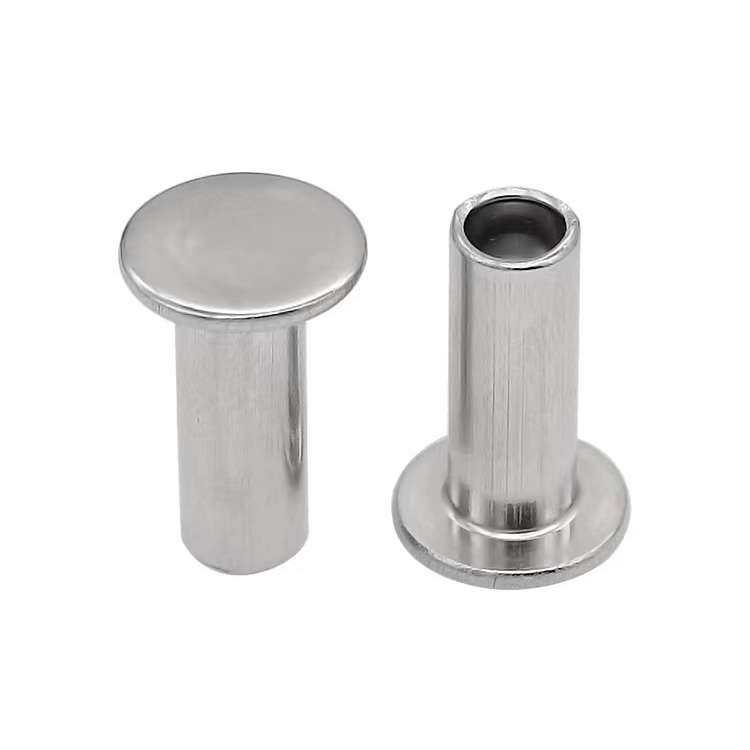
Table of Contents
What Are Aluminum Half Hollow Rivets?
Why Choose Aluminum for Half Hollow Rivets?
How Do You Choose the Right Aluminum Alloy?
How Do Aluminum Half Hollow Rivets Compare with Other Fasteners?
Which Head Style Should You Choose?
Where Are Aluminum Half Hollow Rivets Used?
How Are Aluminum Half Hollow Rivets Manufactured and Inspected?
What Can a Real Electronics Application Tell Us?
What Are Aluminum Half Hollow Rivets?
Nuote manufactures Aluminum Half Hollow Rivets for applications that require a lightweight, permanent fastening solution with efficient installation. Also known as semi-tubular rivets, half tubular rivets, or hollow-end rivets, these fasteners have a partially hollow section at the tail rather than a completely solid shank.
This cavity is an important part of the rivet's working principle. During installation, the hollow end deforms and rolls outward, creating a secure mechanical clinch with significantly less setting force than a conventional solid rivet. This makes the design particularly useful for thin materials, pivoting components, high-volume assembly, and applications where excessive installation pressure could deform the workpiece.
Nuote's aluminum versions are available in 1100 pure aluminum and 5052/5056 aluminum alloys, with shank diameters from approximately 0.8 to 8.0 mm and multiple head configurations and surface finishes.
Why Choose Aluminum for Half Hollow Rivets?
Material selection directly affects the overall performance of a fastening system. Aluminum is particularly attractive when reducing component weight is an important design objective.
- Low weight: Aluminum weighs roughly one-third as much as steel, helping reduce the mass of finished assemblies.
- Corrosion resistance: Aluminum naturally forms a protective oxide layer, reducing the need for conventional anti-rust plating.
- Non-magnetic properties: Aluminum is suitable for assemblies where magnetic materials may interfere with sensitive components.
- Low-force installation: The semi-hollow structure allows the tail to expand with substantially less force than a solid rivet.
- Production efficiency: The design works well with automated riveting equipment for repeatable, high-volume assembly.
- Design flexibility: Different aluminum alloys, head styles, dimensions, and finishes can be selected according to application requirements.
For engineers designing portable electronics, drones, lightweight equipment, sporting goods, or thin aluminum enclosures, these characteristics can provide a useful balance between fastening performance and weight reduction.
How Do You Choose the Right Aluminum Alloy?
Not every aluminum application requires the same strength level. Choosing between 1100, 5052, and 5056 should depend on load requirements, environmental exposure, weight targets, and the characteristics of the materials being joined.
| Aluminum Grade | Typical Strength | Key Characteristics | Recommended Applications |
|---|---|---|---|
| 1100 | Approx. 90–130 MPa | Highly ductile, lightweight, excellent corrosion resistance | Decorative assemblies, trim, non-structural enclosures |
| 5052 | Approx. 220–280 MPa | Good strength, corrosion resistance, versatile performance | General-purpose assemblies, electronics housings, moderate loads |
| 5056 | Approx. 280–350 MPa | Higher strength and excellent corrosion resistance | Marine, outdoor, and higher-stress lightweight assemblies |
1100 aluminum is appropriate when ductility and low weight are more important than mechanical strength. 5052 aluminum offers a practical balance for many general industrial applications. When greater strength and demanding environmental performance are required, 5056 aluminum can be a better choice.
How Do Aluminum Half Hollow Rivets Compare with Other Fasteners?
The value of a half hollow rivet becomes clearer when it is compared with solid rivets and other material options. The semi-hollow structure reduces the amount of material that must be plastically deformed during installation while maintaining a permanent mechanical connection.
| Feature | Aluminum Half Hollow Rivet | Steel Half Hollow Rivet | Aluminum Solid Rivet |
|---|---|---|---|
| Weight | Very low | Higher | Low to moderate |
| Magnetic | No | Yes | No |
| Corrosion Resistance | Excellent | Depends on finish | Excellent |
| Setting Force | Low | Low | High |
| Installation | Suitable for automation | Suitable for automation | Requires greater forming force |
| Best Application | Weight-sensitive assemblies | Heavy-duty industrial assemblies | Applications requiring maximum rivet strength |
In many applications, the decision is not simply about selecting the strongest fastener. The better choice is the fastener that delivers sufficient joint performance while minimizing weight, installation force, production complexity, and maintenance requirements.
Which Head Style Should You Choose?
Head geometry affects appearance, load distribution, clearance, and the interaction between the rivet and the assembled materials. Aluminum half hollow rivets can be produced in several head styles to accommodate different mechanical and design requirements.
- Round head: A traditional profile for visible general-purpose joints.
- Flat head: Useful where a relatively low-profile fastening point is preferred.
- Oval head: Provides a smoother, more decorative appearance.
- Countersunk head: Designed for applications requiring a flush surface.
- Truss head: Provides a wider bearing surface and is useful for softer materials or larger holes.
- Mushroom head: Offers a broad, smooth bearing surface for selected soft-material applications.
Head selection should consider the thickness and hardness of the joined materials, available clearance, required appearance, and the capabilities of the riveting equipment.
Where Are Aluminum Half Hollow Rivets Used?
The combination of low mass, non-magnetic properties, corrosion resistance, and low installation force makes aluminum semi-hollow fastening technology suitable for a wide range of products.
- Portable electronic equipment and aluminum housings
- Drone and unmanned equipment assemblies
- Sporting goods and lightweight equipment
- Consumer products and appliances
- Thin sheet-metal assemblies
- Pivot points and moving components
- Lightweight transportation components
- Outdoor equipment and corrosion-sensitive assemblies
- Decorative and non-structural metal products
They are particularly valuable when a manufacturer needs a permanent joint but cannot tolerate the deformation or high pressing force associated with installing a solid rivet into a thin component.
How Are Aluminum Half Hollow Rivets Manufactured and Inspected?
Consistent rivet performance depends heavily on dimensional accuracy and controlled material properties. A professional manufacturing process typically starts with verified aluminum wire and continues through forming, trimming, deburring, surface treatment, and final inspection.
- Material verification: Aluminum wire is checked for diameter, hardness, and alloy composition.
- Cold heading: Progressive forming creates the shank, head, and semi-hollow cavity.
- Trimming: Excess material and forming flash are removed.
- Deburring: Surface imperfections and micro-burrs are reduced.
- Surface finishing: Plain, anodized, or other specified finishes can be applied.
- Final inspection: Critical dimensions, head geometry, material grade, and surface condition are verified before shipment.
For precision applications, inspection equipment such as laser micrometers, optical comparators, image measuring systems, spectrometers, hardness testers, and salt-spray testing equipment can provide additional quality verification.
Nuote states that its production process includes material traceability, dimensional inspection, optical sorting, and documentation such as material certificates and certificates of conformance where required. Standard samples can be available in approximately 5–7 days, while custom tooling may require approximately 15–20 days.
What Can a Real Electronics Application Tell Us?
Consider a portable electronics manufacturer assembling thin aluminum enclosures. Steel screws created unnecessary weight and introduced magnetic components into an environment containing sensitive electronics. Solid aluminum rivets solved the magnetic issue but required higher installation force, increasing the risk of distortion in thin enclosure walls.
A 5052 aluminum half hollow rivet can address these competing requirements by combining lightweight construction, non-magnetic performance, corrosion resistance, and lower installation force. A configuration such as a 3.0 mm shank with a round head and clear anodized finish can be tailored to the enclosure's geometry and appearance requirements.
This type of application demonstrates an important engineering principle: fastener selection should be based on the complete assembly rather than tensile or shear strength alone. Weight, installation force, material compatibility, corrosion behavior, appearance, automation, and lifecycle requirements can all influence the final choice.
Frequently Asked Questions
Are aluminum half hollow rivets the same as semi-tubular rivets?
Yes. Aluminum half hollow rivets are commonly described as semi-tubular rivets, half tubular rivets, or hollow-end rivets. These terms generally refer to a rivet with a partially hollow tail that expands during installation.
Why are aluminum half hollow rivets suitable for lightweight products?
Aluminum has a much lower density than steel, allowing manufacturers to reduce fastener weight. The semi-hollow structure also reduces the material that must be deformed during installation, helping lower setting force.
Should I choose 1100, 5052, or 5056 aluminum?
Choose 1100 when low weight and ductility are the primary requirements. 5052 is a versatile option for moderate-load applications requiring good corrosion resistance. 5056 is more suitable for higher-strength requirements and demanding outdoor or marine environments.
Can aluminum half hollow rivets be customized?
Yes. Customization can include shank diameter, barrel length, head geometry, aluminum grade, surface finish, and other dimensional requirements. A technical drawing or sample is normally the best starting point for confirming specifications and tooling requirements.
Are these rivets suitable for automated assembly?
Yes. Their repeatable geometry and low-force setting characteristics make them suitable for automated or semi-automated riveting processes, particularly in high-volume manufacturing where consistent installation is important.
Conclusion
Aluminum half hollow rivets offer a practical combination of lightweight construction, corrosion resistance, non-magnetic performance, and efficient low-force installation. By selecting the right aluminum alloy, head style, dimensions, and surface treatment, manufacturers can develop permanent joints that support both product performance and production efficiency.
If you are evaluating aluminum rivets for electronics, drones, sporting goods, lightweight enclosures, or other precision assemblies, working with an experienced manufacturer can simplify material selection, customization, sampling, and quality control. Contact Nuote today to discuss your specifications, request samples, or contact us for a customized aluminum half hollow rivet solution for your production requirements.