
Why Are Brass Turning Parts the Backbone of Precision Manufacturing Across Automotive, Electronics, and Medical Industries?
Brass is one of the most machinable metals on the planet. That single property has made brass turning parts the default choice for precision components across dozens of industries. But machinability alone does not explain the enduring demand. Brass also offers corrosion resistance, electrical conductivity, and a natural aesthetic that few materials can match.
At Nuote Metals, we have specialized in brass turning for over a decade. This article shares what we have learned about material selection, tolerance control, and the applications where brass turned parts deliver the most value.
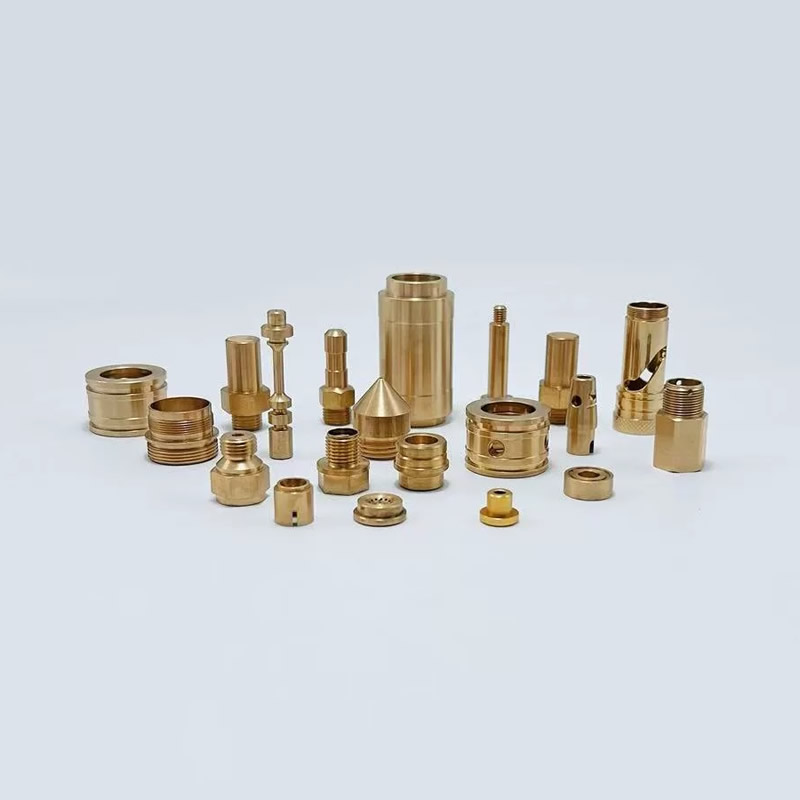
Why Brass Remains the Preferred Material for Turned Components
Brass is an alloy of copper and zinc. The ratio determines its properties. The two grades we work with most frequently are C36000 and C2680.
C36000 Free-Cutting Brass – The Machinability Benchmark
C36000 contains approximately 61.5% copper, 35.5% zinc, and 3% lead. The lead acts as a built-in lubricant during machining, breaking chips into small, manageable pieces and allowing cutting speeds up to 100% on the machinability index—the standard against which all other metals are measured.
C36000 is the material of choice for high-volume precision turning of complex threaded parts, connectors, bushings, and valve components. Its excellent chip control reduces tool wear and shortens cycle times.
C2680 Yellow Brass – When Ductility Matters More Than Speed
C2680 contains approximately 65% copper and 35% zinc. It lacks the lead additive, giving it lower machinability (around 30% of C36000) but significantly higher ductility. C2680 is preferred when the part requires post-machining forming, bending, or crimping. It is also the standard choice for electrical components where lead content must be minimized.
Machinability Comparison
| Property | C36000 | C2680 |
|---|---|---|
| Copper content | ~61.5% | ~65% |
| Machinability index | 100% (benchmark) | ~30% |
| Chip formation | Excellent – short chips | Good – longer chips |
| Best for | High-speed turning, complex threads, connectors | Electrical parts, ductile components, lead-free requirements |
Technical Specifications – Tolerances and Surface Finishes
The value of a brass turning partner is defined by its ability to hold tolerances consistently. At Nuote Metals, we maintain the following standards.
Dimensional Tolerances
| Parameter | Standard Range | Precision Range |
|---|---|---|
| Outer diameter | ±0.05 mm | ±0.01 mm |
| Length | ±0.10 mm | ±0.02 mm |
| Thread pitch diameter | ±0.05 mm | ±0.01 mm |
| Concentricity | ≤0.05 mm TIR | ≤0.01 mm TIR |
For automotive and medical applications, we routinely hold ±0.01 mm on critical dimensions. Typical brass CNC turning achieves ±0.1 to ±0.005 mm depending on part complexity and volume.
Surface Finish Capabilities
| Finish Type | Ra Range | Method |
|---|---|---|
| As-turned (standard) | Ra 1.6 – 3.2 μm | CNC turning |
| Fine turned | Ra 0.8 – 1.6 μm | Reduced feed rate, polished inserts |
| Polished | Ra 0.4 – 0.8 μm | Secondary mechanical polishing |
| Electroplated | Ra 0.2 – 0.8 μm (after plating) | Nickel, tin, or silver plating |
Brass C26000 turned at standard parameters typically achieves Ra ≈ 2.5 μm. For applications requiring lower roughness, reducing feed rate and using diamond-polished tooling can achieve Ra below 0.8 μm.
Two Applications from Our Factory Records
Automotive Electrical Connectors (C36000, Tight Tolerance)
Problem: A tier-one automotive supplier needed brass pin connectors for engine control units. The pins required a diameter tolerance of ±0.015 mm and a surface finish below Ra 1.0 μm to ensure consistent insertion force and low contact resistance. Annual volume exceeded 3 million pieces.
Our solution: We produced the connectors from C36000 brass on Swiss-type CNC lathes with live tooling. In-process laser gauging monitored every 200th piece for diameter, concentricity, and surface finish. The parts were barrel nickel-plated to 3–5 μm for corrosion protection.
Result: Insertion force variation dropped from ±15% to ±4%. The customer reduced incoming inspection from 100% to AQL sampling. Lead time: 12 days for stock sizes; 22 days for custom plated parts.
Medical Device Bushings (C2680, Lead-Free)
Problem: A medical device manufacturer needed lead-free brass bushings for a surgical instrument assembly. The bushings required a smooth internal bore for a sliding shaft, with a clearance tolerance of ±0.02 mm. The material had to comply with RoHS and not contain lead above trace levels.
Our solution: We supplied C2680 lead-free brass bushings, turned and then honed to achieve an internal surface finish of Ra 0.4 μm. The external profile was turned in a single setup to maintain concentricity between the bore and the outer diameter.
Result: The bushings pass a 100% bore gauge inspection. The medical device manufacturer eliminated a secondary reaming operation. Production has continued for over two years with zero field failures.
Quality Systems – What to Look for in a Brass Turning Partner
Not all brass turning suppliers operate at the same level. When evaluating a partner, ask for documentation on the following.
Certifications and Traceability
ISO 9001:2015 is the baseline requirement for any serious brass turning supplier. For automotive work, IATF 16949 is increasingly expected. For medical components, ISO 13485 may be required. Full material traceability—linking the finished part back to the brass rod heat number—is non-negotiable for regulated industries.
In-Process Inspection Capability
A reliable supplier does not rely on final inspection alone. Look for:
In-process gauging: Laser or optical measurement during production, not after.
SPC monitoring: Statistical process control charts for critical dimensions.
Tool wear management: Scheduled insert changes based on piece count, not operator judgment.
Secondary Operations
Many brass turning parts require additional processing. The best suppliers handle these in-house:
Plating: Nickel, tin, silver, or gold
Deburring: Thermal or mechanical
Assembly: Press-fitting, staking, or threading
Brass Turning Parts – FAQ
Q1: What is the difference between C36000 and C2680 brass for turning?
A: The primary difference is lead content and machinability. C36000 contains approximately 3% lead, which acts as an internal lubricant during machining. This gives it a machinability index of 100%—the benchmark against which all other metals are measured. It produces short, easily managed chips and allows higher cutting speeds, making it the preferred choice for high-volume precision turning of complex threaded parts, connectors, and bushings. C2680 is lead-free and contains slightly more copper (about 65%). Its machinability is roughly 30% of C36000, meaning slower cutting speeds and longer chips. However, C2680 offers significantly higher ductility, making it better suited for parts that require post-machining forming, bending, or crimping. It is also the correct choice when lead content must be minimized for regulatory or medical reasons. At Nuote Metals, we stock both grades and can advise on the right choice based on your part geometry, volume, and end-use requirements.
Q2: What tolerances can be achieved with brass CNC turning?
A: Standard brass turning parts achieves tolerances of ±0.05 mm on outer diameter and ±0.10 mm on length. For precision applications, we routinely hold ±0.01 mm on critical dimensions. The achievable tolerance depends on several factors: part size, geometry, material grade, and volume. Smaller parts with simple geometries allow tighter tolerances. Complex parts with multiple features, thin walls, or long length-to-diameter ratios are more challenging. For Swiss-type lathes with in-process gauging, ±0.005 mm is achievable on selected dimensions. We recommend providing a detailed drawing with specific tolerance callouts for critical features rather than applying a blanket tolerance to the entire part. Our engineering team reviews every drawing before quoting and will flag any tolerances that may require secondary operations or special tooling.
Q3: What is the MOQ and lead time for brass turning parts from Nuote Metals?
A: Our standard MOQ is 500 pieces for custom turned parts, though we accommodate lower quantities for prototype and first-article orders. For stock brass rods and standard connector profiles, we can ship from 100 pieces. Lead time depends on material availability and part complexity. For standard brass grades (C36000, C2680) in stock: 7–12 days for production quantities up to 50,000 pieces. For custom plating or secondary operations: add 5–8 days. For new parts requiring tooling or first-article inspection: allow 15–25 days total. We provide a firm lead time with every quotation—no vague ranges. We also offer rush services for urgent requirements. Every shipment includes a full inspection report and material certification.
Send Inquiry



X
We use cookies to offer you a better browsing experience, analyze site traffic and personalize content. By using this site, you agree to our use of cookies.
Privacy Policy