
Why Are Aluminum Tubular Rivets Gaining Ground in Weight-Sensitive and Corrosion-Prone Assemblies?
The Case for Full Tubular Over Semi-Tubular Aluminum
Most buyers default to semi-tubular rivets because they offer a balance of strength and setting force. But there is a specific set of applications where full tubular aluminum rivets are the better engineering choice—not a compromise.
When Full Tubular Wins
| Condition | Why Full Tubular Is Better |
|---|---|
| Material stack under 3 mm | The thin wall rolls with almost no force, preventing damage to thin substrates |
| Soft or brittle materials | Leather, fabric, thin plastic, and composite laminates crush under semi-tubular force |
| Weight-critical assemblies | Full tubular removes 25–30% more material than semi-tubular |
| High-volume automated lines | Lower force means faster cycle times and less tool wear |
| Non-structural attachments | Decorative panels, labels, trim—where shear load is minimal |
The trade-off is strength. A full tubular aluminum rivet provides 60–70% of the shear strength of a solid rivet, compared to 80–90% for semi-tubular. For structural joints, that difference matters. For everything else, it does not.
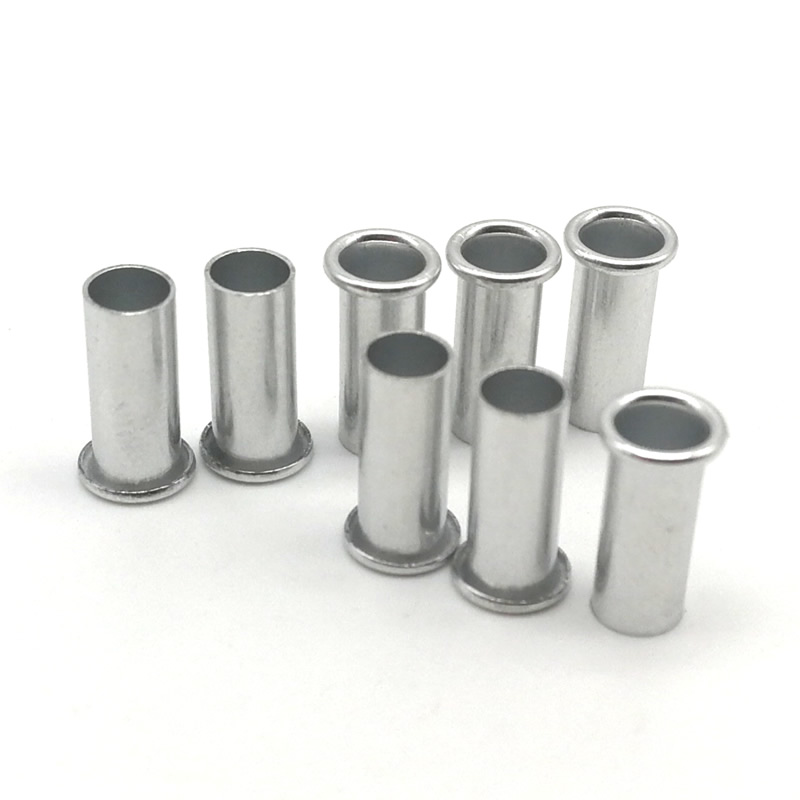
Aluminum Tubular vs. Steel Tubular – A Weight and Corrosion Comparison
Aluminum tubular rivets compete directly with steel tubular rivets in many applications. The decision usually comes down to weight versus strength.
| Property | Aluminum (5056) | Steel (Low Carbon, Plated) |
|---|---|---|
| Density | 2.66 g/cm³ | 7.85 g/cm³ |
| Shear strength | 100–130 MPa | 250–300 MPa |
| Corrosion resistance | Excellent (natural oxide layer) | Poor without plating; plating can chip |
| Setting force | Very low | Moderate |
| Weight for 4 mm × 8 mm rivet | ~0.75 g | ~2.2 g |
| Best for | Weight-sensitive, outdoor, non-structural | High-load indoor, cost-sensitive |
For an assembly using 1 million rivets, switching from steel to aluminum tubular rivets saves approximately 1.45 metric tons of fastener weight. In automotive or aerospace applications, that translates directly into fuel or energy savings.
Technical Specifications – Our Factory Standards
At Nuote Metals, aluminum tubular rivets are manufactured to the following parameters.
Dimensional Range
| Parameter | Range | Tolerance |
|---|---|---|
| Shank diameter | 1.6 mm – 8 mm | ±0.05 mm |
| Wall thickness | 0.20 mm – 0.40 mm | ±0.03 mm |
| Barrel length | 2.5 mm – 12 mm | ±0.10 mm |
| Flange diameter | 3 mm – 16 mm | ±0.10 mm |
| Concentricity | — | ≤0.1 mm TIR |
For shank diameters below 2 mm, wall thickness becomes difficult to control in a fully hollow configuration. In those cases, we recommend semi-tubular aluminum rivets.
Available Alloys
| Alloy | Temper | Shear Strength (MPa) | Corrosion Resistance | Best For |
|---|---|---|---|---|
| 1100 | H12 | 55–70 | Low (indoor only) | Decorative, craft, low-load |
| 5056 | H32 | 100–130 | Very good (marine-grade) | Outdoor, electronics, general purpose |
| 6061 | T4 | 110–140 | Good | Automotive, industrial |
Standard Finishes
| Finish | Properties | Best For |
|---|---|---|
| Mill (as-formed) | Matte silver, natural oxide layer | Indoor, cost-sensitive |
| Clear anodized | Improved corrosion resistance, maintains metallic look | Outdoor, electronics |
| Gold anodized | Decorative, added wear resistance | Visible decorative applications |
| Black anodized | Non-reflective, military aesthetic | Tactical equipment, automotive interior |
Two Applications from Our Factory Records
HVAC Heat Exchanger Fins (5056 Aluminum Tubular Rivets)
Problem: A manufacturer of commercial HVAC units needed to attach thin aluminum fins to copper tubing without crushing the fins. The fins were only 0.12 mm thick, and the assembly operated in a condensing environment with constant moisture. Steel rivets would corrode; semi-tubular aluminum rivets required too much setting force and deformed the fins.
Our solution: We supplied 5056 aluminum tubular rivets with a 2 mm shank and 4 mm barrel length, clear anodized. The full tubular wall rolled with less than 400 N of force—gentle enough to avoid fin deformation. The 5056 alloy provided marine-grade corrosion resistance for the condensing environment.
Result: The customer reduced fin damage from 3% to below 0.2%. The HVAC units passed 500 hours of salt spray testing with no corrosion on the rivets. Production has continued for over two years.
Solar Panel Mounting Clips (6061 Aluminum Tubular Rivets)
Problem: A solar mounting hardware manufacturer needed a rivet to attach aluminum clips to panel frames. The clips had to withstand 25 years of outdoor exposure, including UV, rain, and temperature cycling from -40°C to 85°C. Steel rivets were rejected due to galvanic corrosion risk with the aluminum frame.
Our solution: We supplied 6061 aluminum tubular rivets with a 4 mm shank and 6 mm barrel length, clear anodized. The 6061 alloy provided the necessary strength for the clip attachment, while the anodized finish added UV and corrosion protection. The full tubular design allowed the clip to pivot slightly during installation—eliminating a secondary alignment step.
Result: The mounting clips passed IEC 61215 thermal cycling and humidity-freeze tests. The customer eliminated the secondary alignment step, reducing installation time by 12 seconds per panel.
Aluminum Tubular Rivets – FAQ
Q1: What is the difference between aluminum tubular and aluminum semi-tubular rivets?
A: The difference is the depth of the hollow section. An aluminum tubular rivet (full tubular) is hollow throughout the entire shank. An aluminum semi-tubular rivet has a hollow cavity extending only 45–55% of the shank length from the tail; the remaining section is solid. Full tubular rivets require the least setting force—typically 40–50% of a solid rivet—making them ideal for thin or soft materials. Semi-tubular rivets offer higher shear strength (80–90% of solid) and are better for light structural joints. At Nuote Metals, we manufacture both configurations. For material stacks under 3 mm or for weight-critical assemblies, full tubular is usually the better choice. For anything load-bearing, choose semi-tubular.
Q2: Can aluminum tubular rivets be used in outdoor or marine environments?
Yes, but the alloy matters. 5056 aluminum tubular rivets contain magnesium and chromium, giving them excellent resistance to saltwater and atmospheric corrosion. They are the correct choice for marine-adjacent, outdoor, and high-humidity applications. 6061 offers good corrosion resistance for general outdoor use but can pit in direct salt spray. 1100 is for indoor use only. For the best corrosion protection, specify clear anodized or chromate conversion finishes. At Nuote Metals, we supply 5056 aluminum tubular rivets with anodized finishes specifically for marine and outdoor assemblies. For continuous saltwater immersion, we recommend switching to 316 stainless steel tubular rivets instead.
Q3: How do I calculate the correct barrel length for an aluminum tubular rivet?
A: Because aluminum is soft and the tubular wall is thin, less protruding material is needed than for steel or semi-tubular rivets. Use this formula: Barrel Length = Material Stack Thickness + 0.4 to 0.7 mm. Use the lower end (0.4 mm) for very soft materials—thin fabric, soft leather, foam. Use the higher end (0.7 mm) for harder materials—rigid plastic, thick leather, multiple layers. Example: Joining a 1.5 mm aluminum panel to a 0.8 mm plastic bracket—total stack 2.3 mm. Add 0.5 mm = 2.8 mm barrel length. Round up to the nearest standard length, usually 3.0 mm. Do not use the semi-tubular formula (stack + diameter)—that leaves too much material and causes an oversized, unstable curl. For stacks over 4 mm, full tubular rivets become difficult to control; switch to semi-tubular. Nuote Metals provides free sample kits with three adjacent lengths for testing on your actual material.
Q4: What is the MOQ and lead time for aluminum tubular rivets from Nuote Metals?
A: Our standard MOQ is 20,000 pieces for stock sizes. For first orders or sample runs, we accommodate lower quantities—as low as 5,000 pieces. We provide free samples for stocked sizes; you pay only the courier charge. Lead time: 3–5 days for stock sizes; 15–20 days for non-standard sizes including custom tooling. Every batch includes a material certificate, dimensional inspection report, and RoHS declaration. We have supplied aluminum tubular rivets to customers in over 40 countries. ISO 9001:2015 certified.
Send Inquiry



X
We use cookies to offer you a better browsing experience, analyze site traffic and personalize content. By using this site, you agree to our use of cookies.
Privacy Policy