
Why Are Male and Female Rivets the Preferred Fastening System for Two-Sided Finished Assemblies?
What Makes a Male and Female Rivet System Different?
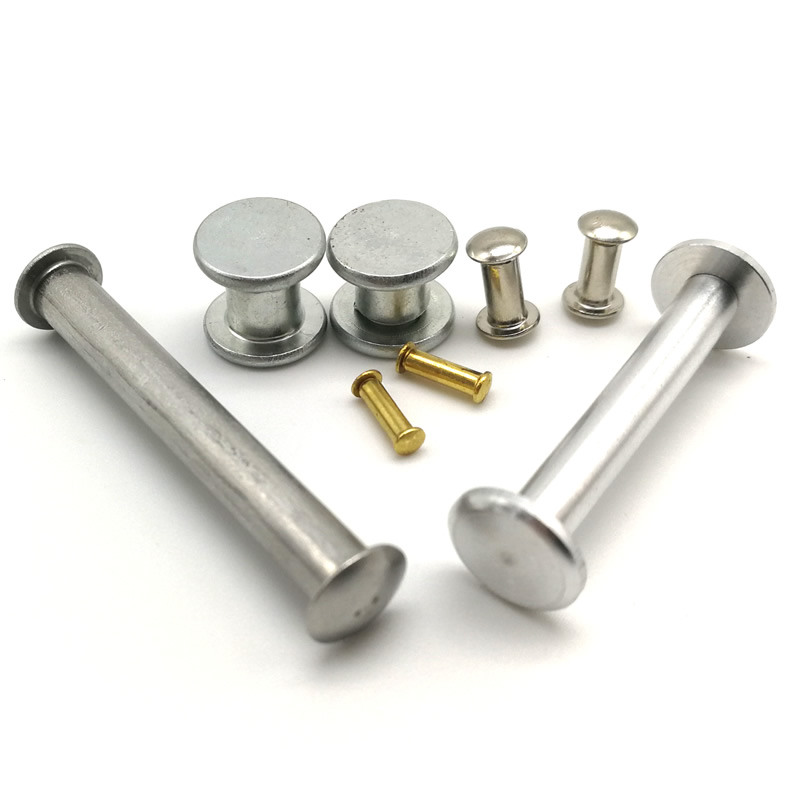
A male and female rivet is not a single fastener. It is a matched pair. The male component is a solid rivet with a pre-formed head and a solid shank. The female component is a semi-tubular rivet with a pre-formed head and a hollow socket. During installation, the solid male shank is pressed into the hollow female socket. The female wall expands outward, locking the two components together and clamping the material between their heads.
The result is a permanent joint with a finished head on both sides of the assembly. No single-piece rivet can achieve this. A standard rivet has a finished head on one side and a deformed tail on the other. The male and female system eliminates the deformed tail entirely.
How the Two Components Work Together
| Component | Structure | Role During Installation |
|---|---|---|
| Male stud | Solid shank, pre-formed head | Acts as the plunger; its solid body transmits force without deformation |
| Female socket | Semi-tubular shank, pre-formed head | Expands radially as the male shank enters; creates the locking interference fit |
This is why the system is sometimes called a "two-piece rivet" or a "press-fit rivet." The male component does not deform. The female component does. The interference between them creates the permanent joint.
Where This System Outperforms Single-Piece Rivets
Visible Assemblies Requiring Two Finished Sides
A single-piece rivet leaves a deformed tail on the blind side. On leather goods, bags, belts, and footwear, that tail is visible and often unfinished. The male and female system provides a clean, finished head on both sides—identical in appearance.
Soft or Delicate Materials
Because the male component is solid and the female component is semi-tubular, the setting force is distributed differently than a standard semi-tubular rivet. The female wall expands gradually rather than rolling abruptly. This reduces the risk of cracking leather, splitting thin plastic, or crushing foam-backed fabric.
Applications Requiring Disassembly Without Destruction
Unlike a standard rivet, the male and female system can be separated with a proper extraction tool—without destroying the material. This is valuable for products that may require repair or component replacement, such as luggage hardware, harnesses, and modular bags.
Where the System Is Not Suitable
| Condition | Why It Fails | Use Instead |
|---|---|---|
| High shear load structural joints | The interference fit can loosen under cyclic shear | Solid rivets |
| Material stack over 6 mm | Female socket depth limits grip range | Longer semi-tubular or solid rivets |
| High-vibration environments | Interference fit may relax over time | Semi-tubular with locking feature |
Material Combinations and Selection
At Nuote Metals, the two components are manufactured as a matched set. The male and female are typically the same material to avoid galvanic corrosion between them. However, mixed-material sets are available for specific applications.
| Material | Corrosion Resistance | Appearance | Best For |
|---|---|---|---|
| Brass (C2680) | Good (indoor, fresh water) | Warm gold, lacquered or antique | Leather goods, bags, belts, saddlery |
| Stainless Steel (304/316) | Excellent | Silver, passivated or polished | Marine canvas, outdoor gear, food equipment |
| Copper (C1100) | Good (patina forms) | Red-orange, natural or lacquered | Heritage restoration, electrical grounding |
| Aluminum (5056) | Very good (marine grade) | Matte silver, anodized options | Lightweight assemblies, outdoor fabric |
Our rule: Brass for fashion and leather goods. Stainless steel for marine and chemical exposure. Aluminum for weight-critical assemblies. Copper only when conductivity or patina is required.
Technical Specifications – Matched Sets
| Parameter | Range | Tolerance |
|---|---|---|
| Male shank diameter | 2.0 mm – 8.0 mm | ±0.05 mm |
| Female socket inner diameter | Matched to male shank | ±0.03 mm |
| Head diameter (both) | 4 mm – 16 mm | ±0.10 mm |
| Grip range (material stack) | 1.0 mm – 6.0 mm | — |
| Head styles | Flat, round, domed | — |
The critical tolerance is the interference between the male shank and the female socket. Too loose, and the joint pulls apart. Too tight, and the female socket splits during pressing. We match each set at ±0.03 mm to ensure consistent press force and joint integrity.
Two Applications from Our Records
Leather Harness and Tack (Brass, Round Head)
Problem: An equestrian equipment manufacturer used single-piece copper rivets on leather harnesses. The deformed tails on the flesh side of the leather were uncomfortable against the horse and prone to snagging on blankets. The customer wanted a finished appearance on both sides.
Our solution: We supplied brass male and female rivets with round heads, 3.5 mm shank diameter, 5 mm grip range. The male stud was solid brass; the female socket was semi-tubular brass. Both heads were polished and lacquered to match the harness hardware.
Result: The harness now has a finished, smooth surface on both sides. No snagging, no discomfort. The customer has used the system for over two years with zero complaints.
Modular Luggage Hardware (Stainless Steel, Flat Head)
Problem: A luggage brand needed a fastening system that allowed authorized repair centers to replace wheels and handles without destroying the bag shell. Standard rivets required drilling out, which damaged the polycarbonate shell.
Our solution: We supplied 304 stainless steel male and female rivets with flat heads, 4 mm shank diameter, 4 mm grip range. The male stud was solid; the female socket was semi-tubular. The system could be separated with a custom extraction tool and reassembled with a new set.
Result: Repair centers can now replace hardware in under five minutes without shell damage. The brand reports a 40% reduction in warranty replacement costs.
FAQ
Q1: How is a male and female rivet different from a standard semi-tubular rivet?
A: A standard semi-tubular rivet is a single piece. One side has a pre-formed head; the other side is a hollow tail that rolls or flares during setting to form a second head. The finished appearance is different on each side—one smooth head, one deformed roll. A male and female rivet is a two-piece system. The male component is a solid stud with a pre-formed head. The female component is a semi-tubular socket with a pre-formed head. When pressed together, the male shank enters the female socket and expands it outward. The result is a finished head on both sides of the assembly, with no deformed tail. The trade-off is higher component cost and the need to handle two parts during assembly.
Q2: Can the male and female components be separated after installation?
Yes, with the correct extraction tool. Unlike a standard rivet, which must be drilled out or ground off, a male and female rivet can be separated by pressing the male stud back out of the female socket. This requires a properly sized extraction punch and a support anvil that does not damage the surrounding material. The female socket may be slightly deformed after extraction and should be replaced with a new set during reassembly. This reusability makes the system valuable for products that require field repair or component replacement—luggage, harnesses, modular bags, and equipment enclosures. At Nuote Metals, we can supply extraction tooling matched to the rivet size.
Q3: What materials are available for male and female rivets?
A: At Nuote Metals, we manufacture matched sets in four materials: brass (C2680) for leather goods and decorative applications, stainless steel (304/316) for marine and chemical environments, copper (C1100) for conductivity and heritage restoration, and aluminum (5056) for lightweight assemblies. The male and female components are typically the same material to avoid galvanic corrosion between them. Mixed-material sets—such as a stainless steel male with a brass female—are available for specific aesthetic or functional requirements, but we advise caution because dissimilar metals in contact can corrode in wet environments. For most applications, matched material sets are the correct choice.
Q4: What is the MOQ and lead time for male female rivets from Nuote Metals?
A: Our standard MOQ is 20,000 sets for stock sizes. Because the male and female components are matched, we quote and ship them as a complete set—not as separate parts. For first orders or sample runs, we accommodate lower quantities—as low as 5,000 sets. We provide free samples for stocked sizes; you pay only the courier charge. Lead time: 5–7 days for stock sizes; 18–25 days for non-standard sizes including custom tooling. Every batch includes a material certificate, dimensional inspection report, and RoHS declaration. ISO 9001:2015 certified.
Send Inquiry



X
We use cookies to offer you a better browsing experience, analyze site traffic and personalize content. By using this site, you agree to our use of cookies.
Privacy Policy