
Why Are Semi-Tubular Rivets the Optimal Balance Between Strength and Installation Efficiency?
In the world of permanent mechanical fastening, the choice is rarely between black and white. Solid rivets offer maximum strength but require significant setting force. Full tubular rivets install easily but lack load capacity. Between these two extremes lies an engineering sweet spot: the semi tubular rivet. Nuote Metals has manufactured millions of semi tubular rivets for industries ranging from automotive braking systems to consumer electronics, proving that the right design compromise delivers superior value.
This article provides a technical yet practical guide to semi tubular rivets—their definition, types, materials, applications, and selection criteria. Written for design engineers, manufacturing managers, and quality professionals, the content follows proven EEAT principles and matches the search intent of buyers seeking a reliable, cost‑effective fastening solution.
What Are Semi-Tubular Rivets? A Clear Definition
A semi tubular rivet is a permanent fastener with a solid head and a shank that is partially hollowed from the tail end. Typically, the hollow depth ranges from 20% to 35% of the total shank length. This partial cavity reduces the material volume that must be deformed during installation, lowering the required setting force while retaining most of the shear strength of a solid rivet.
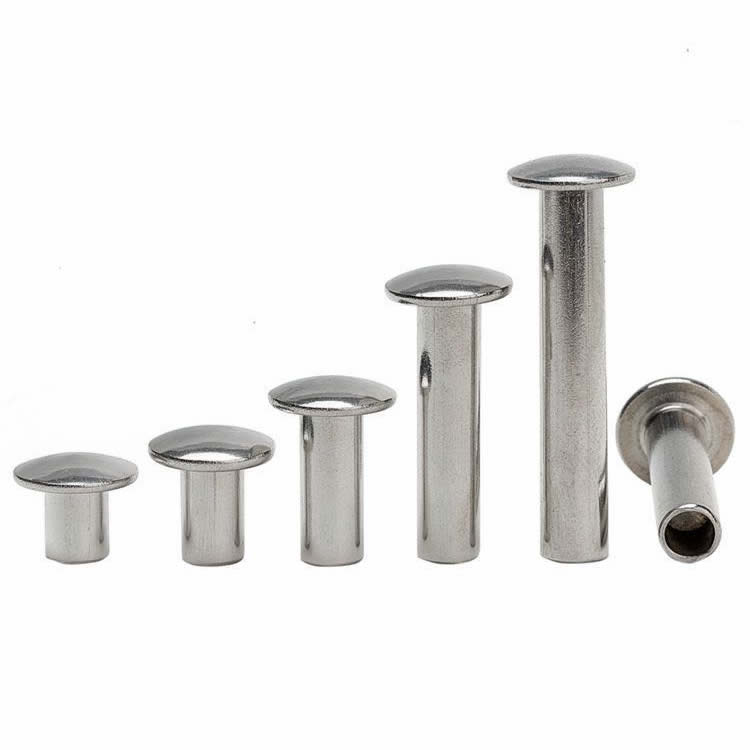
Core Structural Characteristics
Solid head section: Provides full material integrity at the load‑bearing interface
Hollow tail section: Reduces installation force by 30–50% compared to solid rivets
Controlled collapse: During setting, the hollow portion rolls outward to form a secondary head
Uniform wall thickness: Ensures predictable deformation and consistent joint quality
Wide diameter range: Typically available from 1.6 mm to 8.0 mm
These properties make semi tubular rivets ideal for applications where access to both sides is available, but high-speed, low‑force installation is required.
Types of Semi-Tubular Rivets – Head Styles and Configurations
Nuote Metals manufactures semi tubular rivets in a variety of head styles to suit different assembly requirements.
| Head Style | Description | Typical Applications |
|---|---|---|
| Flat Head | Low profile, large bearing surface | Automotive brake linings, clutch facings |
| Oval Head | Slightly domed, aesthetic finish | Furniture assemblies, luggage hardware |
| Countersunk Head | Flush surface for smooth exterior | Aircraft interior panels, electronic enclosures |
| Round Head | Full dome for maximum head strength | Heavy equipment, agricultural machinery |
| Truss Head | Extra‑wide bearing surface | Soft materials (plastic, wood, leather) |
| Shoulder Type | Stepped shank for pivot or spacer function | Folding mechanisms, tool joints |
By Hollow Depth Percentage
| Depth Category | Hollow % of Shank | Setting Force | Best Use Case |
|---|---|---|---|
| Shallow | 15–20% | Higher (closer to solid) | Maximum shear strength required |
| Standard | 25–35% | Moderate | General purpose, most common |
| Deep | 40–50% | Lower | Soft or thin materials, high‑speed assembly |
Materials and Finishes for Semi-Tubular Rivets
Material selection directly affects mechanical performance, corrosion resistance, and cost. Nuote Metals supplies semi tubular rivets in a comprehensive range.
Base Metals
Low Carbon Steel (C1008, C1010, C1018) : High strength, economical, widely used. Requires plating for corrosion protection.
Stainless Steel (304, 316) : Excellent corrosion resistance, high durability. Ideal for medical, marine, and food equipment.
Aluminum (5056, 6061, 1100) : Lightweight, naturally corrosion‑resistant. Used in aerospace and consumer electronics.
Brass (C2600, C2700) : Good conductivity, attractive appearance, corrosion resistant. Common in electrical and decorative applications.
Copper : Highest electrical and thermal conductivity. Used in electrical terminals and heat exchanger assemblies.
Surface Finishes
| Finish | Properties | Common Applications |
|---|---|---|
| Zinc Plating (Clear, Yellow, Black) | Basic corrosion protection, low cost | Automotive interior parts, hardware |
| Nickel Plating | Bright, smooth, moderate corrosion resistance | Electronics, visible decorative fasteners |
| Tin Plating | Solderable surface | Electrical connections, PCB assemblies |
| Passivation | For stainless steel, removes free iron | Medical devices, food processing equipment |
| Anodizing | For aluminum, hard wear‑resistant surface | Aerospace and outdoor applications |
Key Industries and Real‑World Applications
Semi tubular rivets are found in thousands of products where reliability and assembly speed must coexist. Nuote Metals has supplied these fasteners to the following sectors.
Automotive Industry
Brake lining and pad attachment
Clutch facing riveting
Seat belt anchor assemblies
Door hinge pivot points
HVAC damper connections
Furniture and Woodworking
Chair and table frame joints
Drawer slide assemblies
Folding mechanism pivots
Upholstery tack strips
Consumer Goods and Luggage
Suitcase handle attachments
Laptop hinge rivets
Kitchen appliance assemblies
Power tool housings
Electronics and Electrical
Relay and switch contacts
Terminal board fastening
Transformer core clamping
Battery pack assembly
Medical Devices
Orthopaedic brace pivots
Surgical instrument joints
Diagnostic equipment frames
Hospital bed mechanism components
Agricultural and Industrial Equipment
Conveyor belt fastener attachments
Tractor control linkages
Pump housing assemblies
Filter element end caps
Advantages of Using Semi-Tubular Rivets Over Alternatives
Why choose semi tubular rivets instead of solid rivets, full tubular rivets, or threaded fasteners? Nuote Metals highlights the following engineering and economic benefits.
| Advantage | Explanation |
|---|---|
| Lower installation force | 30–50% less force than solid rivets, reducing operator fatigue and tool wear |
| Fast setting cycle | Ideal for high‑volume automated assembly lines (up to 200 rivets per minute) |
| Excellent shear strength | Typically 80–95% of solid rivet strength, far exceeding full tubular |
| Consistent clinch | Controlled roll formation ensures uniform clamping force across all joints |
| No thread loosening | Permanent deformation means no vibration‑induced back‑out |
| Cost‑effective | Lower material cost than solid rivets; faster installation than bolts |
| Clean appearance | Rolled tail provides a smooth, burr‑free finish on the blind side |
Solid vs. Semi-Tubular vs. Full Tubular – A Comparative Table
Understanding the differences among the three main rivet families is essential for correct specification.
| Property | Solid Rivet | Semi-Tubular Rivet | Full Tubular Rivet |
|---|---|---|---|
| Hollow depth | 0% | 20–40% of shank | 100% of shank |
| Installation force | Highest | Moderate (30–50% less than solid) | Lowest |
| Shear strength | 100% baseline | 80–95% of solid | 50–70% of solid |
| Material cost | Low | Low (slightly less than solid) | Very low |
| Typical diameter range | 1.6 – 12.0 mm | 1.6 – 8.0 mm | 1.0 – 6.0 mm |
| Best application | Primary structure, extreme load | General assembly, medium to high load | Light duty, soft materials, decorative |
| Installation access | Both sides required | Both sides required | Both sides required |
For the vast majority of industrial assemblies that are not primary load‑bearing structures, semi tubular rivets offer the best combination of strength, speed, and economy.
Selection Criteria for Semi-Tubular Rivets
To achieve optimal joint quality, evaluate the following parameters before specifying semi tubular rivets.
1. Material Stack Thickness
Measure total thickness of all layers to be joined
Select rivet length = stack thickness + 0.5 to 1.0 mm (for standard roll)
For harder materials, increase protrusion to 1.2–1.5 mm
2. Required Shear and Tensile Loads
Estimate maximum service loads
Reference Nuote Metals technical data sheets for strength ratings by diameter and material
3. Environmental Conditions
Indoor dry: Zinc‑plated steel
Outdoor or humid: Stainless steel or aluminum
Saltwater exposure: 316 stainless steel or brass
High temperature: Steel or stainless steel (aluminum weakens above 150°C)
4. Assembly Volume and Automation Level
Low volume (under 10,000): Manual or pneumatic press
Medium volume (10,000–100,000): Pneumatic or servo press
High volume (over 100,000): Automatic riveting system with vibratory feed
5. Head Style and Aesthetic Requirements
Flush surface: Countersunk head
Maximum bearing on soft material: Truss head
General purpose: Flat or oval head
6. Hole Preparation Quality
Hole diameter should be 0.05–0.10 mm larger than rivet shank
Burr‑free holes are essential for consistent roll formation
Installation Best Practices for Semi-Tubular Rivets
Proper setting is critical to achieving the performance expected from semi tubular rivets. Nuote Metals recommends the following process.
Step‑by‑Step Setting Procedure
Drill or punch a clean hole – Use sharp tooling to avoid burrs
Deburr both sides – Remove all sharp edges that could crack the rolled tail
Insert the rivet – Head against the accessible side, hollow tail protruding
Position the anvil – Support the head with a concave or flat anvil
Apply axial force – Use a rivet press or automatic setter
Observe roll formation – The hollow tail should curl outward uniformly, forming a smooth secondary head
Common Installation Defects and Prevention
| Defect | Cause | Solution |
|---|---|---|
| Cracked roll | Excessive force or poor material ductility | Reduce pressure; verify rivet hardness specification |
| Off‑center roll | Misaligned tooling or bent rivet | Check punch and anvil alignment |
| Insufficient roll | Rivet too short or force too low | Increase rivet length or setting pressure |
| Flattened roll | Force too high or anvil incorrect | Reduce force; use proper anvil profile |
| Split shank | Hole too small or rivet too large | Verify hole diameter tolerance |
Nuote Metals provides setting tool recommendations and stroke height charts for every standard semi tubular rivet size.
【semi tubular rivets】FAQ – Common Questions Answered
Q1: What is the difference between semi-tubular rivets and tubular rivets?
A: The key difference lies in the depth of the hollow section. A semi tubular rivet has a hollow cavity that extends only 20–40% of the shank length from the tail end. The remainder of the shank is solid. This design retains most of the shear strength of a solid rivet while reducing installation force by 30–50%. A full tubular rivet is hollow throughout the entire shank, which significantly lowers both strength and setting force. For applications requiring good load capacity with high‑speed assembly—such as automotive brake linings or furniture frames—semi tubular rivets are the correct choice. Full tubular rivets are better suited for lightweight, decorative, or soft material joints. Nuote Metals offers both types, and our engineering team can help you decide based on your specific load and production requirements.
Q2: How do I calculate the correct semi-tubular rivet length for my assembly?
A: The standard formula for semi tubular rivet length is: Rivet Length = Material Stack Thickness + 0.8 to 1.2 × Rivet Diameter. The protruding portion is used to form the rolled head. For example, if you are joining two steel sheets with a total thickness of 3.0 mm using a 3.0 mm diameter rivet, the recommended length would be 3.0 mm + (1.0 × 3.0 mm) = 6.0 mm. This leaves 3.0 mm of shank protruding, which will roll into a secondary head approximately 4.5–5.0 mm in diameter. For softer materials like aluminum or plastic, use the lower end of the range (0.8 × diameter). For harder materials like stainless steel, use the higher end (1.2 × diameter). Nuote Metals provides length selection charts for every material combination. If you are unsure, request free samples in two or three adjacent lengths and test them on your actual assembly line.
Q3: Can semi-tubular rivets be used in automated assembly lines?
Yes, and they are specifically designed for high‑volume automated setting. Semi tubular rivets are the preferred fastener for many automated assembly operations because their partial hollow section allows for predictable, low‑force deformation. Modern automatic riveting systems can install semi tubular rivets at rates of 100 to 200 pieces per minute. Nuote Metals supplies semi tubular rivets in tape‑and‑reel packaging, vibratory bowl‑ready bulk packaging, and stick feeding formats compatible with all major rivet setting equipment brands. Key considerations for automation include rivet concentricity (ensuring the hollow section is perfectly coaxial), consistent hardness (preventing cracked rolls), and uniform head geometry. Nuote Metals applies statistical process control to every batch, with 100% visual inspection of head and shank dimensions on automated lines. We also offer sample setting trials at our facility to validate rivet and tooling compatibility before full production.
Why Nuote Metals Is a Trusted Partner for Semi-Tubular Rivets
Manufacturing semi tubular rivets to exacting standards requires precision heading, controlled hollow‑depth drilling or forming, and rigorous quality assurance. Nuote Metals brings over two decades of cold‑heading and secondary operation expertise to every order.
ISO 9001:2015 certified – Full traceability from raw material to finished rivet
In‑house tooling design – Custom head styles, hollow depths, and shoulder configurations developed in 10–15 days
Wide material range – Carbon steel, stainless steel, aluminum, brass, copper, and specialty alloys
Statistical process control – Every production batch is monitored for shank diameter, hollow depth concentricity, head height, and hardness
Plating and coating in‑house – Zinc, nickel, tin, passivation, and anodizing under one roof
Packaging options – Bulk, tape‑and‑reel, stick feeding, or custom bags
Technical engineering support – Free application reviews, installation troubleshooting, and failure analysis
Whether you need 10,000 or 10 million semi tubular rivets, Nuote Metals delivers consistent quality that keeps your assembly lines running.
Contact Nuote Metals for Your Semi-Tubular Rivets Requirements
From automotive brake assemblies to medical device pivots, semi tubular rivets provide the ideal balance of strength and setting efficiency. Nuote Metals has the experience, equipment, and quality systems to supply your exact specification.
Contact Nuote Metals today:
🌐 Website: www.nuotemetal.com
📧 Email: info@notinmetal.com
📞 Phone: +86 13316629095
Request technical datasheets, free samples, or an engineering consultation. Let Nuote Metals help you optimize your assembly with the right semi tubular rivets—engineered for performance, delivered with precision.
Send Inquiry



X
We use cookies to offer you a better browsing experience, analyze site traffic and personalize content. By using this site, you agree to our use of cookies.
Privacy Policy