
Why Are Solid Rivets Still the Gold Standard for High-Strength Permanent Joints in Critical Structures?
From the wings of a commercial jetliner to the steel framework of a suspension bridge, permanent fasteners carry a burden of trust that no temporary solution can match. Among all joining technologies, solid rivets remain the most trusted choice when failure is not an option. Nuote Metals has spent over two decades manufacturing precision fasteners, and solid rivets continue to represent the foundation of our engineering expertise.
This article provides a comprehensive technical overview of solid rivets—their definition, classification, material options, application industries, and selection criteria. Written for design engineers, procurement professionals, and quality assurance specialists, the content follows industry-proven EEAT principles and matches the search intent of buyers seeking maximum-strength permanent fastening solutions.
What Are Solid Rivets? A Clear Technical Definition
A solid rivets is a permanent mechanical fastener consisting of a solid metal shaft with a pre-formed head on one end. Unlike hollow or tubular alternatives, solid rivets have no internal cavity—the entire body is forged from a single piece of metal. During installation, the tail end is mechanically deformed (upset) to create a second head, known as the shop head, which permanently clamps the joined materials together.
Core Characteristics of Solid Rivets
Solid one-piece construction: No hollow core, no moving parts—maximum material integrity
Pre-formed head: Available in universal, countersunk, or round head configurations
Deformed tail end: After insertion, the tail is upset to form a permanent second head
High shear and tensile strength: Surpasses most other fastener types in load-bearing capacity
Permanent joint: Cannot be removed without destroying the rivet
These properties make solid rivets the preferred choice for primary structural applications in aerospace, heavy machinery, and infrastructure.
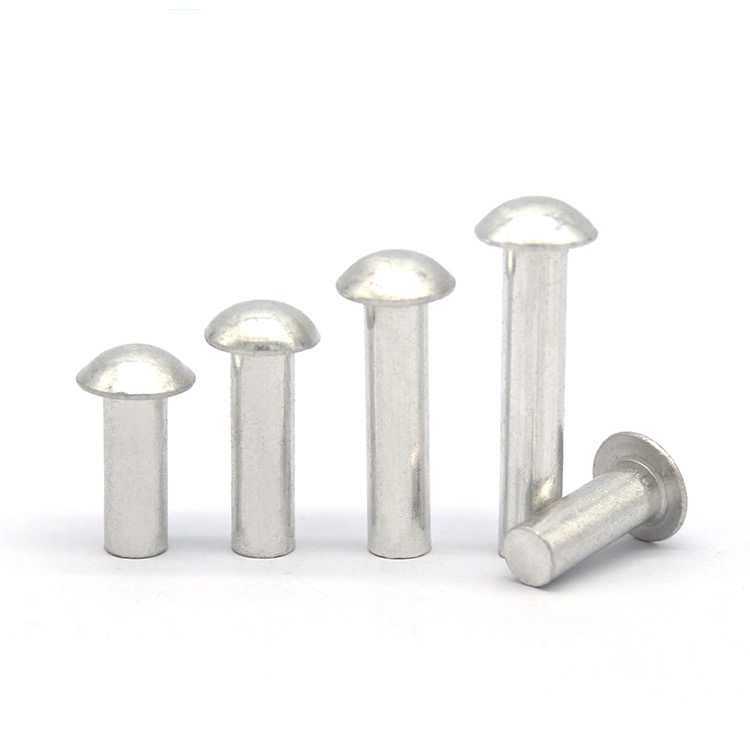
Types of Solid Rivets – Matching the Right Head Style to the Application
Nuote Metals manufactures solid rivets in multiple head configurations. The table below summarizes the most common types and their recommended uses.
| Head Style | Appearance | Typical Applications |
| Universal Head (AN470) | Rounded dome with smooth contour | Aircraft exterior skins, general structural assembly |
| Countersunk Head (AN426) | Flush surface when installed | Aerodynamic surfaces, exterior panels requiring smooth finish |
| Round Head (608) | High-profile dome | Heavy machinery, bridge construction, shipbuilding |
| Flat Head | Low-profile flat top | Interior assemblies, limited clearance applications |
| Brazier Head | Wide, shallow dome | Thin sheet metal, soft materials requiring larger bearing surface |
Each head style addresses specific aerodynamic, clearance, or load-distribution requirements. Selecting the wrong style can compromise joint performance or create undesirable surface protrusions.
Materials and Finishes for Solid Rivets
Material selection directly affects strength, corrosion resistance, weight, and cost. Nuote Metals supplies solid rivets in a comprehensive range of metals and surface treatments.
Base Metals and Alloys
| Material | Key Properties | Typical Applications |
| Aluminum (1100, 2017, 2024, 2117, 5056, 7050) | Lightweight, corrosion-resistant, high strength-to-weight ratio | Aircraft fuselage, wings, aerospace structures-31 |
| Steel (C1008, C1010) | High strength, cost-effective, wear-resistant | Heavy machinery, construction equipment, automotive chassis-31 |
| Stainless Steel (304, 316) | Superior corrosion resistance, high durability | Marine equipment, chemical plants, food processing-33 |
| Copper | Excellent electrical and thermal conductivity, oxidation-resistant | Electrical terminals, plumbing systems, brake linings-31 |
| Brass | Corrosion-resistant, aesthetic appeal, good conductivity | Decorative assemblies, electrical components, marine hardware |
Available Surface Treatments
Plain (uncoated): For internal assemblies where corrosion is not a concern
Zinc plating: Basic corrosion protection for indoor applications
Cadmium plating: Aerospace-grade corrosion protection (MS/NAS standard)
Anodizing: For aluminum rivets, enhances surface hardness and corrosion resistance
Passivation: For stainless steel, removes surface contaminants and improves corrosion resistance
Key Industries and Critical Applications
Because solid rivets deliver unmatched joint integrity, they appear in applications where failure carries severe consequences. Nuote Metals has supplied solid rivets to the following demanding sectors.
Aerospace and Aviation
Primary aircraft structure assembly: Fuselage skin attachment, wing spars, rib connections
Engine components: Mounting brackets, casing assemblies
Control surfaces: Ailerons, flaps, rudders, elevators
Landing gear: High-load structural connections
Commercial aircraft require millions of solid rivets. For example, a single Boeing 747 contains nearly 1.5 million fasteners, with solid-shank rivets used extensively for primary structure assembly. Because solid rivets offer excellent locking characteristics, they are used to assemble the primary structures of an aircraft, mostly attaching skins to the aircraft frame.
Heavy Machinery and Industrial Equipment
Crane booms and chassis: Structural frame connections
Excavator arms: High-load pivot points
Mining equipment: Wear-resistant structural joints
Agricultural machinery: Implement frames and attachments
Construction and Infrastructure
Steel bridge construction: Truss connections, girder assemblies
Building structural frames: Permanent beam-to-column connections
Transmission towers: Steel lattice joints
Shipbuilding: Hull plate connections, bulkhead attachments
Automotive and Transportation
Chassis frames: Structural cross-member connections
Suspension components: Control arm assemblies
Brake systems: Lining attachments, backing plates
Rail transit: Railcar body structures, bogie frames
Defense and Military Equipment
Armored vehicle hulls: Ballistic joint connections
Naval vessel structures: Watertight bulkheads
Military aircraft: Primary and secondary structural assemblies
Advantages of Choosing High-Quality Solid Rivets
Why do engineers continue to specify solid rivets for the world‘s most critical structures? Nuote Metals highlights the following proven advantages.
| Advantage | Description |
| Maximum strength | Superior shear and tensile capacity compared to blind or tubular rivets |
| Permanent joint | Once installed, the connection does not loosen under vibration or cyclic loading |
| No heat damage | Cold-forming installation preserves material properties of joined components |
| Cost-effective | Simple one-piece design reduces manufacturing cost compared to complex fasteners |
| Vibration resistant | No threads to back out—ideal for dynamic and high-vibration environments |
| Easy visual inspection | Joint quality can be assessed by simple visual examination of the formed shop head |
| No nuts or washers required | Single-component solution eliminates additional hardware and assembly steps |
Solid Rivets vs. Alternative Fasteners – A Comparative Analysis
Understanding how solid rivets compare to other fastening solutions is essential for informed design decisions.
| Fastener Type | Strength | Installation Access | Cost per Unit | Reusability | Vibration Resistance |
| Solid Rivet | Very High | Both sides required | Low | No | Excellent |
| Blind Rivet (Pop Rivet) | Moderate | One side only | Medium | No | Good |
| Semi-Tubular Rivet | Good (80-90% of solid) | Both sides preferred | Low | No | Good |
| Bolt and Nut | High | Both sides required | Medium-High | Yes | Poor (needs lock washers) |
| Weld Joint | Very High | Access depends on process | High | No | Good |
For load-critical areas such as airframes, engine parts, and bridge trusses, solid rivets remain the undisputed choice due to their combination of strength, reliability, and cost-effectiveness.
Key Considerations When Selecting Solid Rivets
To achieve optimal performance from solid rivets, evaluate the following parameters before placing an order.
1. Material Stack Thickness
Measure total thickness of materials to be joined
Select rivet length that provides proper tail protrusion for shop head formation (typically 1.5 × shank diameter)
2. Shear and Tensile Load Requirements
Determine maximum expected loads in service
Reference Nuote Metals technical datasheets for rivet strength ratings by diameter and material grade
3. Environmental Exposure
Indoor dry use: Zinc-plated steel or plain steel
Outdoor or humid: Stainless steel or aluminum with anodized finish
Saltwater marine: 316 stainless steel or titanium
High-temperature: Nickel alloy or titanium
4. Access to Both Sides
Solid rivets require access to both sides of the joint for proper installation
If only one side is accessible, consider blind rivets as an alternative
5. Head Style Requirements
Flush aerodynamic surface: Countersunk head (AN426)
General structural: Universal head (AN470)
Maximum bearing area: Brazier head
6. Installation Equipment Availability
Manual: Bucking bar and rivet gun (two-person operation)
Semi-automated: Pneumatic rivet squeezer
Fully automated: CNC riveting systems for high-volume production
Installation Best Practices and Quality Assurance
Correct installation is critical to achieving the performance expected from solid rivets. Nuote Metals integrates rigorous quality control at every stage of production and provides technical support to ensure optimal installation outcomes.
Installation Process Overview
Hole Preparation: Drill or punch hole to precise diameter (typically 0.05–0.10 mm larger than rivet shank)
Deburring: Remove all sharp edges and burrs to prevent stress risers
Insertion: Insert rivet through aligned material holes
Bucking: Place bucking bar against the tail of the rivet
Upsetting: Strike the rivet head with a rivet gun or apply hydraulic pressure to form the shop head
Quality Control Parameters
Shank concentricity: Ensures uniform hole fit
Head concentricity: Maintains consistent appearance and load distribution
Hardness consistency: Prevents cracking during upsetting
Shop head dimensions: Height and diameter must meet specification requirements
【solid rivets】FAQ – Common Questions Answered
Q1: What is the difference between solid rivets and blind rivets?
A: Solid rivets and blind rivets serve different purposes based on installation access and strength requirements. Solid rivets are one-piece fasteners that require access to both sides of the joint for installation. They offer the highest shear and tensile strength among all rivet types and are used for primary structural applications such as aircraft fuselage, bridge trusses, and heavy machinery frames. Blind rivets (often called pop rivets) are designed for single-side installation and consist of a rivet body and a mandrel. While easier to install in confined spaces, blind rivets provide significantly lower strength. In aerospace applications, solid rivets cost approximately 3 to 20 cents each, whereas blind rivets cost 25 to 70 cents each yet offer much less strength. Nuote Metals recommends solid rivets for all load-critical, permanent structural joints.
Q2: How do I determine the correct solid rivet length for my assembly?
A: The correct rivet length is calculated based on the total material stack thickness plus the length required to form a proper shop head. The standard formula is: Rivet Length = Material Stack Thickness + 1.5 × Rivet Diameter. For example, if joining two sheets with a total thickness of 4.0 mm using a 4.0 mm diameter rivet, the recommended rivet length would be 4.0 mm + (1.5 × 4.0 mm) = 10.0 mm. The 6.0 mm protruding beyond the material provides sufficient material to form a shop head with proper height and diameter. For harder materials or larger shop head requirements, a longer protrusion may be necessary. Nuote Metals provides detailed length selection charts for all material combinations and diameter sizes, ranging from micro rivets under 1.6 mm to large structural rivets exceeding 12.0 mm.
Q3: Can solid rivets be used with composite materials in modern aircraft?
Yes, but with special considerations. Modern aircraft such as the Boeing 787 are constructed of approximately 50 percent composite materials. Solid rivets can be used with composites, but the installation parameters differ significantly from metal-to-metal riveting. Composite materials are more sensitive to clamping pressure and hole tolerances. Using standard solid rivets designed for aluminum may cause delamination or cracking around the fastener hole. Nuote Metals offers specialized solid rivets with optimized head geometry and controlled upset characteristics for composite applications. Additionally, the aerospace industry has developed new alloy formulations that allow solid rivet bottoms to expand to 1.7 times the original shank diameter without surface cracking, compared to the traditional 1.5 times. For composite assemblies, Nuote Metals recommends consulting our engineering team for material-specific installation parameters.
Why Nuote Metals Is a Trusted Partner for Solid Rivets
Manufacturing solid rivets demands precision at every stage—from wire drawing to heading to heat treatment. Nuote Metals brings two decades of cold-heading and fastener manufacturing expertise to every order.
ISO 9001:2015 certified facilities: Full traceability from raw material sourcing to finished packaging
In-house tooling development: Custom rivet head styles and shank configurations developed within two weeks
Comprehensive material inventory: Aluminum (1100 through 7050), steel, stainless steel, copper, brass, and titanium
Statistical process control (SPC) : Every production batch is monitored for diameter, head height, concentricity, and hardness
Third-party testing: Mechanical property verification, salt spray testing, and dimensional inspection
Global logistics capabilities: Consistent lead times for both standard and custom solid rivets
Technical engineering team: Free application engineering, installation troubleshooting, and failure analysis
The global solid rivet market was valued at approximately USD 3.78 billion in 2025 and is projected to reach USD 4.58 billion by 2032, growing at a CAGR of 2.8%. As demand for reliable permanent fastening continues to grow across aerospace, automotive, and industrial sectors, Nuote Metals is positioned to meet the most demanding specifications.
Contact Nuote Metals for Your Solid Rivets Requirements
Whether you need standard aluminum solid rivets for high-volume aerospace production or custom titanium rivets for defense applications, Nuote Metals delivers precision, consistency, and technical expertise.
Contact Nuote Metals today:
🌐 Website: www.nuotemetal.com
📧 Email: info@nuotemetal.com
📞 Phone: +86 13316629095
Request technical datasheets, free samples, or engineering consultation. Let Nuote Metals help you secure your critical structures with the right solid rivets—engineered for performance, built for life.
Send Inquiry



X
We use cookies to offer you a better browsing experience, analyze site traffic and personalize content. By using this site, you agree to our use of cookies.
Privacy Policy