
Why Are Stainless Steel Rivets Replacing Plated Steel and Brass Across Marine, Automotive, and Food Industries?
The Market Shift – Why Stainless Steel Is Winning
Stainless steel rivets now hold approximately 40–45% of the blind rivet market. The global rivets market was valued at USD 6.8 billion in 2025 and is projected to reach USD 10.9 billion by 2034, with premium stainless steel and alloy variants growing at 6–9% CAGR—significantly outpacing standard materials.
At Nuote Metals, we have seen this shift first‑hand. Orders for stainless steel rivets have increased steadily over the past two years, with particular strength in automotive (≈42% of output, used by brands including Mercedes‑Benz, Audi, BMW, and BYD), marine and coastal industries, and food processing/medical sectors where washdowns and hygiene are critical.
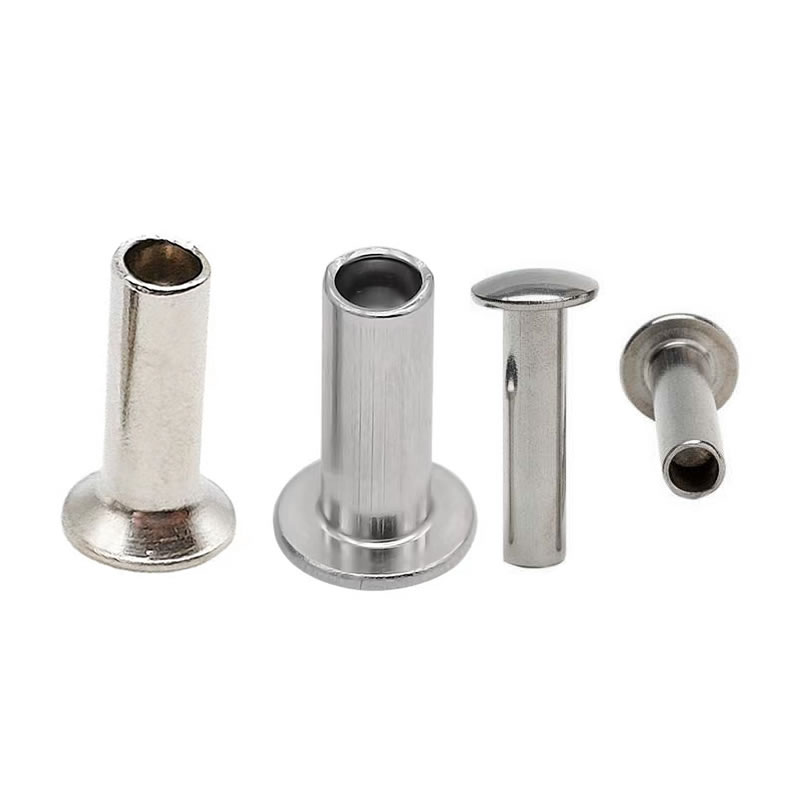
The Stainless Difference – No Plating, No Rust, No Compromise
Carbon steel rivets with zinc plating work—until the plating wears off. Brass rivets work—until they tarnish and stain the surrounding material. Stainless steel works from day one and continues to work for decades, even in rain, salt, chemicals, and humidity.
The reason is chromium. Stainless steel contains at least 10.5% chromium, which forms a self‑healing passive oxide layer. If scratched, the chromium reacts with oxygen to reform the protective barrier. There is no coating to wear off because the protection is built into the metal itself.
| Feature | Stainless Steel | Carbon Steel (Plated) | Brass |
|---|---|---|---|
| Corrosion resistance | Excellent (inherent) | Depends on plating | Good (natural) |
| Plating failure risk | None | High – plating wears off | None |
| Strength | Very high (620–750 MPa) | High (400–500 MPa) | Moderate (315–390 MPa) |
| Best for | Marine, outdoor, food, medical | Budget indoor | Decorative, electrical |
304 vs. 316 – The Grade Decision That Determines Longevity
The choice between 304 and 316 is the most important specification decision for stainless steel rivets. It determines how long the rivet lasts in your environment.
| Grade | Key Alloy Elements | Salt Spray Resistance (ASTM B117) | Best For |
|---|---|---|---|
| 304 | 18% Cr, 8% Ni | 200 – 500 hours | General outdoor, rain, humidity, food contact |
| 316 | 16% Cr, 10% Ni, 2% Mo | 1,000+ hours | Marine, coastal, saltwater, chemical, acidic |
The difference is molybdenum. 316 contains 2–3% molybdenum, providing superior resistance to chlorides (saltwater, de‑icing salts, bleach). 304 offers excellent general corrosion resistance but can pit in prolonged saltwater exposure.
Our rule: Choose 304 for general outdoor, food equipment, and industrial assemblies with limited salt exposure. Choose 316 for marine, coastal, chemical, and any chloride‑rich environment.
Three Designs – Matching the Rivet to the Application
At Nuote Metals, we manufacture stainless steel rivets in three configurations:
| Design | Tail Design | Setting Force (vs. solid) | Shear Strength | Best For |
|---|---|---|---|---|
| Solid | Fully solid | 100% | Maximum (100%) | Structural, high‑load, permanent |
| Semi‑Tubular | Partially hollow (45–55% of length) | 25–30% | 80–90% | High‑volume production, thin materials, pivot joints |
| Full Tubular | Fully hollow (tube‑style) | 15–20% | 60–70% | Lightweight assemblies, soft materials, outdoor displays |
Semi‑tubular rivets reduce setting force by approximately 70% compared to solid, while providing 80–90% of the shear strength. Full tubular rivets set with only 15–20% of the force required for solid rivets, making them ideal for thin or delicate materials.
Two Applications from Our Factory Records
Marine Equipment (316 Stainless Steel Solid Rivets)
A manufacturer of boat lifting equipment used zinc‑plated steel rivets for structural assemblies. After one season in saltwater, plating wore off and rivets rusted—compromising strength. We supplied 316 stainless steel solid rivets (6.0 mm shank, 10.0 mm round head). The 316 grade provides 1,000+ hours of salt spray resistance, and the solid design delivers maximum shear and tensile strength. The customer now specifies 316 for all marine structural assemblies.
Food Processing Equipment (304 Stainless Steel Solid Rivets)
A commercial food processing equipment manufacturer used plated carbon steel rivets for machine guards and frame assemblies. After six months of daily washdowns, the plating wore off and rust contaminated the production environment. We supplied 304 stainless steel solid rivets with a passivated finish. The 304 grade is FDA‑compliant, resists daily washdowns, and the solid construction delivers full strength for equipment guards. The customer converted all food‑contact assemblies to stainless steel.
Passivation – The Standard Finish for Stainless Steel
Passivation is included at no extra charge at Nuote Metals. It removes free iron particles from the surface that could cause rust staining. Available finishes include passivated (natural silver, standard), bead blasted (matte silver, anti‑glare), and electropolished (bright mirror‑like, for medical and food applications).
FAQ
Q1: What is the difference between 304 and 316 stainless steel rivets?
A: The difference is molybdenum. 316 contains 2–3% molybdenum, which provides superior resistance to chlorides—saltwater, de‑icing salts, and bleach. 304 offers excellent general corrosion resistance but can pit in prolonged saltwater exposure. 304 provides 200–500 hours of salt spray resistance (ASTM B117); 316 provides 1,000+ hours. Choose 304 for general outdoor and food processing; choose 316 for marine, coastal, and chemical environments.
Q2: Can stainless steel rivets be used with aluminium or other dissimilar metals?
Yes, with precautions. Stainless steel is cathodic (noble) and aluminium is anodic (active). In wet conditions, aluminium can corrode preferentially. Our recommendations: Apply an insulating barrier (primer, paint, or anti‑corrosion paste). Use a large flange head to distribute load. Seal the joint edge. In severe marine environments, consider polymer‑coated stainless steel rivets. Consult our engineering team for galvanic compatibility charts.
Q3: What is the MOQ and lead time for stainless steel rivets from Nuote Metals?
A: Our standard MOQ is 20,000 pieces. For first orders or sample runs, we accommodate lower quantities. We provide free samples for sizes in stock—you pay only the courier charge. Lead time: 3–5 days for stock sizes; 15–25 days for non‑standard sizes (including custom tooling). Every product is 100% inspected by our QC department before shipment. We have supplied stainless steel rivets to over 70 countries. ISO 9001:2015 certified.
Send Inquiry



X
We use cookies to offer you a better browsing experience, analyze site traffic and personalize content. By using this site, you agree to our use of cookies.
Privacy Policy