
Brass vs. Stainless Steel Eyelets: Which Material Fits Your Application?
Why the Choice Is Harder Than It Looks
The default assumption is that stainless steel is always the better material because it resists corrosion. That assumption is wrong in a significant number of applications.
Brass eyelets cost less, conduct electricity, and match gold-toned hardware. Stainless steel eyelets cost more, conduct almost nothing, and stay silver-grey forever. Neither material is universally superior. The correct choice depends on five variables: environment, electrical requirement, appearance, load, and budget.
This comparison focuses on those five variables rather than on generic material descriptions.
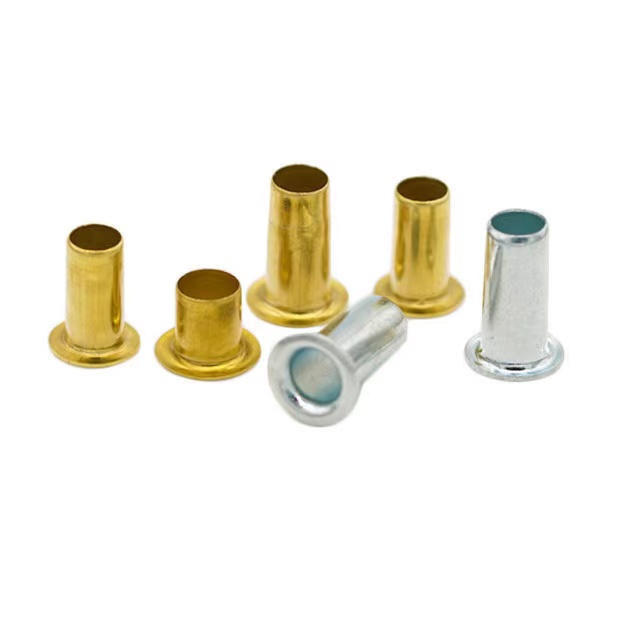
Five Decision Dimensions, Side by Side
| Dimension | Brass Eyelets (C2680) | Stainless Steel Eyelets (304 / 316) |
|---|---|---|
| Corrosion resistance | Good indoors and in fresh water; dezincifies in salt spray | Excellent; 316 exceeds 1,000 hours salt spray |
| Electrical conductivity | ~28% IACS—usable for grounding and terminals | <3% IACS—not suitable for current-carrying joints |
| Tensile strength | 310–650 MPa | 515–620 MPa (304); similar for 316 |
| Appearance | Warm gold; can be lacquered, nickel-plated, or antiqued | Silver-grey; passivated, polished, or electropolished |
| Relative cost | Lower | 1.3–1.6× brass for equivalent size |
| Setting behavior | Soft, rolls easily, low force | Work-hardens; requires higher force and better tooling |
| Best environment | Indoor, fresh water, electrical, decorative | Marine, chemical, food processing, medical, outdoor |
The table reveals the central trade-off. Brass wins on conductivity, appearance flexibility, cost, and ease of setting. Stainless wins on corrosion resistance and strength in aggressive environments.
When Brass Eyelets Are the Correct Choice
Brass is not a compromise. In four scenarios, it is the better engineering decision.
Electrical and Grounding Applications
Brass provides approximately 28% IACS conductivity. That is sufficient for PCB through-hole reinforcement, grounding studs, terminal connections, and low-current contacts. Stainless steel at under 3% IACS introduces resistance and is the wrong material for any current-carrying joint.
Visible Products with Gold-Toned Hardware
Leather goods, handbags, belts, and premium packaging frequently use brass buckles, snaps, and zippers. A stainless steel eyelet next to a brass buckle creates a visible material mismatch. Lacquered brass eyelets maintain colour consistency and prevent tarnishing during retail handling.
Indoor and Fresh-Water Environments
Brass performs well in dry indoor conditions and fresh water. A brass eyelet in an office chair, an indoor banner, or a freshwater boat cover will outlast the product without corrosion. Specifying stainless in these environments adds cost without adding service life.
Cost-Sensitive, High-Volume Production
For orders in the hundreds of thousands, the 1.3–1.6× price difference between stainless and brass becomes material. When the environment does not require stainless, brass reduces unit cost without compromising performance.
When Stainless Steel Eyelets Are Mandatory
Stainless steel is not an upgrade for every application. It is a requirement in four specific conditions.
Salt Spray and Coastal Exposure
Grade 316 stainless contains 2–3% molybdenum and resists chloride pitting for over 1,000 hours in salt spray testing. Brass dezincifies in continuous salt exposure—the zinc leaches out, leaving a porous copper structure that weakens and stains surrounding fabric. For boat covers, dock hardware, and coastal architecture, 316 is the correct specification.
Chemical Washdowns and Food Processing
Food equipment is cleaned daily with alkaline or acidic sanitizers. Grade 304 handles most food-contact chemicals; 316 is required for chloride-rich cleaners. Brass is generally unacceptable in food-contact zones because of lead content and zinc leaching.
Medical and Sterile Environments
Autoclaves, sterile drapes, and surgical equipment require materials that withstand repeated steam sterilization and chemical disinfection. Stainless steel maintains strength and corrosion resistance through thermal cycling from cryogenic temperatures to 800°C.
Long-Life Outdoor Structures
Architectural canopies, tensioned fabric structures, and outdoor signage expected to last 15–25 years require stainless. Brass will discolour and weaken within a few years in the same exposure.
The Middle Path – Coated Brass
A frequently overlooked option is brass with a protective coating. Nickel-plated brass eyelets provide the formability and cost advantage of brass with improved surface corrosion resistance. Tin-plated ones add solderability for electrical applications.
Coated brass is not a substitute for stainless in salt spray or chemical exposure. It is a practical solution for mild outdoor use, humid indoor environments, and applications where a silver finish is required but full stainless corrosion resistance is not.
| Option | Corrosion Level | Conductivity | Relative Cost |
|---|---|---|---|
| Natural lacquered brass | Indoor, fresh water | 28% IACS | Lowest |
| Nickel-plated brass | Mild outdoor, humid indoor | Reduced | Low–medium |
| Tin-plated brass | Indoor, electrical | 28% IACS (solderable) | Low–medium |
| 304 stainless | General outdoor | <3% IACS | Medium–high |
| 316 stainless | Marine, chemical | <3% IACS | Highest |
Two Selection Cases from Our Records
Coastal Awning Manufacturer – Brass Failed, 316 Solved It
Problem: A Florida awning maker used lacquered brass eyelets on outdoor canvas. Within one season, the lacquer wore through, the brass tarnished, and green staining appeared on the light-coloured fabric. Replacement required removing the canvas.
Our recommendation: 316 stainless steel spur eyelets with matching spur washers, passivated finish. The spurs prevented rotation under wind load; the 316 grade resisted chloride pitting.
Result: Three years of coastal exposure with no staining and no pull-outs. The manufacturer now specifies 316 for all outdoor products and retains brass only for indoor showroom displays.
Premium Leather Brand – Stainless Was the Wrong Aesthetic
Problem: A leather goods brand switched to 304 stainless eyelets to eliminate tarnishing complaints. Corrosion stopped, but the silver-grey eyelets clashed with the brand’s brass buckles and gold-tone zippers. Customer feedback described the hardware as “mismatched.”
Our recommendation: Lacquered C2680 brass eyelets in the same dimensions. The lacquer prevented the tarnishing that had prompted the original switch, while restoring colour consistency across all hardware.
Result: Tarnishing complaints remained at zero, and the aesthetic mismatch was resolved. The brand now specifies lacquered brass for all gold-toned collections and reserves stainless for silver-toned lines.
Brass vs. Stainless Steel Eyelets – FAQ
Q1: Can brass eyelets be used outdoors if they are lacquered?
Partially. Lacquered brass eyelets are suitable for mild outdoor conditions—inland awnings, garden furniture, covered outdoor signage—where direct salt exposure and prolonged moisture are absent. The lacquer provides a temporary barrier, but it will wear through at contact points and edges within one to three years depending on abrasion. Once the coating fails, brass tarnishes and, in salt or chloride conditions, begins to dezincify. For continuous outdoor exposure, coastal environments, or applications where replacement is difficult, specify 304 or 316 stainless steel instead. Lacquered brass is a reasonable choice for indoor and sheltered outdoor use, not for exposed marine or industrial conditions.
Q2: Is stainless steel ever the wrong choice for eyelets?
Yes—in three situations. First, electrical applications: stainless steel has less than 3% IACS conductivity and introduces resistance into grounding or terminal joints. Second, gold-toned hardware assemblies: a silver-grey stainless eyelet next to a brass buckle creates a visible mismatch that buyers notice. Third, cost-sensitive indoor products: if the environment is dry and the product will never see salt or chemicals, stainless adds cost without adding service life. Brass or coated brass performs equally well indoors at lower unit cost. The right question is not “which material is better” but “which environment will this eyelet actually face.”
Q3: How much does the cost difference actually amount to?
For equivalent sizes, stainless steel eyelets typically cost 1.3 to 1.6 times brass. The exact ratio depends on size, wall thickness, grade, and order volume. Grade 316 commands a higher premium than 304 because of molybdenum content. On a 500,000-piece order, that difference is significant—which is why specifying stainless only where the environment requires it matters. At Nuote Metals, we quote both materials side by side when a customer is unsure, so the cost difference is visible before a decision is made. We do not recommend stainless for indoor dry applications simply because it sounds more durable.
Q4: Can brass and stainless steel eyelets be used in the same product?
Yes, but they must not touch in wet conditions. When brass and stainless steel are in direct contact and moisture is present, a galvanic couple forms. The brass, being less noble in this pairing, corrodes preferentially. This shows up as accelerated dezincification around the contact point. If a product requires both materials—for example, stainless eyelets on an outdoor section and brass eyelets on an indoor decorative section—keep them physically separated or use an insulating washer between dissimilar materials. For mixed-material assemblies exposed to moisture, consult a galvanic compatibility chart before finalizing the design.
Send Inquiry



X
We use cookies to offer you a better browsing experience, analyze site traffic and personalize content. By using this site, you agree to our use of cookies.
Privacy Policy