
Which Full Hollow Rivets Are Best for Lightweight and Low-Force Fastening Applications?
Choosing the right fastening solution is about more than simply joining two components. In industries where lightweight construction, delicate materials, and efficient assembly are essential, conventional solid rivets may create unnecessary pressure, increase component weight, or damage the materials being joined.
Full hollow rivets provide an alternative through their completely hollow shank structure. They require less material deformation during installation and are particularly useful for applications involving leather, fabrics, thin plastics, and lightweight assemblies. Understanding their construction, materials, dimensions, and installation requirements helps manufacturers achieve more consistent fastening results.
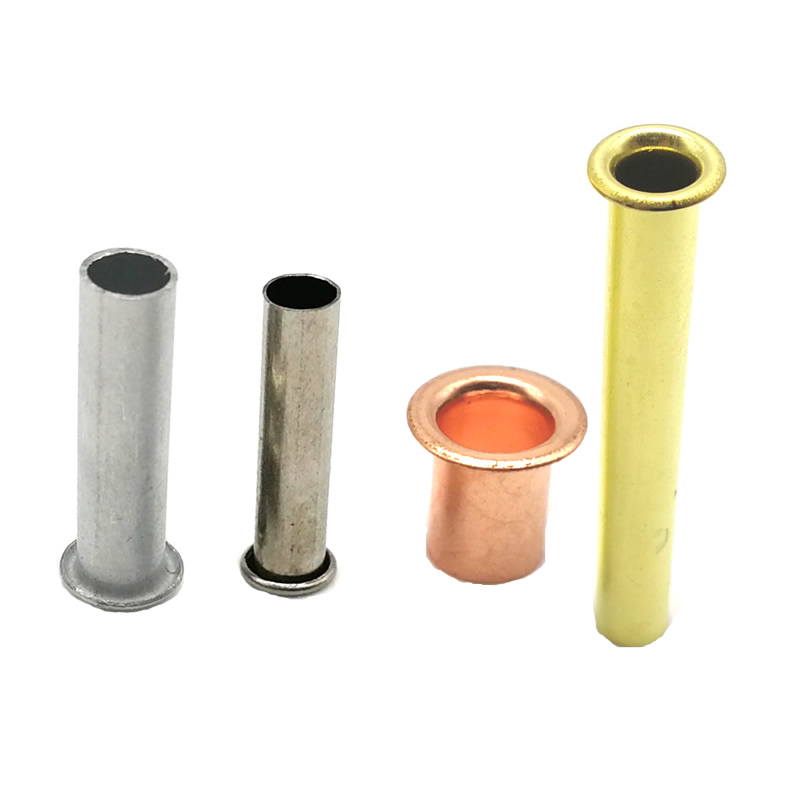
Table of Contents
- What Are Full Hollow Rivets?
- How Do Full Hollow Rivets Work?
- Key Advantages of Full Hollow Rivets
- Full Hollow Rivets vs. Other Rivet Types
- Which Materials Are Available?
- Where Are Full Hollow Rivets Commonly Used?
- How to Choose the Right Full Hollow Rivets
- Installation Methods and Best Practices
- Common Fastening Problems and Solutions
- What to Look for in a Full Hollow Rivet Manufacturer
- Frequently Asked Questions
1. What Are Full Hollow Rivets?
Full hollow rivets are permanent mechanical fasteners designed with a completely hollow shank. Unlike solid rivets, which contain solid metal throughout their shafts, full hollow rivets feature an open internal passage running through the entire shank.
They generally consist of two main sections:
- Pre-formed head: The upper section provides a bearing surface that holds one side of the assembled materials.
- Hollow shank: The tubular section passes through aligned holes in the components and deforms during installation to create a secure mechanical connection.
During riveting, the open end of the shank expands or rolls outward under controlled pressure, forming a retaining flange. This deformation creates a clamping connection without requiring a separate nut or threaded component.
Full hollow rivets are also commonly known as full tubular rivets or tubular rivets. The terminology can vary between manufacturers, so buyers should always confirm that the rivet has a fully hollow shank rather than a partially hollow one.
Important distinction: A full hollow rivet has a hollow passage throughout its shank. This is different from a semi-tubular rivet, which has only a partial cavity at the tail end.
Because less metal needs to be displaced during setting, full hollow rivets can be installed with relatively low force. This makes them particularly valuable when working with soft or easily distorted materials.
2. How Do Full Hollow Rivets Work?
The working principle of a full hollow rivet is based on controlled plastic deformation. Instead of tightening through threads, the fastener creates a permanent mechanical joint by expanding its hollow shank after insertion.
The Basic Riveting Process
1
Prepare the materials
Align the components and prepare holes that match the specified rivet dimensions. Proper hole alignment helps prevent unnecessary stress during assembly.
2
Insert the rivet
Pass the hollow shank through the prepared holes until the pre-formed head sits against the material surface.
3
Position the riveting tool
Place the appropriate setting tool against the open end of the shank. The tool must support controlled deformation without damaging the rivet head or surrounding materials.
4
Expand the hollow shank
Apply the specified force using a compatible riveting machine or hand-operated tool. The hollow tail flares outward to form the retaining section.
5
Inspect the finished joint
Check the formed flange, head seating, component alignment, and overall joint condition. Perform functional or pull-out testing when required.
The final connection depends on several factors, including the rivet material, wall thickness, shank length, hole size, and total material stack thickness. These variables should be considered together rather than selected independently.
3. Key Advantages of Full Hollow Rivets
Full hollow rivets offer several practical benefits for manufacturers looking to improve fastening efficiency while protecting sensitive components.
3.1 Lower Installation Force
The hollow shank requires less metal deformation than a comparable solid rivet. This can significantly reduce the force needed for setting. Depending on the rivet design and material, the setting force can be substantially lower than that of solid rivets.
This is especially important for thin sheet materials, leather, textiles, and plastic components that may crack, deform, or tear under excessive pressure.
3.2 Reduced Component Weight
Removing unnecessary material from the shank reduces the weight of each fastener. Although the weight saving of one rivet may appear small, the combined effect can become meaningful in products containing hundreds or thousands of fasteners.
Weight reduction is particularly relevant to portable equipment, consumer electronics, transportation components, and lightweight assemblies.
3.3 Suitable for Delicate Materials
Soft materials often require fastening methods that minimize localized stress. Full hollow rivets can provide a gentler setting process when correctly designed and installed.
They are therefore useful for applications involving fabric, leather, rubber, and thin plastic components.
3.4 Permanent Mechanical Connections
Once properly installed, a full hollow rivet forms a permanent mechanical connection. It does not depend on threaded engagement, adhesives, or routine tightening.
This makes it useful for products that require stable fastening throughout their intended service life.
3.5 Efficient Production
Full hollow rivets can be integrated into manual, pneumatic, and automated riveting operations. Their suitability for different production environments makes them a practical option for manufacturers seeking repeatable assembly processes.
Application reminder: Low setting force does not automatically mean high joint strength. Full hollow rivets should be selected according to the actual tensile, shear, vibration, and service-load requirements of the finished assembly.
4. Full Hollow Rivets vs. Other Rivet Types
Not all rivets are designed to perform the same function. Selecting an unsuitable rivet structure can lead to unnecessary installation costs, weak joints, or material damage.
The following table compares three common rivet designs.
| Comparison | Full Hollow Rivets | Semi-Tubular Rivets | Solid Rivets |
|---|---|---|---|
| Shank structure | Completely hollow | Partially hollow | Completely solid |
| Material usage | Low | Moderate | High |
| Setting force | Generally lowest | Moderate | Generally highest |
| Weight | Lightest for comparable dimensions | Intermediate | Heaviest |
| Deformation | Full tubular tail expansion | Partial tail expansion | Solid shank deformation |
| Typical applications | Soft materials and lightweight assemblies | General industrial assemblies | Higher-load fastening applications |
When Should You Choose Full Hollow Rivets?
Consider full hollow rivets when:
- The joined materials are relatively soft or thin.
- Reducing installation pressure is a priority.
- Overall component weight needs to be minimized.
- The application requires a permanent mechanical connection.
- The joint does not require the high structural capacity of a solid rivet.
When Might Another Rivet Type Be Better?
Semi-tubular rivets may provide a useful balance between installation force and joint strength for general assembly applications. Solid rivets are often more appropriate when the connection must withstand higher mechanical loads.
The correct choice should always be validated through application-specific testing.
5. Which Materials Are Available for Full Hollow Rivets?
Material selection directly affects corrosion resistance, mechanical properties, weight, conductivity, appearance, and manufacturing cost. Different industries therefore require different material solutions.
Nuote Metals Technology Co.,Ltd. supplies full hollow rivets in several material options to support different industrial requirements.
Carbon Steel
Carbon steel offers a practical combination of strength, availability, and cost efficiency. It is suitable for many indoor industrial and general fastening applications.
Common finishes: Zinc plating and nickel plating, depending on requirements.
Typical uses: Furniture, appliances, and general industrial assemblies.
Stainless Steel
Stainless steel provides better corrosion resistance than ordinary carbon steel. Grades such as 304 and 316 are selected according to environmental and performance requirements.
Common finishes: Natural, polished, and passivated surfaces.
Typical uses: Outdoor equipment, marine-related components, and demanding industrial environments.
Brass
Brass offers an attractive appearance, useful electrical conductivity, and good formability. Its decorative properties make it popular for visible fastening applications.
Common finishes: Natural, nickel-plated, and antique finishes.
Typical uses: Leather products, decorative hardware, and electrical accessories.
Copper
Copper is valued for its excellent electrical and thermal conductivity. Its relatively soft nature can also support forming operations.
Common finishes: Natural, lacquered, and tin-plated options.
Typical uses: Electrical components, grounding accessories, and thermal-related assemblies.
Aluminum
Aluminum is a lightweight material with good corrosion resistance in suitable environments. It is a useful choice when minimizing component weight is important.
Common finishes: Natural and specified surface treatments.
Typical uses: Electronics, portable equipment, and lightweight assemblies.
Material Selection Comparison
| Material | Main Advantage | Considerations | Suitable Applications |
|---|---|---|---|
| Carbon Steel | Cost efficiency | Needs suitable corrosion protection | Indoor industrial products |
| Stainless Steel | Corrosion resistance | Higher material cost and forming requirements | Outdoor and industrial equipment |
| Brass | Appearance and conductivity | Mechanical properties vary by alloy | Decorative and electrical products |
| Copper | Electrical and thermal conductivity | Relatively soft material | Electrical and thermal assemblies |
| Aluminum | Lightweight construction | Strength depends on alloy and design | Portable and lightweight equipment |
When comparing materials, buyers should also consider galvanic corrosion. For example, joining dissimilar metals in humid or outdoor environments may create corrosion risks. Material compatibility should be evaluated before finalizing a specification.
6. Where Are Full Hollow Rivets Commonly Used?
Because of their lightweight construction and relatively low setting force, full hollow rivets are used in many products where fastening performance and material protection must be balanced.
6.1 Leather Goods and Accessories
Leather products often require fasteners that can hold multiple layers without causing excessive tearing or surface distortion. Full hollow rivets are used in bags, belts, wallets, straps, and various leather accessories.
Brass and other decorative materials are frequently considered when the fastener remains visible on the finished product.
6.2 Textile and Fabric Products
Manufacturers of canvas products, fabric covers, tarpaulins, and soft goods may require lightweight fastening solutions. Full hollow rivets can be suitable when the material stack and required holding force are compatible with the rivet design.
Proper head dimensions and flange formation are important for distributing pressure across the fabric.
6.3 Electronics and Electrical Equipment
Small electronic assemblies often contain thin metal sheets, plastic housings, and lightweight internal components. Full hollow rivets can help connect these components while minimizing additional fastener weight.
Copper and brass may be considered when electrical conductivity is relevant, although the complete electrical design must account for contact resistance and current requirements.
6.4 Automotive Components
Automotive manufacturers use different rivet structures for interior panels, trim assemblies, protective covers, and other non-critical fastening applications.
Full hollow rivets may be suitable where low weight and controlled assembly force are more important than the high structural strength required in safety-critical connections.
6.5 Furniture and Household Products
Furniture accessories, folding mechanisms, decorative fittings, and household hardware may use tubular fasteners to connect multiple parts efficiently.
The appropriate material and dimensions depend on the expected operating loads, frequency of movement, and environmental exposure.
6.6 Industrial Lightweight Assemblies
Industrial covers, protective enclosures, lightweight brackets, and selected equipment accessories can also benefit from full hollow rivets.
In these applications, the main objective is to achieve reliable fastening without introducing unnecessary weight or excessive assembly pressure.
7. How to Choose the Right Full Hollow Rivets
Choosing the correct full hollow rivet requires more than matching its outside diameter to an existing hole. A reliable specification should consider the complete assembly, operating environment, and installation process.
7.1 Determine the Shank Diameter
The shank diameter must match the prepared hole and the required joint performance. A rivet that is too small may create excessive clearance, while an oversized rivet may be difficult to insert or damage the surrounding material.
Nuote Metals offers full hollow rivets in shank diameters from 0.8 mm to 10 mm. The appropriate size depends on the specific product design.
7.2 Calculate the Material Stack Thickness
Material stack thickness refers to the combined thickness of all components being joined.
The barrel length must provide enough material for insertion and tail expansion while allowing the rivet to form a stable retaining flange.
Do not select barrel length based only on the thickness of the first component. Include every layer in the assembled stack.
7.3 Select the Appropriate Head Style
Head design affects appearance, surface contact, and installation requirements.
- Round head: Provides a visible raised profile and a broad bearing surface.
- Flat head: Offers a lower-profile appearance where surface clearance matters.
- Countersunk head: Can provide a more flush appearance when the material and installation design support countersinking.
Confirm available head styles with the manufacturer before finalizing the drawing.
7.4 Consider Operating Conditions
Environmental conditions can significantly influence fastener service life.
Consider the following questions:
- Will the rivet be exposed to moisture or outdoor conditions?
- Will the assembled product operate in a marine or chemical environment?
- Is electrical conductivity required?
- Will the fastener experience repeated vibration?
- Does the application involve temperature changes?
- Will the fastener remain visible on the finished product?
These factors help determine the most suitable material and surface finish.
7.5 Evaluate Mechanical Requirements
Although full hollow rivets are useful for lightweight fastening, they are not suitable for every load condition.
Buyers should define the expected tensile load, shear load, vibration exposure, and required service life. For critical assemblies, conduct pull-out, shear, and durability testing using representative production materials.
7.6 Confirm Manufacturing Tolerances
Dimensional consistency is essential for repeatable assembly, particularly in automated production lines.
Important dimensions include:
- Shank outside diameter
- Inside diameter and wall thickness
- Head diameter and head height
- Overall length
- Barrel length
- Concentricity
- Surface finish and coating thickness
For custom projects, provide engineering drawings with clearly defined critical dimensions and tolerances. This allows the manufacturer to evaluate production feasibility before mass manufacturing.
Practical purchasing tip: If you are unsure about the correct rivet size, provide the manufacturer with a drawing, material stack thickness, target application, and expected production quantity. This is more effective than requesting a quotation based on diameter alone.
8. Installation Methods and Best Practices
Even a correctly specified full hollow rivet can produce an unreliable joint if the installation process is poorly controlled. The following practices help improve assembly consistency.
Use Compatible Riveting Equipment
Depending on the rivet dimensions and production volume, manufacturers may use manual riveting machines, pneumatic presses, or automated riveting equipment.
The tooling must match the rivet head and shank geometry. Incorrect punches or supports can cause uneven deformation and damage to the finished surface.
Control Installation Pressure
Excessive pressure can crush the hollow shank, distort the head, or damage the assembled materials. Insufficient pressure may result in incomplete flange formation and a loose connection.
Establish suitable machine settings through sample trials and validate them with production-representative materials.
Maintain Proper Hole Quality
Incorrect hole diameter, burrs, and poor alignment can interfere with rivet insertion and affect the final connection.
Check hole dimensions and edge conditions before beginning production. Consistent hole preparation is particularly important in automated assembly.
Inspect the Finished Joint
After installation, inspect the following characteristics:
- The pre-formed head sits correctly against the material.
- The expanded tail has a consistent shape.
- The joined components do not show cracks or unwanted deformation.
- The rivet is not loose or visibly tilted.
- The finished joint meets the specified mechanical requirements.
For high-volume production, inspection frequency and acceptance criteria should be documented in the quality control plan.
9. Common Fastening Problems and Solutions
Understanding typical riveting defects helps manufacturers reduce production interruptions and improve finished-product quality.
| Common Problem | Possible Cause | Recommended Solution |
|---|---|---|
| Shank collapses during setting | Excessive force or unsuitable tooling | Adjust the setting process and verify tool compatibility. |
| Loose rivet connection | Incorrect barrel length or incomplete deformation | Review rivet dimensions and machine settings. |
| Material tearing | Hole size, head size, or clamping pressure is unsuitable | Evaluate material support and head dimensions. |
| Uneven tail expansion | Misalignment or inconsistent tool contact | Improve positioning and tooling alignment. |
| Surface corrosion | Unsuitable material or surface finish | Select a material and finish appropriate for the environment. |
| Inconsistent assembly results | Dimensional variation or unstable process parameters | Strengthen incoming inspection and process control. |
When a problem occurs repeatedly, replacing the rivet with a larger size is not always the correct solution. The root cause may involve the tooling, hole preparation, material compatibility, or assembly parameters.
10. What to Look for in a Full Hollow Rivet Manufacturer
Choosing a reliable supplier is an important part of maintaining product quality and production efficiency. Buyers should evaluate manufacturing capabilities rather than comparing quotations based only on unit price.
Manufacturing Experience and Technical Support
A capable manufacturer should understand rivet forming, material characteristics, tooling design, and dimensional requirements. Technical support is especially valuable for customized products that do not follow standard specifications.
Material and Size Flexibility
Different projects require different combinations of material, diameter, barrel length, and head geometry. A supplier with flexible manufacturing capabilities can help reduce the difficulty of sourcing multiple fastener specifications.
Quality Control Procedures
Ask about inspection methods for critical dimensions, material verification, surface finish, and finished-product consistency.
Depending on the project, useful quality documentation may include:
- Material certificates
- Dimensional inspection reports
- Surface treatment specifications
- Sample approval records
- Certificates of Conformance
Sample Availability and Production Communication
Testing samples before placing a large order allows buyers to confirm compatibility with their actual assembly process.
Clear communication about tooling, lead times, minimum order quantities, packaging, and delivery schedules also helps reduce purchasing risks.
Why Consider Nuote Metals Technology Co.,Ltd.?
Nuote Metals Technology Co.,Ltd. specializes in metal components, including rivets, eyelets, stamping parts, CNC turning parts, and customized metal accessories.
For customers sourcing full hollow rivets, the company provides several material options, including carbon steel, stainless steel, brass, copper, and aluminum.
Its product range covers full hollow rivets with shank diameters from 0.8 mm to 10 mm, supporting different industrial fastening requirements.
Nuote Metals also provides customized manufacturing based on customer drawings and samples. This gives buyers the opportunity to discuss dimensions, materials, head styles, and other project-specific requirements before confirming production.
Whether you are developing a new product or optimizing an existing assembly, working directly with a manufacturer can make technical communication and specification confirmation more efficient.
11. Frequently Asked Questions About Full Hollow Rivets
Q1. What is the main difference between full hollow rivets and semi-tubular rivets?
Full hollow rivets have a completely hollow shank from the tail to the head, while semi-tubular rivets have only a partial cavity at the tail. Full hollow rivets generally require less setting force, whereas semi-tubular rivets offer a balance between deformation requirements and joint performance.
Q2. Are full hollow rivets suitable for heavy-duty applications?
They can be used in selected industrial applications, but their suitability depends on the required tensile and shear strength, material thickness, rivet dimensions, and joint design. For high-load structural connections, solid rivets or other fastening systems may be more appropriate.
Q3. Which materials can be used to manufacture full hollow rivets?
Common options include carbon steel, stainless steel, brass, copper, and aluminum. Each material offers different mechanical, corrosion-resistance, electrical, and weight characteristics.
Q4. Can full hollow rivets be customized?
Yes. Depending on manufacturing feasibility, customized rivets can be produced according to customer drawings or samples. Specifications may include shank diameter, barrel length, head dimensions, material, and surface finish.
Q5. How do I determine the correct barrel length?
Start with the total thickness of all materials being joined. Then consider the additional length required for the tail to expand and form a secure retaining flange. The final specification should be confirmed through manufacturer recommendations and installation testing.
Q6. Do full hollow rivets require special installation equipment?
They require suitable riveting tools or machines that can support controlled deformation of the hollow shank. Manual, pneumatic, and automated equipment may be used depending on rivet dimensions and production requirements.
Q7. Are full hollow rivets suitable for leather and fabric products?
Yes. They are commonly considered for leather goods, textile products, canvas covers, and other soft-material assemblies. However, head dimensions, material thickness, and setting pressure must be selected carefully to avoid tearing or deformation.
Q8. How can I prevent full hollow rivets from loosening?
Choose the correct barrel length and shank diameter, prepare accurately sized holes, and use compatible installation tooling. Validate the finished connection through appropriate pull-out or mechanical testing.
Q9. What information should I provide when requesting a quotation?
Provide the required material, shank diameter, barrel length, head style, surface finish, material stack thickness, drawing or sample, estimated quantity, and intended application. This information helps the manufacturer evaluate your requirements more accurately.
Q10. Can I request samples before placing a bulk order?
Sample availability depends on the selected specification and customization requirements. Contact the manufacturer to confirm sample arrangements, costs, and delivery time before starting mass production.
Looking for a Reliable Full Hollow Rivet Manufacturer?
The right fastening component can make a significant difference in assembly efficiency, product weight, and long-term connection performance.
At Nuote Metals Technology Co.,Ltd., we support customers with full hollow rivets in different materials and specifications, including customized solutions based on drawings and samples.
Whether you need standard sizes or specially designed hollow rivets for a new project, our team is ready to discuss your requirements.
Contact us today with your drawings, material requirements, or product samples. Let Nuote Metals help you find a suitable fastening solution for your application.
Contact Us for Full Hollow RivetsSend Inquiry



X
We use cookies to offer you a better browsing experience, analyze site traffic and personalize content. By using this site, you agree to our use of cookies.
Privacy Policy