
What Are the Most Common Tubular Rivet Selection Mistakes—and How Do You Avoid Them?
Mistake One – Choosing the Wrong Hollow Depth
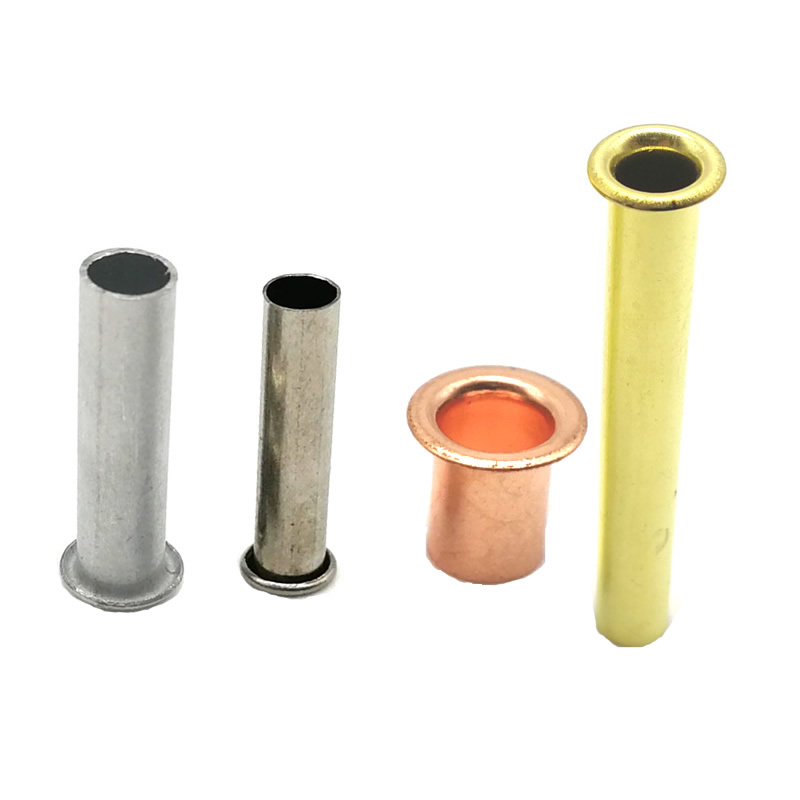
The most consequential decision in tubular rivet/full-tubular-rivets selection is hollow depth. Many buyers default to full tubular because it sets with the least force, or to semi-tubular because it sounds stronger. Neither default is correct.
How the Two Configurations Differ
| Factor | Semi-Tubular | Full Tubular |
|---|---|---|
| Hollow depth | 45–55% of shank | 100% of shank |
| Setting force | 25–30% of solid | 15–20% of solid |
| Shear strength | 80–90% of solid | 60–70% of solid |
| Pivot capability | Yes—can be set loose | No—wall collapses |
| Material stack limit | Up to 8 mm | Up to 4 mm |
| Correct for | Structural joints, electrical terminals, high-volume | Soft materials, decorative, low-load |
The correction: If the joint carries structural load or requires pivot movement, specify semi-tubular. If the material is soft and the stack is under 4 mm, full tubular is appropriate. Do not use full tubular for anything load-bearing simply because it is easier to set.
Mistake Two – Mismatching Material to Environment
Material selection is often driven by cost or habit rather than by the actual operating environment. Three mismatches account for most premature failures.
The Three Common Mismatches
| Mismatch | What Happens | Correct Choice |
|---|---|---|
| Brass in continuous salt spray | Dezincification—zinc leaches out, leaving porous copper | 316 stainless steel |
| Steel in humid or washdown environments | Plating chips, rust begins at edges and holes | 304 or 316 stainless steel |
| Aluminum in high-vibration structural joints | Fatigue cracking at the head-to-shank transition | Steel or stainless steel semi-tubular |
Material Selection by Environment
| Environment | Recommended Material | Avoid |
|---|---|---|
| Indoor, dry | Steel (plated), brass | No restrictions |
| Outdoor, inland | 304 stainless, aluminum (5056) | Steel without plating |
| Coastal or salt spray | 316 stainless | Brass, steel, 6061 aluminum |
| Chemical or acidic | 316 stainless | All others |
| High-conductivity electrical | Copper (100% IACS) | Stainless, steel |
| Weight-critical | Aluminum (5056) | Steel, copper, brass |
The correction: Identify the most aggressive condition the rivet will face—not the average condition. A rivet that sees salt spray twice a year still needs 316 stainless, because the corrosion products will stain and weaken the joint over time.
Mistake Three – Calculating Barrel Length Incorrectly
Barrel length errors are the most frequent cause of installation defects. Too short, and the roll is weak. Too long, and the roll is oversized or splits.
The Correct Formulas
| Rivet Type | Formula | Example |
|---|---|---|
| Semi-Tubular rivet | Stack Thickness + (0.8 to 1.2) × Shank Diameter | 2.0 mm stack, 4 mm shank: 2.0 + (1.0 × 4.0) = 6.0 mm |
| Full Tubular rivet | Stack Thickness + (0.4 to 0.7) × Shank Diameter | 2.0 mm stack, 4 mm shank: 2.0 + (0.5 × 4.0) = 4.0 mm |
The correction: Use the higher multiplier for harder materials (steel, stainless) and the lower multiplier for softer materials (aluminum, brass, copper). Always test with free samples in two adjacent lengths before committing to production.
Two Production Cases Where Specification Changes Solved Failures
Agricultural Equipment Panel (Semi-Tubular, 304 Stainless)
Problem: A manufacturer of tractor engine covers used zinc-plated steel semi-tubular rivets. The covers were washed down weekly, and the plating failed within six months. Rust stains appeared on the painted panels, and some rivets loosened as the steel corroded.
Original specification: Steel semi-tubular, 4 mm shank, 6 mm barrel, zinc plated.
Corrected specification: 304 stainless steel semi-tubular rivets, 4 mm shank, 6 mm barrel, passivated. The 304 grade handles weekly washdowns and outdoor storage. The semi-tubular design maintained the necessary shear strength for the panel attachment.
Result: Two years in service with zero corrosion and zero loosening. The customer converted all engine cover models to stainless steel.
HVAC Duct Flange (Full Tubular, Aluminum 5056)
Problem: An HVAC contractor used brass full tubular rivets to attach aluminum duct flanges. The ducts operated in a condensing environment with constant moisture. Brass dezincified within 18 months, leaving white corrosion products on the aluminum and weakening the joint.
Original specification: Brass full tubular, 3 mm shank, 5 mm barrel.
Corrected specification: 5056 aluminum full tubular rivets, 3 mm shank, 5 mm barrel, clear anodized. The 5056 alloy is marine-grade and compatible with the aluminum duct material—no galvanic couple. The anodized finish added corrosion protection.
Result: Three years in service with no corrosion and no joint failures. The contractor now specifies 5056 aluminum for all condensing-environment ductwork.
Technical Specifications – Our Factory Standards
| Parameter | Range | Tolerance |
|---|---|---|
| Shank diameter | 1.6 mm – 10 mm | ±0.05 mm |
| Barrel length | 2 mm – 30 mm | ±0.15 mm |
| Head diameter | 1.6 – 2.8 × shank diameter | ±0.10 mm |
| Hollow depth (semi-tubular) | 45–55% of shank | ±5% |
Head Styles Available
- Flat head – flush surface, low profile
- Round head – classic domed profile
- Countersunk head – sits flush or below surface
- Truss head – extra-wide for soft materials
- Pan head – moderate profile
Standard Finishes
- Natural (as-formed)
- Zinc plating – basic corrosion protection for steel
- Nickel plating – bright finish, wear resistance
- Tin plating – solderable surface
- Passivation – for stainless steel
- Anodized – for aluminum
All finishes are RoHS compliant.
Tubular Rivets – FAQ
Q1: What is the difference between semi-tubular and full tubular rivets?
A: The difference is hollow depth. A semi-tubular rivet has a hollow cavity extending 45–55% of the shank length from the tail; the rest is solid. A full tubular rivet is hollow through the entire shank. Semi-tubular rivets offer higher shear strength (80–90% of solid) and can be used as pivot points. Full tubular rivets set with the least force (15–20% of solid) but provide only 60–70% of solid strength. Use semi-tubular for structural joints, electrical terminals, and anything load-bearing. Use full tubular for soft materials, thin stacks under 4 mm, and decorative assemblies. At Nuote Metals, we manufacture both configurations in five materials.
Q2: Why do tubular rivets fail prematurely in outdoor applications?
A: The most common cause is material mismatch. Brass dezincifies in salt spray. Plated steel rusts once the coating chips. Aluminum can pit in alkaline or chloride environments. The solution is to match the material to the most aggressive condition the rivet will face—not the average condition. For coastal or marine exposure, specify 316 stainless steel. For general outdoor use, 304 stainless steel or 5056 aluminum. For indoor dry environments, plated steel or brass is acceptable. If you are unsure, request free samples and test them in the actual environment before committing to production.
Q3: How do I calculate the correct barrel length for a tubular rivet?
A: The formula depends on the configuration. For semi-tubular rivets: Barrel Length = Material Stack Thickness + (0.8 to 1.2) × Shank Diameter. For full tubular rivets: Barrel Length = Material Stack Thickness + (0.4 to 0.7) × Shank Diameter. Use the higher multiplier for harder materials and the lower multiplier for softer materials. Example: a 3.0 mm stack with a 4 mm semi-tubular rivet requires 3.0 + (1.0 × 4.0) = 7.0 mm. The same stack with a full tubular rivet requires 3.0 + (0.5 × 4.0) = 5.0 mm. Always test with free samples in two adjacent lengths before production.
Q4: What is the MOQ and lead time for tubular rivets from Nuote Metals?
A: Our standard MOQ is 20,000 pieces for stock sizes. For first orders or sample runs, we accommodate lower quantities—as low as 5,000 pieces. We provide free samples for stocked sizes; you pay only the courier charge. Lead time: 3–5 days for stock sizes; 15–25 days for non-standard sizes including custom tooling. Every batch includes a material certificate, dimensional inspection report, and RoHS declaration. We have supplied tubular rivets to customers in over 70 countries. ISO 9001:2015 certified.
Send Inquiry



X
We use cookies to offer you a better browsing experience, analyze site traffic and personalize content. By using this site, you agree to our use of cookies.
Privacy Policy