
When Should You Specify Brass Tubular Rivets Instead of Solid or Semi‑Tubular?
Most buyers think of rivets as solid cylinders. But a fully hollow brass tubular rivet solves problems that solid rivets cannot: fast automated setting, no damage to soft substrates, and minimal material cost. At Nuote Metals, we produce tubular rivets for customers who need high volume, low force, and a clean aesthetic. This guide tells you exactly when to choose them – and when to avoid them.
What Distinguishes Brass Tubular Rivets from Other Brass Rivets?
The table below places brass tubular rivets in context with brass semi‑tubular and solid brass rivets. The key difference is the hollow depth.
| Type | Hollow Depth | Setting Force (relative to solid) | Typical Shear Strength (MPa, C26000) | Best Use Case |
|---|---|---|---|---|
| Solid brass | 0% | 100% (baseline) | 280–320 | High‑load structural joints, marine hardware |
| Brass semi‑tubular | 20–40% of shank | 60–70% | 220–260 | General assembly, furniture pivots, electrical terminals |
| Brass tubular | 100% of shank | 40–50% | 140–180 | Lightweight decorative, soft materials, low‑load electronics |
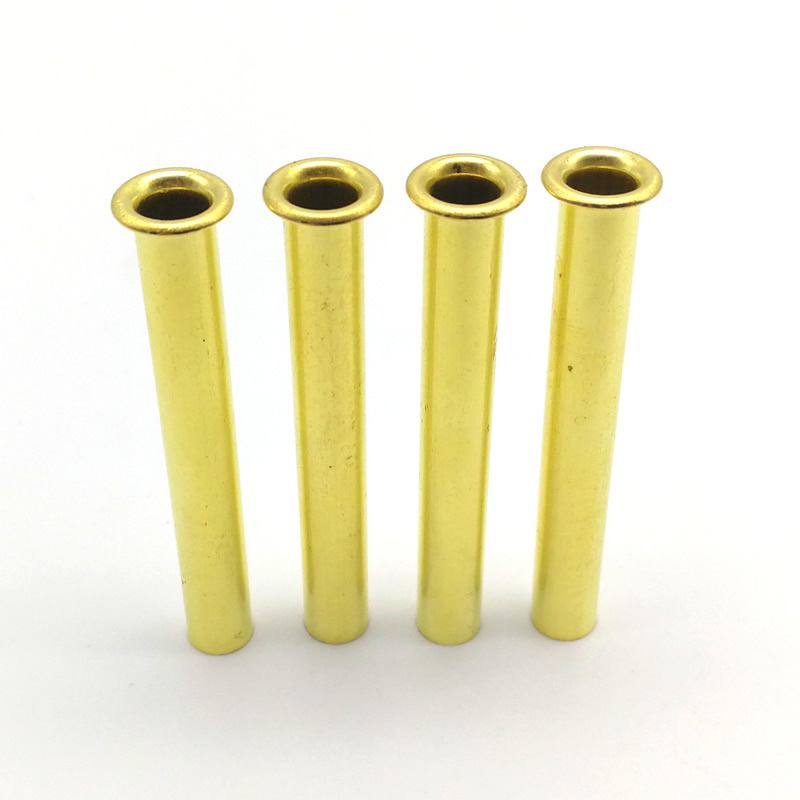
Our definition: A tubular rivet is a permanent fastener with a pre‑formed head and a shank that is hollow from the tail all the way to the head. During installation, the thin wall rolls outward with very low force, creating a clean, uniform curl.
Applications: Where Brass Tubular Rivets Are the Best Choice
Application 1: Soft or Thin Materials (Leather, Fabric, Plastic Films)
Problem: Solid or semi‑tubular rivets require enough setting force to deform a thick wall. That force can crack thin plastic, crush soft leather, or tear fabric.
Why brass tubular works: The wall thickness of a tubular rivet is typically 0.15–0.30 mm. It rolls with minimal axial pressure. The material underneath sees almost no stress.
Real case: A European bag maker used steel semi‑tubular rivets on 1.2 mm vegetable‑tanned leather. The rivets often cracked the leather around the hole. We supplied C26000 brass tubular rivets with a 4 mm shank. The lighter setting force eliminated cracking. The brass finish also matched the bag’s gold hardware.

Application 2: High‑Volume Automated Assembly (Over 100,000 Pieces)
Problem: Every millisecond of cycle time matters. Solid rivets need longer stroke and higher force, which slows down automatic riveting machines.
Why brass tubular works: Tubular rivets set in one quick, low‑force stroke. Automatic feeders handle them easily because the hollow shank is less likely to jam. Cycle rates can reach 200–300 rivets per minute.
Real case: A lighting fixture manufacturer needed to attach brass nameplates to aluminium housings – 500,000 units per year. Switching from solid brass to brass tubular rivets reduced their setting cycle time by 40% and eliminated cracked housings.
Technical Specifications – Our Factory Parameters for Brass Tubular Rivets
All numbers below are for brass tubular rivets manufactured by Nuote Metals from C26000 or C27000 alloy.
Standard Dimensional Range and Tolerances
| Parameter | Available Range | Standard Tolerance |
|---|---|---|
| Shank outside diameter | 1.5 mm – 8 mm | ±0.05 mm |
| Wall thickness | 0.15 mm – 0.40 mm (depending on OD) | ±0.03 mm |
| Flange diameter | 3 mm – 16 mm | ±0.10 mm |
| Overall length (head to tail) | 2.5 mm – 12 mm | ±0.10 mm |
| Head height (dome style) | 0.6 mm – 1.5 mm | ±0.10 mm |
Note: Because the shank is fully hollow, the minimum wall thickness is limited by our stamping process. For diameters under 2 mm, we recommend semi‑tubular instead.
Standard Finishes for Tubular Brass Rivets
| Finish | Appearance | Tarnish Resistance | Typical Lead Time (stock sizes) |
|---|---|---|---|
| Natural (tumbled) | Matte gold | Low | 3 days |
| Polished + lacquered | Bright gold | High | 7 days |
| Nickel‑plated | Bright silver | Very high | 7 days |
| Tin‑plated | Matte silver | High (solderable) | 7 days |
| Antique / oxidized | Dark bronze | Moderate | 7 days |
All finishes are RoHS compliant.
Real Cost Analysis – Why Tubular Saves Money
The lower material content of a brass tubular rivet directly reduces your cost. Use this formula to compare:
Cost per 1,000 pieces = (Brass coil weight per rivet × scrap rate) + stamping + finishing
For a 5 mm shank diameter, 6 mm length:
| Type | Brass weight (approx.) | Relative material cost | Setting time (seconds per rivet, auto) |
|---|---|---|---|
| Solid brass | 2.1 g | 100% | 0.8 – 1.0 |
| Semi‑tubular | 1.5 g | 70% | 0.6 – 0.8 |
| Tubular | 0.9 g | 43% | 0.4 – 0.6 |
Over 500,000 rivets, switching from solid to tubular saves approximately 600 kg of brass and 100+ hours of machine time.
Quality and Documentation – Our Transparent Policies
ISO 9001:2015 – Traceable Production
Every batch of rivets from Nuote Metals includes a lot number that traces to:
Coil certificate (alloy, heat number, hardness)
Stamping press log (date, operator, tooling ID)
Final inspection report (dimensions, wall thickness, concentricity)
Sampling and Inspection
We follow AQL 1.0 for critical dimensions (shank OD, wall thickness), 2.5 for major (length, flange OD), and 4.0 for minor (cosmetic). Every 500 pieces, 10 samples are measured.
Our Transparent Customer Policies (Plain English)
Free samples – For stocked sizes. You pay courier.
Custom tubular lengths – Tooling ready in 10 calendar days for non‑standard lengths or flange shapes.
MOQ – 20,000 pieces for standard sizes; lower for first orders.
Lead time – Stock: 3–5 business days. Custom (including tooling): 15–20 business days.
We have supplied brass tubular rivets to leather goods, lighting, and electronics customers across 30+ countries.
Installation Guide – Specific to Tubular Brass Rivets
Because the wall is thin, tubular rivets require different setting parameters than solid or semi‑tubular.
Recommended Setting Force (Newtons, C26000)
| Shank Diameter | Material Stack Thickness | Force (N) | Notes |
|---|---|---|---|
| 2 mm | 1.0 – 2.0 mm | 300 – 500 | Light mallet or hand press |
| 3 mm | 1.5 – 2.5 mm | 500 – 800 | Pneumatic press recommended |
| 4 mm | 2.0 – 3.0 mm | 800 – 1,200 | Use single stroke |
| 5 mm | 2.5 – 3.5 mm | 1,000 – 1,500 | Avoid multiple hits |
| 6 mm | 3.0 – 4.0 mm | 1,200 – 1,800 | Hydraulic press for consistency |
Critical Success Factors
Hole diameter: Punch or drill 0.05 – 0.10 mm larger than shank OD. Too tight – the thin wall buckles. Too loose – the curl is uneven.
Deburring: Absolutely essential. A raised burr will split the thin wall. Use a deburring tool on both sides.
Anvil profile: Use a shallow‑concave anvil that matches the curl shape. A flat anvil will crush the wall.
No lubrication needed – Brass is naturally slippery. Lubricant can cause the rivet to slip in the feeder.
Common Mistakes We Have Seen
| Mistake | Consequence | Our Fix |
|---|---|---|
| Hole 0.2 mm too large | Uneven, wavy curl | Reduce hole size to +0.05–0.10 mm |
| Burr on the hole | Split barrel | Deburr both sides before setting |
| Using a flat anvil | Flattened, cracked roll | Switch to concave anvil |
| Too much force (over 2,000 N on 4 mm) | Wall collapse, head deformation | Reduce force by 20–30% |
【brass tubular rivets】FAQ – Three Questions We Answer Daily
Q1: Can I use brass tubular rivets outdoors? Will they corrode?
A: Brass tubular rivets made from C26000 (70/30) are suitable for indoor use and mild outdoor conditions (e.g., a garden banner, a shaded awning). They will gradually tarnish to a darker brown but will not lose mechanical integrity for several years. However, in direct, continuous salt spray or coastal environments, C26000 brass can undergo dezincification – the zinc leaches out, leaving porous copper. Our recommendation: For outdoor applications away from salt (inland, fresh water only), C26000 with a lacquered finish is acceptable. For coastal or marine use, we suggest switching to C23000 red brass tubular rivets (85% copper) or 316 stainless steel tubular rivets – we manufacture both. If you insist on brass for aesthetic reasons, specify C23000 red brass with a clear lacquer, and expect to replace after 3–5 years.
Q2: How do I calculate the correct barrel length for a brass tubular rivet?
A: Tubular rivets require much less protrusion than solid or semi‑tubular because the thin wall only needs to curl, not fold a thick section. Our formula: Barrel Length = Material Stack Thickness + 0.5 to 0.8 mm. Example: joining a 1.5 mm leather panel to a 0.5 mm fabric lining – total stack 2.0 mm. Add 0.6 mm = 2.6 mm barrel length. Round up to the nearest standard length (usually 2.8 mm or 3.0 mm). Do not use the semi‑tubular formula (stack + 1.0× diameter) – that will leave too much material and cause a messy, oversized curl. For stacks thicker than 4.0 mm, tubular rivets are not recommended; switch to semi‑tubular. Order free samples in two adjacent lengths and test on your actual material – we provide sample kits.
Q3: Are brass tubular rivets strong enough for furniture or luggage?
Yes, for certain joints. Brass tubular rivets are widely used in luggage handles, drawbar attachments, and light‑duty furniture pivots (e.g., folding chair mechanisms, desk drawer slides). However, they are not suitable for load‑bearing structural joints such as chair legs that support a person’s weight. The shear strength of a 4 mm brass tubular rivet is approximately 150–180 MPa. For comparison, a solid steel rivet of the same diameter is 300–350 MPa. Our rule of thumb: If the joint will experience more than 50 N of shear force (about 5 kg of weight), choose semi‑tubular or solid. If the joint is purely for alignment, decoration, or light movement (e.g., a hinge on a jewellery box, a strap pivot on a backpack), tubular is fine. We can provide calculated load ratings for your specific stack thickness – just ask.
Contact Nuote Metals for Your Brass Tubular Rivets Project
Tell us your material stack (type and thickness), required shank diameter and length, annual volume, and environment. We will reply with a specific alloy recommendation, a barrel length calculation, free samples, and an itemized quote.
Send Inquiry



X
We use cookies to offer you a better browsing experience, analyze site traffic and personalize content. By using this site, you agree to our use of cookies.
Privacy Policy