
Where Do You Still Use a Square Head Screw?
Look at most screws today, and the head is either Phillips or hex. But if you work on old farm equipment, heavy timber framing, or some classic machinery, you’ll see a different shape: four flat sides. That’s the Square Head Screw . It’s not common in new designs anymore, but it’s far from gone. This special screw has a stubborn, old-school strength to it. The square drive is simple—a wrench fits snugly on all four sides, giving you a huge amount of turning power with almost no risk of the tool slipping and stripping the head. That’s why you still find them in places where things need to be tightened down for good, and where the screws might get rusty and need a lot of force to remove years later.
Compared to modern socket heads, they stick out more. They aren’t sleek. But for sheer gripping power and durability in a tough environment, this special screw is hard to beat. It’s a tool, not a decoration.
Forging the Square: A Cold Header's View
My name is Ray, and I run the cold heading machines that make our line of special screw, including the square heads. Most screws are made this way—we don’t cut them; we forge them. It’s stronger and faster.
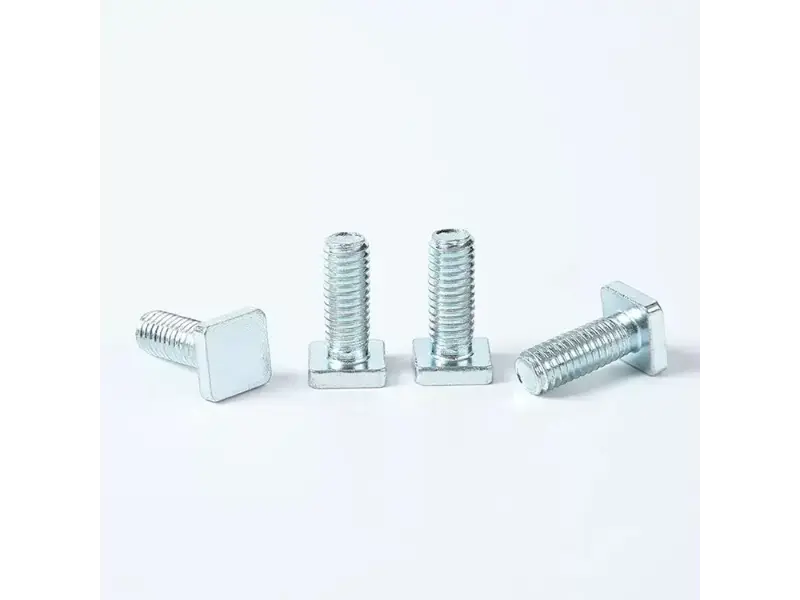
Making a Square Head Screw starts with a coil of steel wire. It’s fed into the machine, cut to length, and then the fun begins. The blank gets hit by a series of dies. The first blows start to form the head. But forming a clean, sharp square isn’t as easy as making a round head. The metal has to flow into the corners of the die cavity perfectly.
The trick is in the die design and the sequence. You can’t just squash the metal into a square in one hit. It takes two or three precise blows in different dies to get that shape without leaving flash (excess material) or having the corners be weak. You have to let the metal move where you want it. When it’s right, you get a clean, sharp square with defined edges. If the die is worn or the setup is off, the corners get rounded, and the wrench won’t fit tight.
After the head is formed, another part of the machine rolls the threads. This is where the screw gets its real strength—rolled threads are tougher than cut threads. We run them in different materials: low-carbon steel for general use, or sometimes stainless for corrosion resistance.
For me, quality check is visual and by feel. I’ll take a sample Square Head Screw and try a wrench on it. It should fit snug with no play. I’ll also look at the underside of the head—the bearing surface—to make sure it’s flat and smooth. A bad head means a useless screw, no matter how good the threads are.
We had an order last year from a company that restores vintage tractors. They needed authentic-looking Square Head Screws in specific sizes, but made with modern, consistent steel. That’s a job for cold heading. It was satisfying to make a part that looks old but performs like new.
So, while it might seem like a relic, the Square Head Screw is still a serious fastener for serious jobs. Making it well is about understanding how metal flows under pressure to create a shape that a wrench can really trust.
Send Inquiry



X
We use cookies to offer you a better browsing experience, analyze site traffic and personalize content. By using this site, you agree to our use of cookies.
Privacy Policy