
Why Do Stainless Steel Eyelets Outlast Other Fasteners in Aggressive Environments?
The Three Aggressive Environments That Destroy Ordinary Eyelets
Not all corrosive environments are the same. Each attacks fasteners differently. Understanding the mechanism helps you select the right grade.
Salt Spray and Coastal Exposure
Chloride ions from seawater break down the passive oxide layer on stainless steel. Grade 304 stainless steel eyelets resists this for 200–500 hours in salt spray testing. Grade 316, with 2–3% molybdenum, exceeds 1,000 hours. Brass dezincifies. Aluminum pits. Plated steel rusts once the coating scratches.
Chemical Washdowns and Food Processing
Food processing equipment is cleaned daily with alkaline or acidic sanitizers, often at high temperature. Grade 304 handles most food-contact chemicals. Grade 316 is required for chloride-rich cleaners or high-acid products. The eyelet must also resist crevice corrosion where the flange meets the material.
Thermal Cycling and High Temperature
Autoclaves, ovens, and heat exchangers subject fasteners to repeated heating and cooling. Stainless steel maintains strength from cryogenic temperatures to 800°C. Brass softens. Aluminum weakens above 150°C. Plated steel can flake.
Alloy Selection by Environment – A Practical Table
| Environment | Recommended Grade | Expected Service Life | Notes |
|---|---|---|---|
| Indoor, dry | 304 | 50+ years | No corrosion risk |
| Outdoor, inland | 304 | 20–30 years | Rain and humidity only |
| Coastal (within 5 km) | 316 | 15–25 years | Chloride spray |
| Direct saltwater splash | 316 | 10–20 years | Not for immersion |
| Food processing (daily washdown) | 304 or 316 | 15+ years | 316 for chloride cleaners |
| Chemical plant (acid/alkali) | 316 | 10–20 years | Verify chemical compatibility |
| Autoclave / steam sterilization | 304 | 10+ years | Thermal cycling |
| Continuous saltwater immersion | 316 (passivated) | 5–10 years | Consider titanium or duplex |
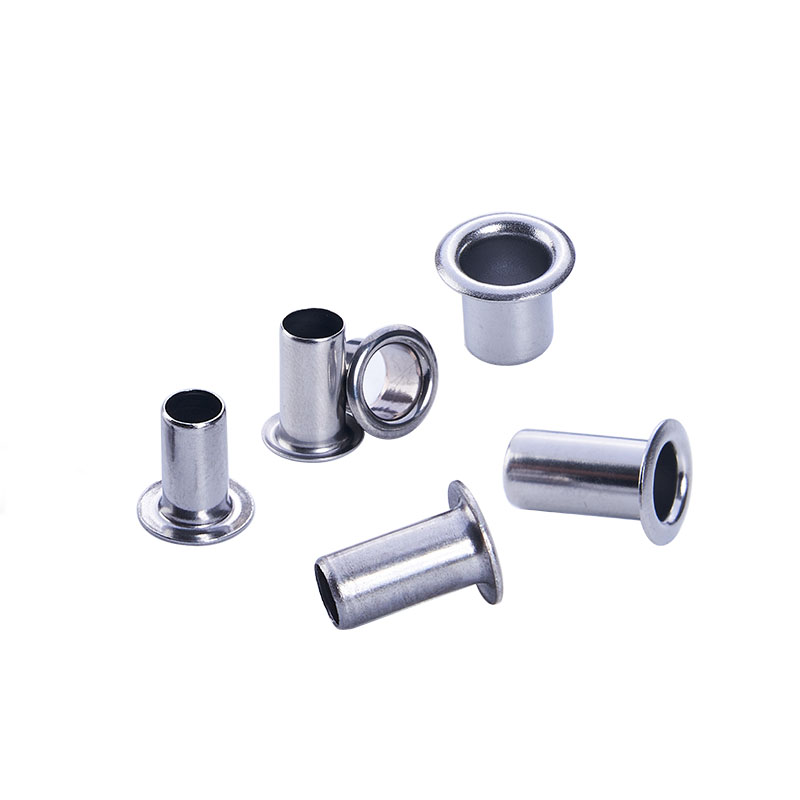
Surface Treatment – The Step Most Suppliers Skip
The alloy determines the base corrosion resistance. The surface treatment determines whether that resistance is fully realized.
Passivation – The Minimum Standard
Passivation removes free iron particles left on the surface during manufacturing. These particles rust first, creating stains and initiating pitting. Nitric acid passivation per ASTM A967 restores the chromium oxide layer to full thickness. Nuote Metals performs passivation in-house on every stainless steel eyelet order.
Electropolishing – For the Most Demanding Applications
Electropolishing goes further. It removes a microscopic layer of material from the surface, smoothing peaks and removing embedded contaminants. The result is a mirror-like finish with maximum corrosion resistance. Electropolished stainless steel eyelets are specified for pharmaceutical, semiconductor, and high-purity food applications.
Finish Comparison
| Finish | Corrosion Protection | Surface Smoothness | Best For |
|---|---|---|---|
| Mill (as-stamped) | Moderate | Rough | Indoor, dry, cost-sensitive |
| Passivated | High | Smooth | Outdoor, marine, food, medical |
| Electropolished | Very high | Mirror-like | Pharmaceutical, semiconductor, high-purity |
Installation Quality – The Hidden Factor in Eyelet Lifespan
A correctly specified eyelet can still fail prematurely if installation is poor. Three factors matter most.
Hole Size and Deburring
The hole should be 0.05–0.10 mm larger than the eyelet shank. A burr on either side of the hole acts as a stress riser and can crack the barrel during roll formation. Deburr both sides. This is non-negotiable for stainless steel, which work-hardens faster than brass.
Setting Force and Tooling
Stainless steel requires higher setting force than brass or aluminum. Use hardened tool steel dies with a polished concave profile. A single, firm stroke is essential. Multiple strikes cause work hardening and cracking.
Common Defects and Causes
| Defect | Cause | Correction |
|---|---|---|
| Cracked roll | Excessive force or burred hole | Reduce force, deburr hole |
| Incomplete roll | Insufficient force | Increase force or use correct die |
| Off-center roll | Misaligned tooling | Check punch and anvil alignment |
| Galling | Stainless steel adhering to tooling | Use polished dies and lubricant |
Two Field Cases from Our Production Records
Commercial Bakery Oven Doors (304 Stainless Steel)
Problem: A bakery equipment manufacturer used zinc-plated steel eyelets to secure insulation blankets on oven doors. The ovens operated at 220°C and were washed down daily with alkaline cleaner. Plating failed within six months, and rust contaminated the insulation. Brass eyelets tarnished and lost strength at temperature.
Our solution: We supplied 304 stainless steel standard eyelets with a passivated finish, 5 mm shank, 8 mm barrel length. The 304 grade handles the alkaline cleaner and thermal cycling. Passivation maximized the chromium oxide layer.
Result: Two years in service, zero corrosion, zero failures. The customer converted all oven models to stainless steel eyelets.
Coastal Architectural Canopy (316 Stainless Steel)
Problem: An architectural fabricator installed a tensioned fabric canopy 200 meters from the ocean. The eyelets securing the fabric to the frame were originally brass. Within one year, they showed dezincification and green staining on the white fabric. Replacement required disassembling the canopy.
Our solution: We supplied 316 stainless steel spur eyelets with matching spur washers, electropolished finish. The spurs bit into the fabric to prevent rotation. Electropolishing provided maximum chloride resistance.
Result: Three years after replacement, no corrosion and no staining. The fabricator now specifies 316 electropolished eyelets for all coastal projects.
FAQ
Q1: Can 304 stainless steel eyelets be used in a chlorinated swimming pool environment?
A: Proceed with caution. Chlorinated pool water contains hypochlorous acid, which can breach the passive layer of 304 stainless steel, especially in warm water or low pH conditions. We have seen 304 eyelets pit after six months in indoor pool covers. For continuous or frequent chlorinated water exposure, upgrade to 316 stainless steel eyelets. The molybdenum content resists chlorine-induced pitting. For occasional exposure—a pool cover used only on weekends—304 with passivation may suffice, but 316 is recommended for any commercial or warranty-sensitive application. Free test coupons are available for chlorinated water testing.
Q2: How do I know if passivation was performed correctly?
A: The most common verification method is the copper sulfate test per ASTM A380. A drop of copper sulfate solution is applied to the surface. If free iron is present, copper deposits as a pink stain. If the surface is properly passivated, no color change occurs. At Nuote Metals, we perform copper sulfate testing on every passivation batch and retain records. For critical applications, we can also provide ferroxyl test results. If your supplier cannot provide passivation verification documents, the passivation may be incomplete or skipped entirely.
Q3: Can stainless steel eyelets be used with aluminum sheets without causing galvanic corrosion?
Yes, but isolation is required. Stainless steel is cathodic and aluminum is anodic. In the presence of moisture, the aluminum will corrode preferentially around the eyelet. To prevent this, use a nylon or PET insulating washer between the stainless steel eyelet and the aluminum surface. The washer breaks the electrical path. For high-temperature applications, use a fiberglass or ceramic washer. Sealing the joint edge with a flexible sealant provides additional protection. At Nuote Metals, we supply pre-assembled insulating washers for stainless steel eyelets used in aluminum assemblies. For severe marine environments, consider polymer-coated stainless eyelets instead.
Summary: Stainless steel eyelets outlast brass, aluminum, and plated steel in salt spray, chemical washdowns, and thermal cycling. Choose 304 for general outdoor and food processing; choose 316 for coastal and chloride-rich environments. Passivation is the minimum finish; electropolishing is for the most demanding applications. Installation quality—hole size, deburring, and single-stroke setting—determines whether the eyelet reaches its full lifespan. Nuote Metals supplies ISO 9001-certified stainless steel eyelets with full traceability.
Send Inquiry



X
We use cookies to offer you a better browsing experience, analyze site traffic and personalize content. By using this site, you agree to our use of cookies.
Privacy Policy