
Why Are Tubular Rivets Becoming the Preferred Fastener for Lightweight, High-Volume Assembly?
A curious shift is occurring across manufacturing sectors. For decades, solid rivets were the default choice for permanent joints. But manufacturing has changed. Lighter materials, faster production lines, and tighter cost controls have pushed engineers to reconsider what a rivet can be. At Nuote Metals, we have watched tubular rivets move from a niche product to a mainstream solution across automotive, electronics, furniture, and leather goods industries.
The reason is straightforward: they deliver most of the strength of solid rivets at a fraction of the setting force and cost. They are not the right fastener for every job. But for a growing number of applications, they are the most practical choice on the market.
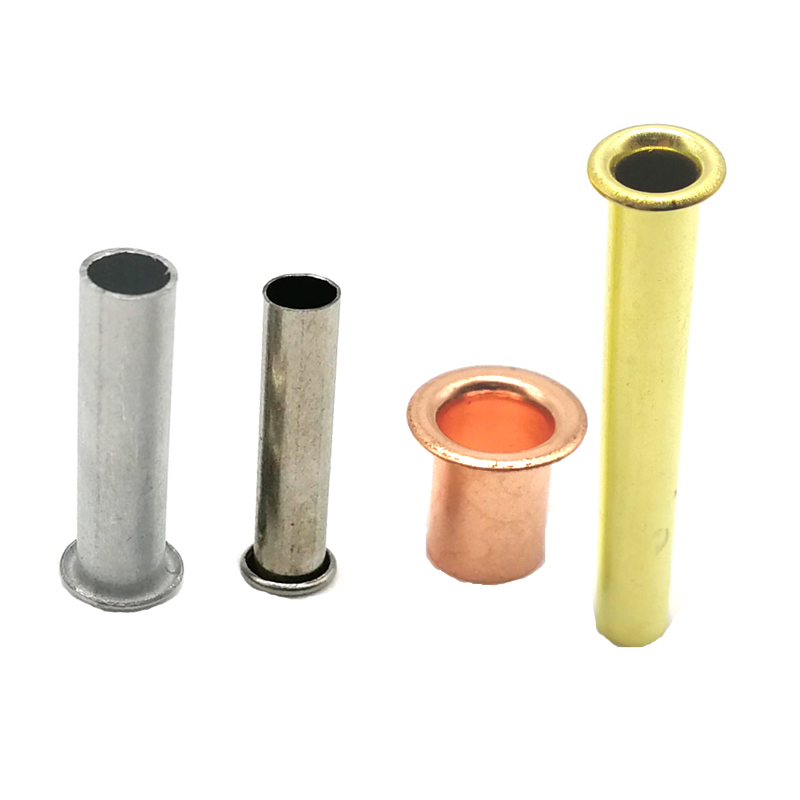
What Exactly Is a Tubular Rivet?
A tubular rivet is a mechanical fastener with a solid head and a shank that is partially or fully hollow. The hollow section reduces the amount of metal that must be deformed during installation. When a setting tool applies axial pressure, the hollow end curls or flares outward, forming a second head—often called a clinch—that clamps the materials together.
This is the critical difference from a solid rivet. A solid rivet has no hollow section and must be deformed entirely by force. A tubular rivet, by contrast, requires significantly less force because only the thin wall of the hollow section needs to roll.
The term "tubular rivet" is often used interchangeably with semi-tubular rivet, though there is a technical distinction. A semi-tubular rivet has a hollow depth that does not exceed 112% of the shank diameter. A full tubular rivet is hollow throughout the entire shank. Both fall under the tubular rivet family, and both offer the same core advantage: lower setting force.
The Numbers That Explain the Shift
The data tells a clear story. The global base metal tubular rivet market is projected to grow from approximately USD 2.13 billion in 2025 to USD 3.8 billion by 2035, at a compound annual growth rate of around 6%.
At Nuote Metals, we have observed this trend first-hand. Orders for tubular rivets have increased steadily over the past two years, with particular strength in three segments:
Electronics assembly – they provide secure fastening without risking damage to circuit boards or delicate housings
Furniture manufacturing – clean appearance and strong joints at high speed
Automotive interiors – lightweight, corrosion-resistant, and vibration-proof
The common thread across these industries is the same: manufacturers need fast, reliable, cost-effective permanent joints. they deliver exactly that.
Three Advantages That Make them Stand Out
Lower Setting Force, Faster Assembly
A tubular rivet requires only a fraction of the force needed for a solid rivet of the same diameter. The hollow shank rolls outward under pressure rather than requiring the entire shank to be displaced. This means lighter tools, less operator fatigue, and faster cycle times on automated lines.
For high-volume production, the difference is substantial. Tubular rivets can be installed at rates of 200 to 300 pieces per minute on automated equipment. Solid rivets, by comparison, are slower and require more powerful presses.
Permanent Joints That Do Not Loosen
Unlike screws or bolts, tubular rivets create permanent joints. There are no threads to back out under vibration. Once set, the rivet remains locked in place for the life of the assembly. This makes them particularly valuable in applications subject to constant movement or vibration, such as automotive components, luggage, and mechanical linkages.
Pivot Capability
They can be used as pivot points because the swelling of the rivet is confined to the tail. Solid rivets expand radially and generally fill the hole, limiting movement. they by contrast, can be set to a loose fit when movement is required. This makes them ideal for hinges, folding mechanisms, and rotating assemblies.
Material Options – Matching the Rivet to the Application
At Nuote Metals, we manufacture them in five material families. Each offers distinct properties for different environments.
| Material | Key Properties | Best For |
|---|---|---|
| Brass (C2680) | Good corrosion resistance, decorative gold finish, 28% IACS conductivity | Electrical terminals, leather goods, visible applications |
| Stainless Steel (304/316) | Excellent corrosion resistance, high strength, non-magnetic | Marine, medical, outdoor, food processing |
| Copper (C1100) | Highest conductivity (100% IACS), soft, forms protective patina | Busbars, grounding, heat sinks, roofing |
| Aluminum (5052/5056) | Lightweight (one-third of steel), good corrosion resistance | Aerospace, electronics, EV components, lightweight structures |
| Steel (low carbon) | High strength, cost-effective, needs plating | General industrial, hidden assemblies, cost-sensitive applications |
Two Applications from Our Factory Records
Consumer Electronics Enclosure
A laptop manufacturer needed a non-magnetic fastener for joining thin aluminum housing panels. The material was only 0.8 mm thick, and solid rivets were causing deformation around the hole. We supplied 5056 aluminum tubular rivets with a 3 mm shank and clear anodized finish.
The tubular design set with very low force, preventing distortion of the thin housing. The anodized finish matched the existing aluminum components. Weight added per device: less than 2 grams. Over one million units, the customer saved over 1.5 metric tons of fastener weight compared to steel alternatives.
Leather Bag Hardware
A European bag maker was using steel semi-tubular rivets on vegetable-tanned leather. The setting force from the steel rivets often cracked the leather around the hole, creating a rejection rate of approximately 2%. We supplied C2680 brass tubular rivets with a polished and lacquered finish.
The lighter setting force eliminated cracking entirely. The brass finish matched the bag's gold hardware and resisted tarnishing from skin oils. The rejection rate dropped to below 0.1%. The manufacturer has since converted all leather goods lines to our rivets.
Technical Specifications – Our Factory Standards
At Nuote Metals, we manufacture them to the following specifications.
Dimensional Range
| Parameter | Range | Tolerance |
|---|---|---|
| Shank diameter | 0.8 mm – 10 mm | ±0.05 mm |
| Barrel length | 2 mm – 30 mm (customizable) | ±0.15 mm |
| Head diameter | 1.6 – 2.8 × shank diameter | ±0.10 mm |
| Hollow depth (semi-tubular) | 20–40% of shank length | ±5% |
Head Styles Available
- Flat head – low profile, flush surface
- Round head – classic domed profile
- Countersunk head – sits flush or below surface
Standard Finishes
- Natural (as-formed)
- Zinc plating – basic corrosion protection
- Nickel plating – bright finish, wear resistance
- Tin plating – solderable surface
- Silver plating – high conductivity
- Gold plating – premium decorative
- Lacquered – prevents tarnishing
- Antique – aged appearance
All finishes are RoHS compliant.
FAQ
Q1: What is the difference between tubular and solid rivets?
A: The difference is the hollow section. A tubular rivet has a partially or fully hollow shank, while a solid rivet is completely solid. The hollow section reduces the amount of metal that must be deformed during installation, meaning tubular rivets require significantly less setting force than solid rivets of the same diameter. they can also be used as pivot points because the swelling is confined to the tail, whereas solid rivets expand radially and fill the hole. However, solid rivets offer higher shear strength and are better suited for heavy-duty structural applications. For most lightweight to medium-duty assemblies, they provide an excellent balance of strength and installability.
Q2: What materials are available for tubular rivets from Nuote Metals?
A: At Nuote Metals, we manufacture them in five material families: brass (C2680), stainless steel (304 and 316), copper (C1100), aluminum (5052 and 5056), and low-carbon steel. Each material serves a different purpose. Brass offers good corrosion resistance and a decorative gold finish, making it ideal for leather goods and electrical terminals. Stainless steel provides excellent corrosion resistance for marine, medical, and outdoor applications. Copper delivers the highest electrical conductivity (100% IACS) for busbars and grounding. Aluminum is lightweight and corrosion-resistant, suitable for aerospace and electronics. Steel is the most cost-effective option for general industrial use. We can also customize finishes including zinc plating, nickel plating, tin plating, silver plating, and lacquered coatings.
Q3: How do I calculate the correct barrel length for a tubular rivet?
A: The correct barrel length depends on your total material stack thickness. For a standard tubular rivet, the barrel must extend completely through the material and have enough protruding length to form a proper roll. The general formula is: Barrel Length = Material Stack Thickness + 0.5 to 1.5 mm. The extra length forms the rolled curl. For softer materials (thin fabric, soft leather), use the lower end of the range (0.5–0.8 mm). For harder materials (thick leather, rigid plastic, multiple layers), use the higher end (1.0–1.5 mm). If the barrel is too short, the curl will be weak and the rivet may pull out. If too long, the curl will be oversized or may split. For applications requiring a back washer, add the washer thickness to the material stack before calculating. We recommend ordering free sample rivets in two or three adjacent lengths and testing them on your actual material with your setting tool.
Quality and Transparency
Nuote Metals operates under ISO 9001:2015 certification. Every batch of our component is traceable to the raw material certificate (heat number), production press log, and final inspection report. We perform 100% in-process inspection throughout production, not just spot checks.
Our Customer Policies
- Free samples – stocked sizes available; you pay only courier
- Custom tooling – ready in 10 days for non-standard diameters, lengths, or head styles
- MOQ – 20,000 pieces for standard sizes; lower for first orders
- Lead time – stock: 3–5 days; custom (including tooling): 15–25 days
- 8-hour technical response – inquiries answered within one business day
We have supplied tubular rivets to customers in over 70 countries.
Send Inquiry



X
We use cookies to offer you a better browsing experience, analyze site traffic and personalize content. By using this site, you agree to our use of cookies.
Privacy Policy