
What Exactly Are Male and Female Rivets?
In the world of fasteners, most rivets are simple: a single piece you insert and deform. But for some specialized jobs, you need a two-part system. This is where male and female rivets come in. They are also commonly called post-and-cap rivets or double-cap rivets.
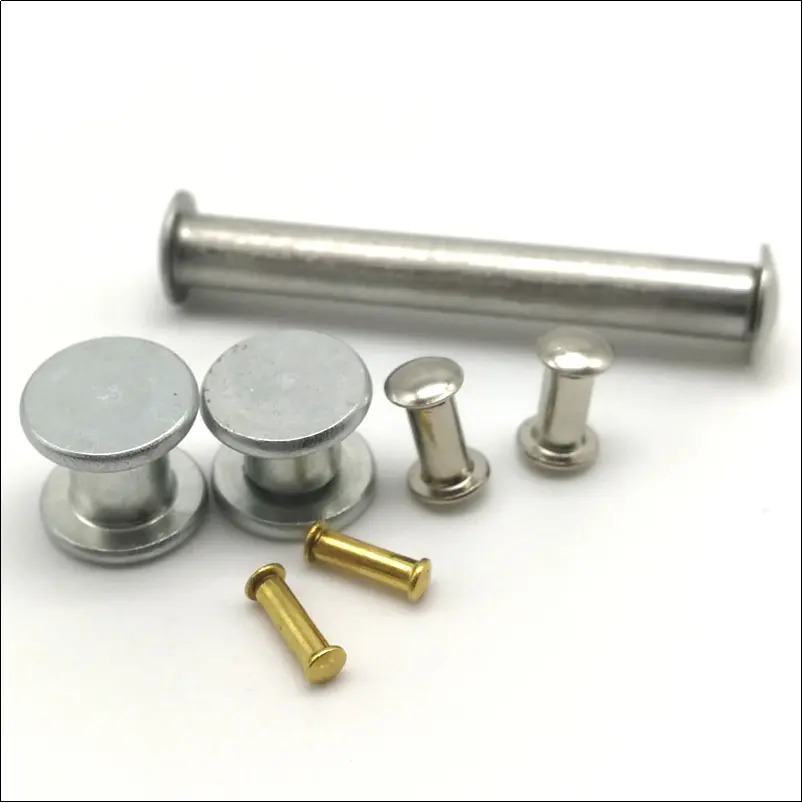
Think of it like a button and buttonhole, but made of metal. The "male" part is the post—a solid pin with a pre-formed head. The "female" part is a hollow sleeve or cap. You insert the male post through the materials you're joining, then slide the female cap over the protruding end. Using a simple press or a hammer, you swage (squeeze) the female cap onto the post. This action flares the cap's end, locking the two pieces together and clamping your materials securely in between.
So why use this two-piece system instead of a standard solid rivetor pop rivet? It offers a unique advantage: a completely finished look on both sides. Both the male head and the female cap present smooth, factory-formed domed or flat heads. This makes them perfect for applications where both sides of the joint will be visible and need a clean, uniform appearance—like on nameplates, leather belts, luggage, or high-end decorative panels. They provide a robust, permanent, and aesthetically pleasing clinch.
A Two-Part Harmony on the Production Line
My name is Anya, and I oversee the assembly and packaging for our specialty rivet lines. The male and female rivets require a different kind of attention. We don't just make one part; we have to produce and perfectly match two separate components that become one unit for the customer.
On the production floor, the male posts and female caps are often made on separate, dedicated machines. The male posts are cold-headed to create their heads and shanks. The female caps are drawn from metal cups into their precise hollow shape. The critical thing is consistency. The diameter of the male post and the inner diameter of the female cap must have a precise interference fit—tight enough to swage securely, but not so tight that assembly is impossible.
My team's job is kit-making. We take bins of male posts and bins of female caps, and we package them together in the correct ratios for the customer's order. Before boxing, we do frequent test fits. We'll randomly sample a handful of posts and caps from the batch and assemble them in a small press. We check for a smooth fit and a clean, secure swage. If the cap splits or fits too loosely, we know there's a dimensional issue in one of the production runs.
Compared to setting a standard pop rivet, installing male and female rivets is a slightly slower, two-handed process. But the result is unmatched for a clean, double-sided finish. We recently supplied a large batch to a company manufacturing professional musical instrument cases. They needed these rivets for the heavy-duty handle attachments. The male and female rivets provided a strong mechanical hold that could withstand the weight, while the finished caps looked seamless and professional on both the inside and outside of the expensive case lining.
In a nutshell, while most rivets are about hidden strength, male female rivets are about combining that strength with visible, finished quality on both ends. They solve a specific aesthetic problem that other rivets can't.
Send Inquiry



X
We use cookies to offer you a better browsing experience, analyze site traffic and personalize content. By using this site, you agree to our use of cookies.
Privacy Policy