
Why Do We at Nuote Metals Recommend Copper Rivets for Current, Heat, and Lasting Beauty?
Walk into any substation, lift the hood of an old electric locomotive, or examine a century‑old copper roof. Chances are, you will find copper rivets holding critical parts together. We have supplied these fasteners to power equipment makers, heritage restorers, and leather workshops alike. Over the years, we have learned exactly where copper rivets shine – and where they do not. Here is our honest, experience‑based guide.
The Three Copper Rivet Types We Manufacture (And When to Use Each)
Many buyers ask us: “What is the difference?” The table below sums up our product range.
| Type | Hollow Depth | Setting Force (vs. solid copper) | Our Recommendation For |
|---|---|---|---|
| Solid | None | Baseline | Heavy busbars, structural grounding, historic shipbuilding |
| Semi‑Tubular | 20–40% of shank | 30–40% less | Electrical terminals, heat sinks, general industrial assembly |
| Tubular | 100% of shank | 50–60% less | Leather belts, lightweight decorative joints, soft materials |
Our rule of thumb: If you need maximum current‑carrying cross‑section, go solid. For 80% of production jobs, semi‑tubular is the best balance. For handcrafted goods, tubular is the classic choice.
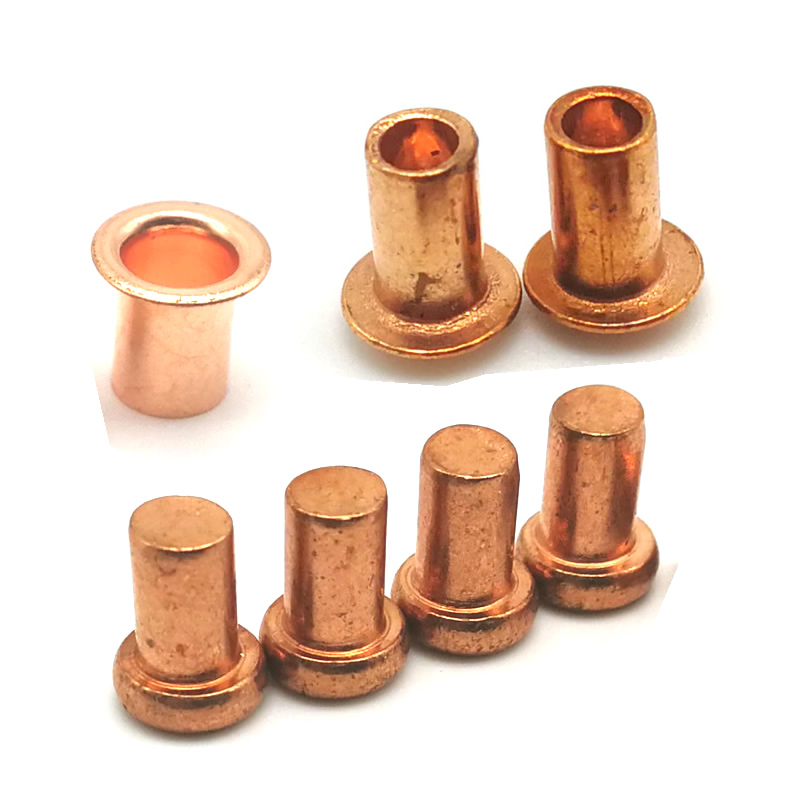
What Makes Copper Rivets Different – From Our Production Floor
We run cold‑heading machines for steel, stainless, brass, and copper every day. Copper behaves differently, and those differences become advantages in the right applications.
Three Properties That Matter to Our Customers
Conductivity: Copper rivets (C11000) give you 100% IACS. Aluminium gives 61%, brass 28%, stainless under 3%. When the joint must carry current, nothing else comes close.
Thermal transfer: 401 W/m·K – copper rivets actually help move heat away from the joint. We have seen this solve overheating problems in power modules.
Natural patina: Unlike plated steel that rusts or stainless that stays cold grey, copper ages from bright red to brown to a distinctive green. Architects and heritage specialists choose copper for this reason.
One Practical Benefit We See Every Day
Copper is soft. That means lower setting forces, less wear on your presses, and fewer rejected parts. A solid copper rivet needs about half the pressure of a steel rivet of the same diameter. Your production team will notice the difference.
Our Copper Alloy Guide – Which Grade Should You Specify?
Not all copper is the same. We stock four grades because each solves a different problem.
| Grade (UNS) | Conductivity (% IACS) | Best Application | Why We Recommend It |
|---|---|---|---|
| C11000 (ETP) | 100% | General electrical terminals, busbars, grounding | Highest conductivity, cost‑effective |
| C10200 (Oxygen‑Free) | 99.9% | High‑vacuum gear, cryogenic assemblies | No hydrogen embrittlement; weldable |
| C12200 (DHP) | 85–90% | Plumbing, roofing, water contact | Better corrosion resistance in wet conditions |
| C14500 (Tellurium) | 90–95% | Rivets needing secondary machining | Free‑machining; easy to drill or tap |
Our advice for most buyers: Start with C11000 semi‑tubular copper rivets. If your joint will touch water regularly (roofing, pipes), switch to C12200. For everything else, we will help you decide.
Where Our Customers Use Copper Rivets (Real Examples)
We have shipped copper rivets to five continents. Here are the most common applications.
Electrical Power Equipment
Busbar connections – Solid copper rivets create permanent, high‑current joints that never loosen.
Transformer terminals – Semi‑tubular copper rivets speed up assembly while maintaining full conductivity.
Lightning protection systems – Copper rivets resist underground and rooftop corrosion.
Thermal Management
Heat sink assemblies – Semi‑tubular copper rivets attach fins to bases. The rivet itself becomes part of the cooling path.
Radiator cores – Tubular copper rivets join thin fins without crushing them.
Architecture & Heritage
Copper roofing – Solid copper rivets match the panel material and develop matching patina over time.
Historic ship and train restoration – Copper rivets replace original fasteners exactly.
Leather & Craft (Smaller Volume, But Steady Demand)
Belts, harnesses, saddles – Tubular copper rivets are easy to set by hand with a hammer and anvil.
Denim workwear – Those classic copper rivets on jeans? They are tubular copper rivets, and we still make them.
Copper vs. Brass vs. Stainless – A Quick Comparison From Our Lab
We produce all three, so we have no favourite. Here is how they compare side by side.
| Property | Copper (C11000) | Brass (C26000) | Stainless 304 |
|---|---|---|---|
| Electrical conductivity | 100% IACS | 28% IACS | <3% IACS |
| Thermal conductivity (W/m·K) | 401 | 120 | 16 |
| Corrosion in saltwater | Good (patina forms) | Moderate (dezincification) | Excellent (316 even better) |
| Setting force required | Low | Low | High |
| Appearance over time | Red → brown → green | Gold → dark brown | Silver‑grey (unchanged) |
| Typical cost | Medium | Medium | High |
Our simple rule: Current or heat = copper. Salt spray = stainless steel. Decorative gold = brass. Tell us your environment, and we will confirm the choice.
Our Installation Tips – Learned From Decades of Customer Support
We do not just sell rivets. We help customers set them correctly. Here is what we have learned about copper.
Hole Preparation
Drill or punch the hole 0.05–0.10 mm larger than the rivet shank.
Deburr both sides. A sharp burr will cut into soft copper during roll formation – we have seen cracked tails from this simple oversight.
Setting Pressure
Use 30–40% lower pressure than you would for a steel rivet of the same diameter.
If you are using a pneumatic press, start low and increase gradually until the roll forms fully. Copper does not need brute force.
Tooling
Polished, hardened steel anvils and punches only. Rough or dirty tooling leaves marks on the visible surface.
Replace tooling slightly more often than for steel – copper is a bit “stickier”.
Common Mistakes We Have Helped Customers Fix
| Mistake | Consequence | Our Fix |
|---|---|---|
| Too much pressure | Flattened, mushroomed head | Reduce force by 30% |
| Burred hole | Split shank or cracked roll | Deburr thoroughly |
| Dirty tooling | Surface marks on visible rivets | Clean anvils with alcohol |
| Wrong grade for water contact | Corrosion around C11000 rivets in plumbing | Switch to C12200 |
We include a one‑page setting guide with every sample order. Just ask.
【copper rivets】FAQ – Answers to the Three Questions We Hear Most
Q1: Can I use your copper rivets outdoors? Will they turn green?
A: Yes, and yes – that green colour is a feature, not a failure. Copper rivets are naturally weather‑resistant. When exposed to air and moisture, they first form a brown oxide layer, then over several years a stable green patina (basic copper carbonate). This patina is non‑porous and stops further corrosion. We have supplied copper rivets for church roofs that are still sound after 80 years. If you want to keep the bright copper look, we can supply lacquered copper rivets – but the lacquer will eventually wear off outdoors. Our advice: embrace the patina. For plumbing applications with aggressive water (low pH or high chlorides), use our C12200 copper rivets instead of C11000. They are formulated for better water resistance.
Q2: What happens if I use copper rivets with aluminium? How do I avoid galvanic corrosion?
A: Direct copper‑aluminium contact in a moist environment creates a galvanic cell, and the aluminium will corrode. We have seen aluminium busbars fail within two years because someone used plain copper rivets. Here is how we help customers avoid this:
We supply tin‑plated copper rivets – the tin layer acts as a barrier metal compatible with both copper and aluminium.
We recommend applying an anti‑oxidant compound (Noalox or similar) to the joint interface.
We suggest sealing the joint edge with a flexible sealant to keep moisture out.
If plating or sealing is not possible, we advise using aluminium rivets for aluminium‑to‑aluminium joints. We manufacture those too. Tell our team the exact materials, and we will propose the safest solution.
Q3: How do I calculate the right length for a semi‑tubular copper rivet?
A: Because copper is softer and rolls more easily than steel, the formula is different. For semi‑tubular copper rivets, use: Rivet Length = Material Stack Thickness + (0.6 to 0.8) × Rivet Diameter. Example: joining two copper sheets with total thickness 2.5 mm using a 3.0 mm diameter semi‑tubular rivet. Length = 2.5 + (0.7 × 3.0) = 2.5 + 2.1 = 4.6 mm. Round up to the nearest standard length – usually 5.0 mm. For solid copper rivets, use the same formula as steel: stack thickness + 1.5 × diameter. For tubular copper rivets, use stack thickness + 0.5 to 0.8 mm (very little protrusion needed). We strongly recommend ordering sample rivets in two or three adjacent lengths and testing them on your actual material stack. Nuote Metals provides free sample kits exactly for this purpose – just ask.
Why Our Customers Trust Nuote Metals for Copper Rivets
We are not a trading company. We are a manufacturer. That means we control quality from raw copper rod to finished rivet.
One‑stop shop – Solid, semi‑tubular, and tubular copper rivets from the same production line.
Grades in stock – C11000, C10200, C12200, C14500. No waiting for special melts.
In‑house finishing – Tin plating, nickel plating, lacquering, antique patina, polishing.
ISO 9001:2015 certified – Full traceability on every batch.
Engineering support – We answer your technical questions before and after the sale.
And because we also manufacture stainless steel rivets, brass rivets, and aluminium rivets, we can advise you honestly when copper is the right choice – and when it is not.
Contact Nuote Metals – Let Us Help You With Your Copper Rivet Project
You now have the technical details. But every application has its own quirks. Tell us about your material stack, operating environment, and production volume. We will reply with a specific recommendation, datasheets, and free samples of the right copper rivets.
Contact Nuote Metals today:
🌐 Website: www.nuotemetal.com
📧 Email: info@notinmetal.com
📞 Phone: +86 13316629095
Let us get your copper rivet specification right – the first time.
Send Inquiry



X
We use cookies to offer you a better browsing experience, analyze site traffic and personalize content. By using this site, you agree to our use of cookies.
Privacy Policy