
Why Would You Choose Copper Hollow Rivets?
Walk into any hardware supplier and you'll find boxes of steel and aluminum hollow rivets. They're the everyday choice. But tucked on a shelf, you might spot a smaller box of copper hollow rivets. They cost more, so what's the point? They're for jobs where the common options fall short.
Copper does three things exceptionally well. First, it's the best conductor of heat and electricity among common rivet metals. Second, it's naturally antimicrobial—it resists bacteria and mold. Third, it develops that distinctive green patina over time, which some designs actually want. So you'll find copper hollow rivets in electrical grounding applications, in vintage-style leatherwork, in marine fittings, and even in some food-grade equipment where hygiene is critical.
Compare that to the others. Aluminum hollow rivets are light and cheap. Steel hollow rivets are strong. Stainless steel hollow rivets resist rust. But none of them combine top-tier conductivity with that natural antimicrobial property and classic aging look. Copper is the specialist.
A Different Kind of Run
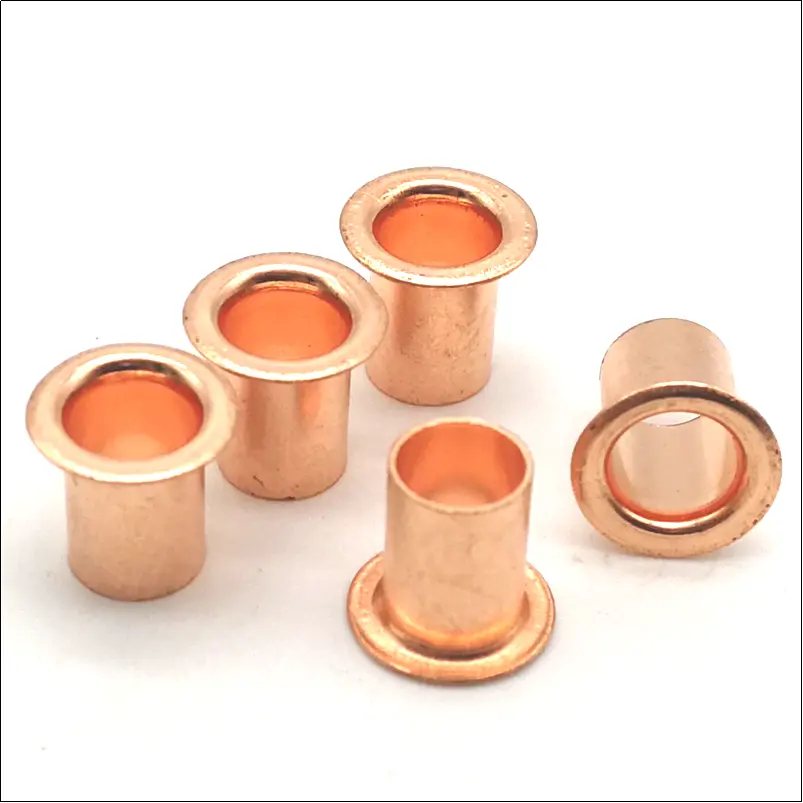
I'm on the set-up team for our specialty metals, and copper orders always make my day a little different. The copper wire has a deep, rosy color even before we start. When it feeds into the header to form the hollow rivets, the sound is different—softer, almost muted compared to the sharp crack of steel. The metal is so malleable; it flows like stiff butter under the die.
The challenge with copper hollow rivets isn't strength, it's finish. Copper marks if you look at it wrong. We run them with polished, mirror-finish dies to prevent scoring. After forming, they get a gentle tumble in a soft media, not to deburr them aggressively, but to bring out that warm, even luster. We handle them with cotton gloves from this point on.
The mandrel wire for these hollow rivets is also special—often steel with a copper wash, to have the tensile strength to pull and snap cleanly without galling the soft copper sleeve.
I remember a specific order for a shipyard. They needed copper hollow rivets for the interior joinery of a restored historic yacht. They weren't just fasteners; they were part of the authentic specification. The foreman told us, "They need to look right now, and they must not promote rot in the oak timbers fifty years from now." That stuck with me. It wasn't about the rivet's shear strength; it was about its entire character over a lifetime.
So, while you'd never use them to assemble a truck panel, copper hollow rivets have their vital, niche role. They remind you that in engineering and craftsmanship, sometimes the right material isn't the strongest or cheapest—it's the one that solves a very specific set of problems that nothing else can.
Send Inquiry



X
We use cookies to offer you a better browsing experience, analyze site traffic and personalize content. By using this site, you agree to our use of cookies.
Privacy Policy