
Why Do We at Nuote Metals Offer Hollow Rivets in Five Different Materials – and How to Choose?
A lightweight electronics enclosure requires a different fastener than a marine canvas cover or a brake lining. Hollow rivets – rivets with a hollow or partially hollow shank – reduce setting force and assembly time. But the material determines corrosion resistance, strength, conductivity, and cost. At Nuote Metals, we produce hollow rivets in brass, stainless steel, copper, aluminum, and steel. This guide compares them directly.
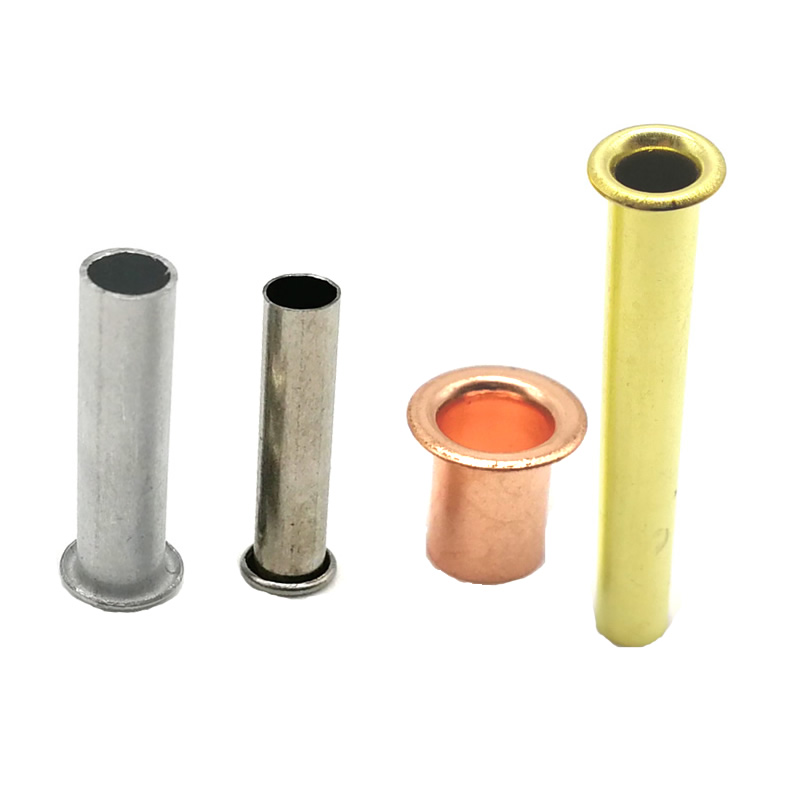
What Exactly Is a Hollow Rivet? (Our Definition)
A hollow rivet is a permanent fastener with a pre‑formed head and a shank that is either fully hollow (tubular) or partially hollow (semi‑tubular) from the tail end. During installation, the hollow portion rolls outward, forming a second head that clamps materials together. The hollow design reduces the metal volume that must be deformed, lowering setting force by 30–60% compared to a solid rivet of the same diameter.
At Nuote Metals, our hollow rivets cover both tubular (100% hollow) and semi‑tubular (20–40% hollow) types – across five material families.
Five Materials – One Comparison Table
The table below summarizes the key differences. Use it as your first filter.
| Material | Corrosion Resistance | Strength (Shear) | Conductivity | Best For |
|---|---|---|---|---|
| Brass | Good (dezincification risk in salt) | Medium | 28% IACS | Electrical terminals, leather goods, decorative |
| Stainless Steel | Excellent (316 marine grade) | High | Poor (<3% IACS) | Marine covers, medical, chemical, food |
| Copper | Good (patina forms) | Low‑Medium | 100% IACS | Busbars, heat sinks, grounding, roofing |
| Aluminum | Good (5056 marine grade) | Medium | 61% IACS | Aerospace, EV trays, boat decks, electronics |
| Steel (low carbon) | Poor (needs plating) | High | Low | General industrial, hidden assemblies, cost‑sensitive |
Each material is available in both semi‑tubular and full tubular configurations. Our engineering team can help you match the right material to your environment.
Detailed Material by Material – With Real Case Examples
Brass Hollow Rivets (C26000 / C23000)
Properties: 70/30 or 85/15 copper‑zinc. Good corrosion resistance in fresh water and mild atmospheres. Attractive gold colour. Conductivity ~28% IACS.
Real case: A leather goods maker in Italy needed a fastener for high‑end belts. They chose C26000 brass semi‑tubular hollow rivets with a polished and lacquered finish. The rivets match the brass buckles perfectly and resist tarnishing from skin oils. Three years – no complaints.
Best for: Electrical terminals, switchgear, leather belts, handbags, saddlery, marine hardware in fresh water.
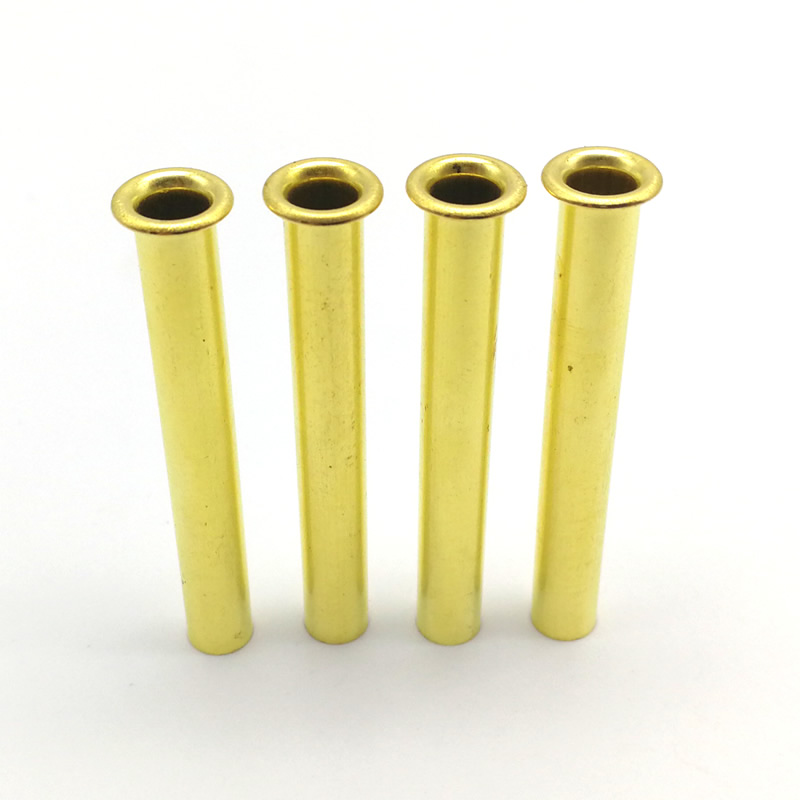
Stainless Steel Hollow Rivets (304 / 316)
Properties: Excellent corrosion resistance – 316 adds molybdenum for saltwater. High strength (500+ MPa tensile). Non‑magnetic when annealed. Poor electrical conductivity.
Real case: A boat cover manufacturer in Florida used brass hollow rivets – they tarnished and lost their roll strength after one season. We supplied 316 stainless steel spur hollow rivets with mating washers. The spurs bite into the canvas, and the 316 material resists salt spray indefinitely. Now standard for all their coastal products.
Best for: Marine covers, medical drapes, food processing belts, chemical plant tarpaulins, outdoor industrial curtains.
Copper Hollow Rivets (C11000 / C12200)
Properties: Highest electrical conductivity (100% IACS) and thermal conductivity (401 W/m·K). Soft, easy to set. Forms a protective green patina outdoors.
Real case: A power distribution company needed to join copper busbars in a substation. Bolted connections loosened over time due to thermal cycling. We supplied C11000 solid copper rivets (not hollow – but for busbars they needed solid). For lower‑current applications, copper hollow rivets are used in heat sinks. Another customer uses copper tubular hollow rivets to attach cooling fins to LED light housings – the rivet itself carries heat away from the LEDs.
Best for: Electrical busbars, grounding terminals, heat sinks, lightning protection, roofing, heritage restorations.
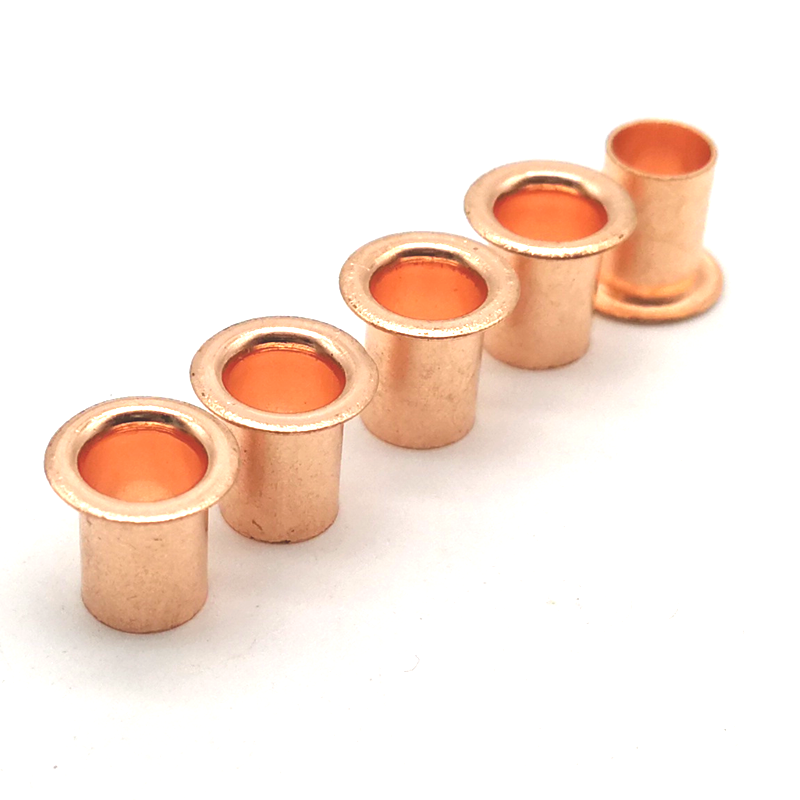
Aluminum Hollow Rivets (5056 / 6061)
Properties: One‑third the weight of steel. Good corrosion resistance (5056 excellent in saltwater). Conductivity ~61% IACS. Soft, easy to set.
Real case: An electric vehicle battery manufacturer needed to join aluminium enclosures – 12,000 fasteners per vehicle. Steel rivets added too much weight. We supplied 6061 aluminum semi‑tubular hollow rivets with a 4 mm shank. Semi‑tubular design reduced setting force by 35% for automated lines. Total weight saving: over 8 kg per vehicle.
Best for: Aerospace, EV battery trays, boat decks, electronics enclosures, lightweight structures.
Steel Hollow Rivets (Low Carbon C1008 / C1010)
Properties: Highest strength‑to‑cost ratio. Poor corrosion resistance – must be plated (zinc, nickel, or black oxide). Magnetic.
Real case: A furniture manufacturer needed a low‑cost fastener for folding chair mechanisms – not exposed to moisture. We supplied zinc‑plated steel semi‑tubular hollow rivets in 5 mm diameter. The rivets set quickly on a pneumatic press, and the zinc plating provides sufficient protection for indoor use. Cost per rivet: one‑third of stainless steel.
Best for: Indoor furniture, automotive interior parts (plated), appliances, toys, general industrial assemblies where weight is not critical.
Technical Specifications – Our Guaranteed Tolerances
We manufacture hollow rivets to the following standards. These numbers apply across all five materials.
Dimensional Tolerances
| Parameter | Range | Tolerance |
|---|---|---|
| Shank outside diameter | 1.6 mm – 10 mm | ±0.05 mm |
| Head diameter | 3 mm – 18 mm | ±0.10 mm |
| Total length (semi‑tubular) | 3 mm – 30 mm | ±0.15 mm |
| Barrel length (full tubular) | 2 mm – 15 mm | ±0.10 mm |
| Hollow depth (semi‑tubular) | 20–40% of shank | ±5% |
| Concentricity | ≤ 0.1 mm TIR | 100% visual |
For aerospace or medical precision, we can tighten shank diameter to ±0.02 mm.
Available Finishes by Material
| Material | Standard Finishes |
|---|---|
| Brass | Natural, lacquered, nickel‑plated, antique |
| Stainless | Mill, polished, passivated |
| Copper | Bright, lacquered, antique, tin‑plated |
| Aluminum | Mill, clear anodized, gold/black anodized, chromate |
| Steel | Zinc plated (clear/yellow/black), nickel plated, black oxide |
All finishes are RoHS compliant.
Quality Assurance and Transparent Policies
Certifications We Hold
ISO 9001:2015 – Full quality management system with batch traceability.
RoHS – All materials and finishes comply. Certificates available on request.
Our Inspection Process
Every batch of hollow rivets undergoes:
100% in‑process dimensional checks – every 500 pieces.
Hardness sampling – Rockwell or Brinell per material spec.
Plating thickness verification – X‑ray fluorescence for plated finishes.
Roll formation test – Sample setting on matching material stack.
Customer Policies (No Hidden Surprises)
Free samples – For stock sizes. Pay only express shipping.
Custom tooling within 10 days – Non‑standard head shapes, barrel lengths, or diameters.
100% pre‑shipment inspection – QC sign‑off on every carton.
MOQ 20,000 pieces – Lower volumes possible for sample runs.
Lead times – Stock: 3–5 days. Custom (including tooling): 15–25 days.
8‑hour technical response – Email or phone.
We have supplied hollow rivets to customers in over 70 countries.
Installation Overview – What Works for Each Material
| Material | Setting Force (relative to steel) | Tooling Advice |
|---|---|---|
| Brass | 30–40% less | Polished steel anvils; avoid marring visible surface |
| Stainless steel | 10–20% more | High‑carbon steel dies; lubricate to prevent galling |
| Copper | 40–50% less | Clean, smooth tooling; low force |
| Aluminum | 30–40% less | Single clean stroke; avoid multiple hits |
| Steel | Baseline | Standard hardened tooling |
Universal rule: Hole diameter = rivet shank + 0.05–0.10 mm. Deburr thoroughly.
【hollow rivets】FAQ – Three Questions We Answer Daily
Q1: What is the difference between a hollow rivet and a blind rivet (pop rivet)?
A: This confuses many buyers. A hollow rivet (tubular or semi‑tubular) requires access to both sides of the joint. You insert the rivet from one side and support the head with an anvil while a punch rolls the hollow tail from the other side. A blind rivet (pop rivet) is installed from one side only – a mandrel is pulled through the rivet body, expanding the blind side. Hollow rivets generally provide higher shear strength and a cleaner, flush finish on both sides. But they need two‑sided access. At Nuote Metals, we manufacture both types. If your assembly has open access to both sides, hollow rivets are faster and more economical in high volume. If one side is enclosed, choose blind rivets.
Q2: Which material for outdoor saltwater use – brass, stainless, or copper?
A: 316 stainless steel is the clear winner for continuous saltwater exposure. Brass (even C23000 red brass) can undergo dezincification over time – though red brass lasts much longer than yellow brass. Copper forms a protective patina and performs well in saltwater, but it is softer and less strong than stainless. Our ranking: 316 stainless > copper > red brass > 304 stainless > brass > steel. For a boat cover or dock hardware, specify 316 stainless steel spur hollow rivets with matching washers. For a historic ship restoration where appearance matters, copper hollow rivets are authentic and durable. For a coastal sign that is not immersed, red brass is acceptable.
Q3: How do I calculate the correct barrel length for a semi‑tubular hollow rivet?
A: The formula is: Barrel Length = Material Stack Thickness + (0.8 to 1.2) × Shank Diameter. Use the higher multiplier (1.2) for harder materials (steel, stainless) to ensure enough material for a strong roll. Use the lower multiplier (0.8) for soft materials (aluminum, copper, brass). Example: joining two steel sheets of total 3.0 mm thickness with a 4.0 mm diameter semi‑tubular rivet. Length = 3.0 + (1.0 × 4.0) = 7.0 mm. For full tubular hollow rivets, use a much shorter protrusion: Stack Thickness + 0.5 to 0.8 mm. Our advice: Order free sample rivets in two adjacent lengths and test them on your actual material stack. Nuote Metals can supply sample kits – just tell us your materials.
Why Our Customers Trust Nuote Metals for Hollow Rivets
We are a manufacturer, not a trader. Our factory in Dongguan, China, runs ISO 9001:2015‑certified processes with in‑house tooling and finishing.
Five materials – Brass, stainless, copper, aluminum, steel – all under one roof.
Two configurations – Semi‑tubular and full tubular.
In‑house tooling – Custom head styles or barrel lengths ready in 10 days.
In‑house finishing – Plating, anodizing, passivation, lacquering.
Full traceability – Every batch tracked from raw coil to shipment.
Free samples – Test before you commit.
We also manufacture solid rivets . So when a hollow rivet is not the right answer, we have alternatives.
Contact Nuote Metals for Your Hollow Rivets Requirements
From brass belt rivets to stainless marine eyelets to aluminium battery tray fasteners, hollow rivets save weight and reduce setting time. Tell us your material, stack thickness, environment, and production volume. We will reply with a specific alloy and type recommendation, technical datasheets, and free samples.
Contact Nuote Metals today:
🌐 Website: www.nuotemetal.com
📧 Email: info@notinmetal.com
📞 Phone: +86 13316629095
Let us help you choose the right hollow rivet – the first time.
Send Inquiry



X
We use cookies to offer you a better browsing experience, analyze site traffic and personalize content. By using this site, you agree to our use of cookies.
Privacy Policy