
Why Would You Use Copper Rivets?
Most rivets are steel or aluminum. They're strong, cheap, and do the job. But sometimes, you need something different. That's where copper rivets come in. They're not the strongest, and they're not the cheapest. So why use them? For three reasons: they look classic, they conduct electricity and heat better than almost anything, and they're naturally antimicrobial. You'll find them in old-school leatherwork, electrical grounding straps, marine fittings, and even in some brewery equipment. They're the specialist's choice.
They come in all the standard types. You can get solid copper rivets, which are tough and used where you need a lot of strength in the joint, like in heavy canvas or copper roofing. There are semi-tubular copper rivets , which are faster to set and great for leather goods or lighter assemblies. And there are full tubular copper rivets which act like bushings or pivots. The head styles vary too—round head, flat head, countersunk—depending on whether you want the rivet to show or sit flush.
Forging the Red Metal: A Cold Header's Take
I'm Samir, and I run the cold heading line for non-ferrous metals. Making copper rivets is a different feel from steel or aluminum.
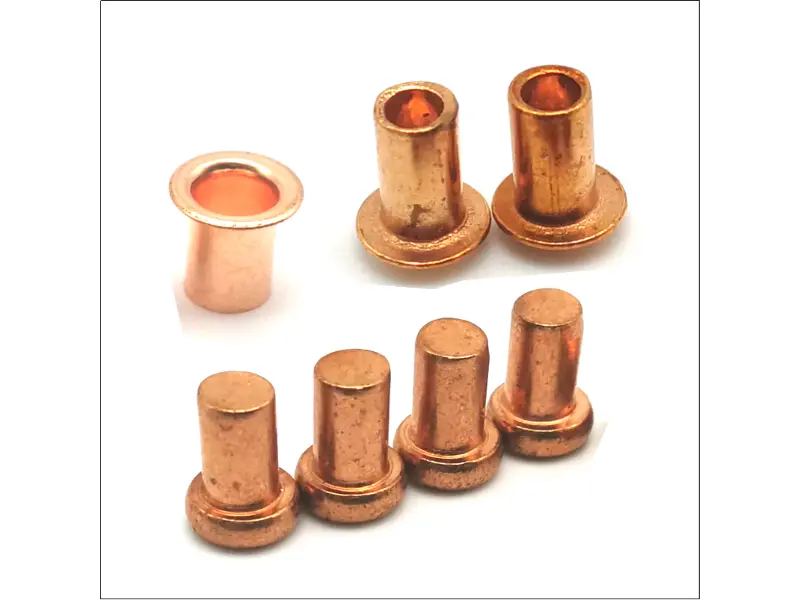
The copper wire coil itself is a deep reddish color. When it feeds into the header, the first thing you notice is how soft it is. The machine doesn't work as hard. The sound is different—a softer, duller thud compared to the sharp crack of steel. Copper flows like stiff putty under the die. This makes it easier to form complex head shapes without stressing the tools.
But that softness is also the challenge. Copper marks incredibly easily. If there's a tiny scratch or bit of grit on the die, it will imprint on every single rivet head. We polish our copper dies to a mirror finish and clean them constantly. You also have to be careful with the force. Too much, and the copper can deform in ways you don't want; too little, and the head isn't fully formed.
We make all kinds: solid copper rivets that get their heads forged in one or two blows, and semi-tubular ones where a punch pierces a shallow hole in the end. For solid ones, the grain of the metal follows the shape, making them very tough. For semi-tubular, getting the depth of the hole just right is key—too deep and it's weak, too shallow and it won't set properly.
After heading, they go to the thread-rolling station if they're screw rivets, or straight to cleaning. We often tumble them to bring out that warm, shiny finish that customers expect. You can't leave copper looking dull.
The best part of the job is seeing where they end up. Last month, we made a batch of large, round head solid copper rivets for a shipyard restoring a classic wooden schooner. They weren't just fasteners; they were part of the boat's authentic character. That's the thing with copper—you're often buying more than just a part. You're buying a look, a property, a bit of tradition. And making them means respecting that.
Send Inquiry



X
We use cookies to offer you a better browsing experience, analyze site traffic and personalize content. By using this site, you agree to our use of cookies.
Privacy Policy