
Products
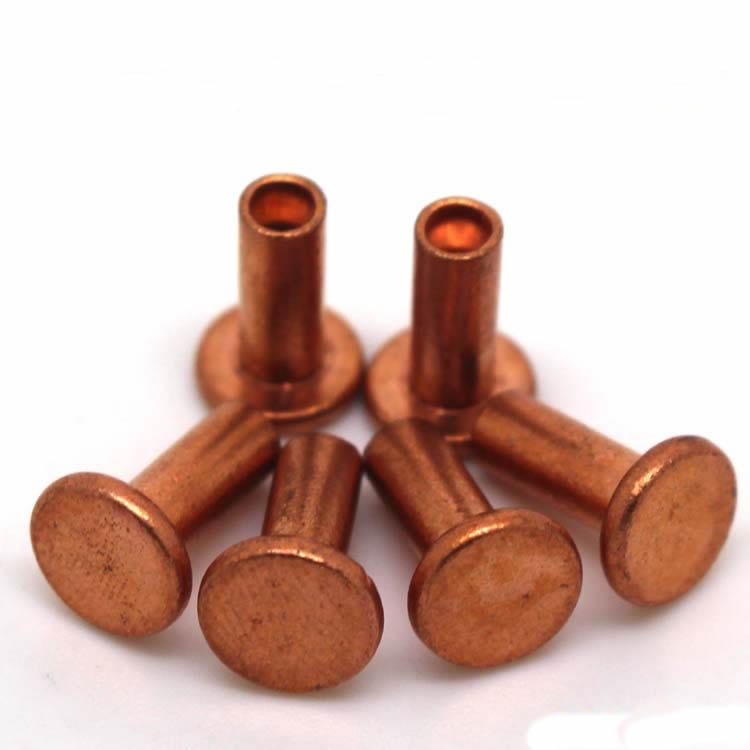
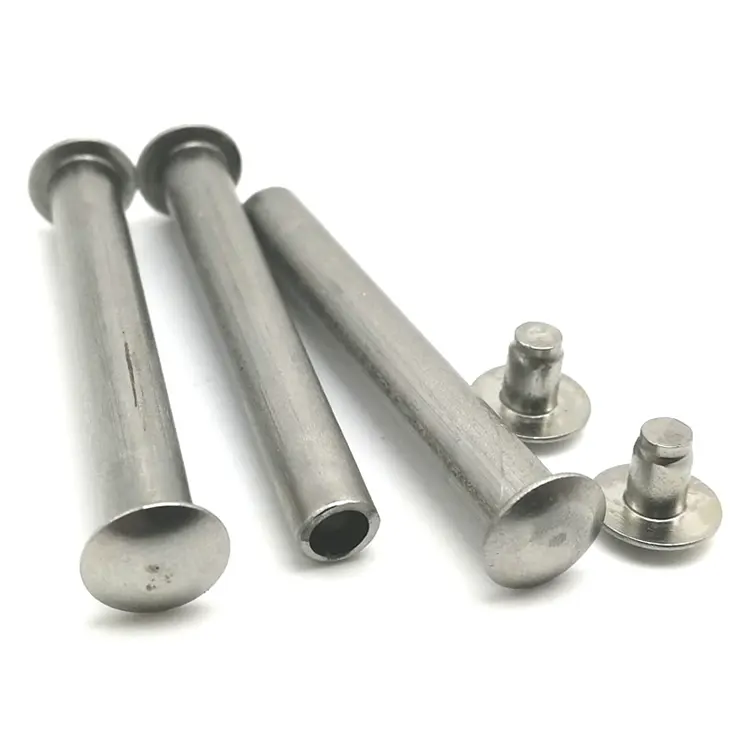
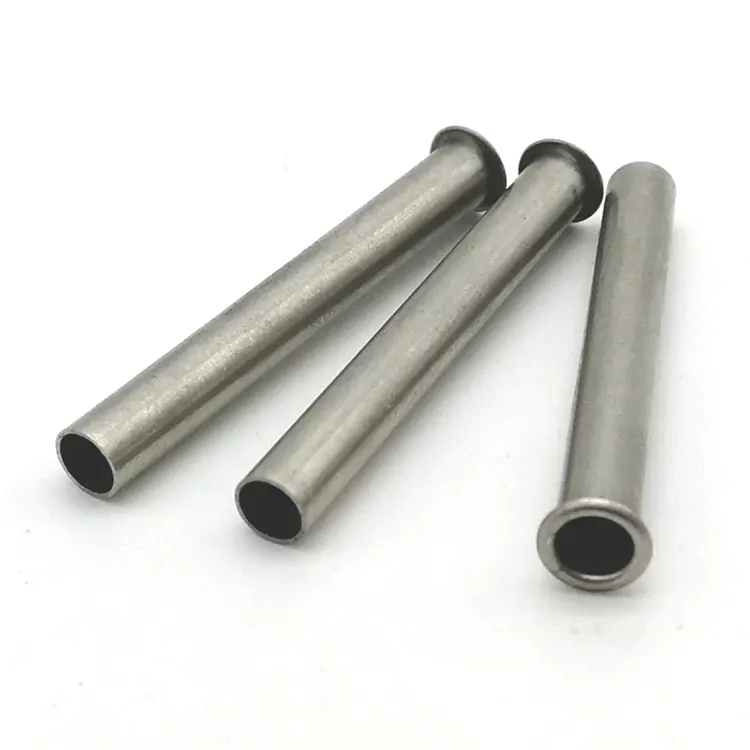
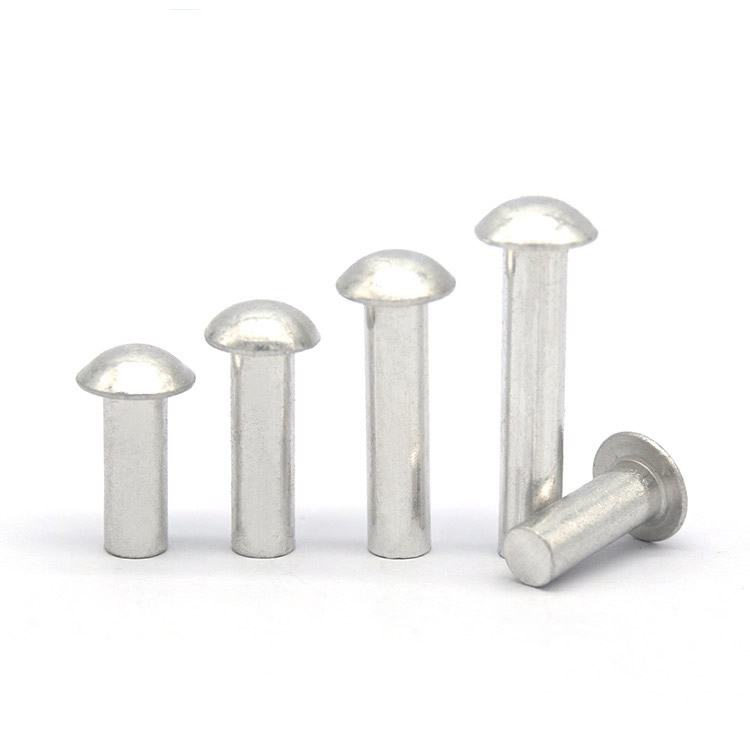
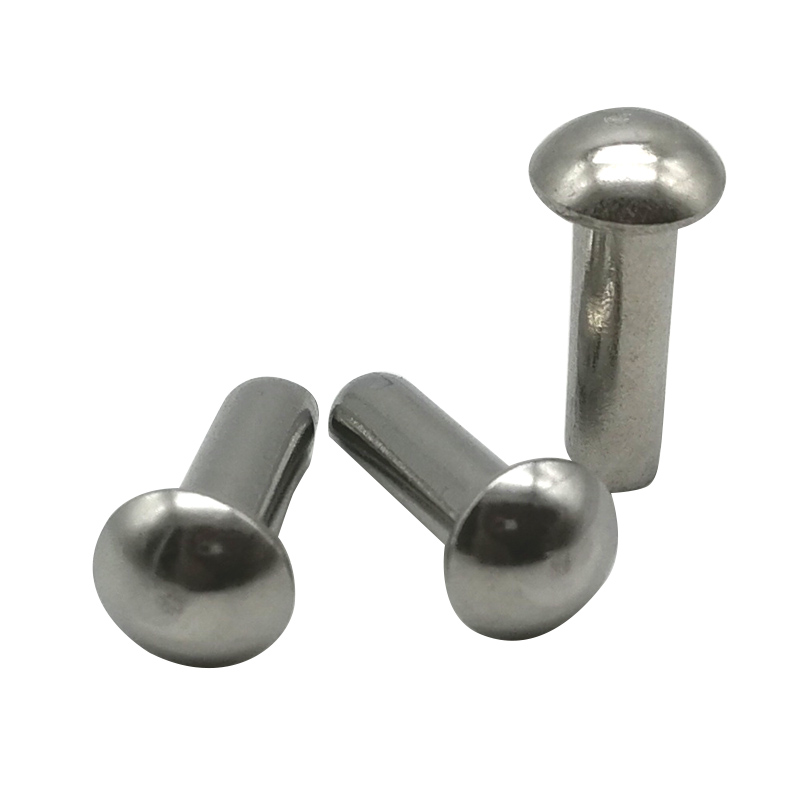
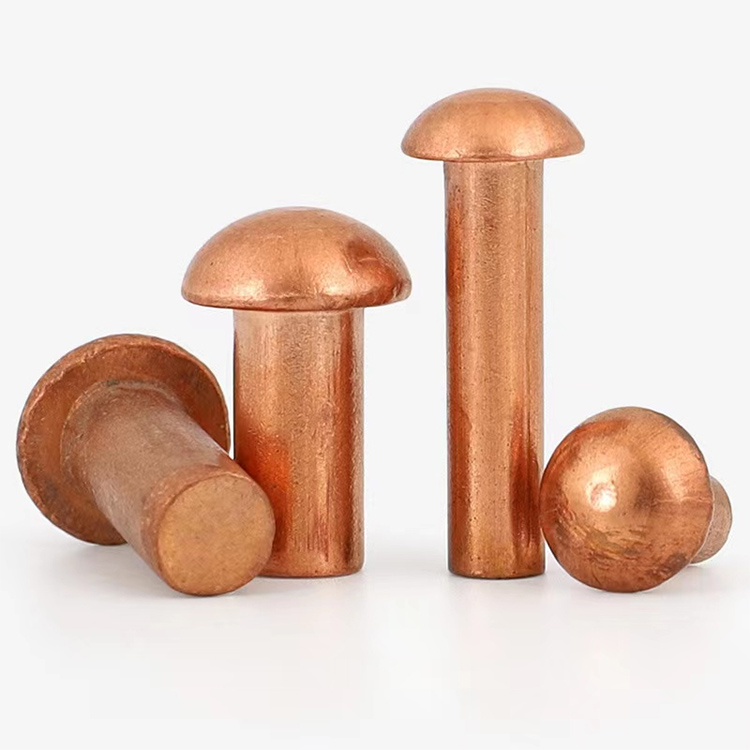
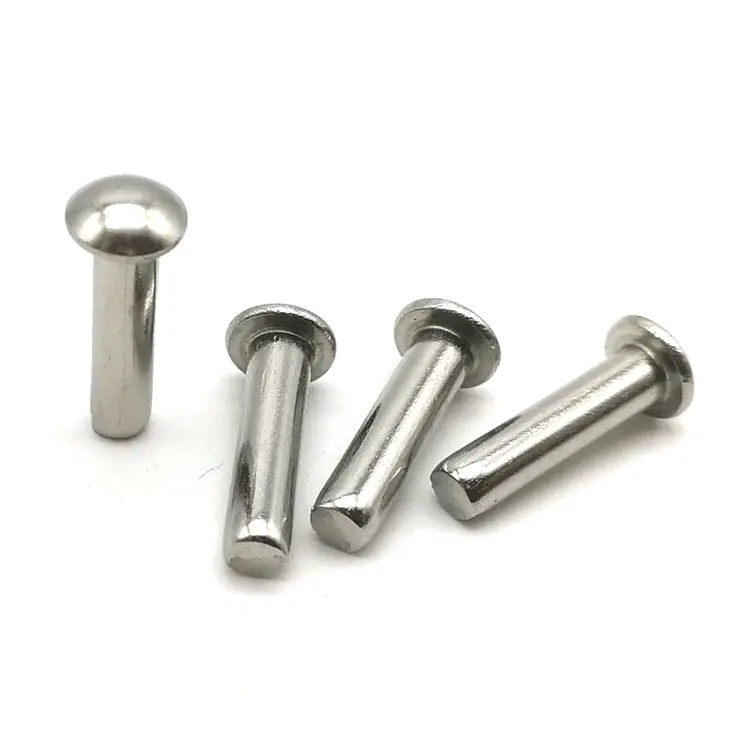
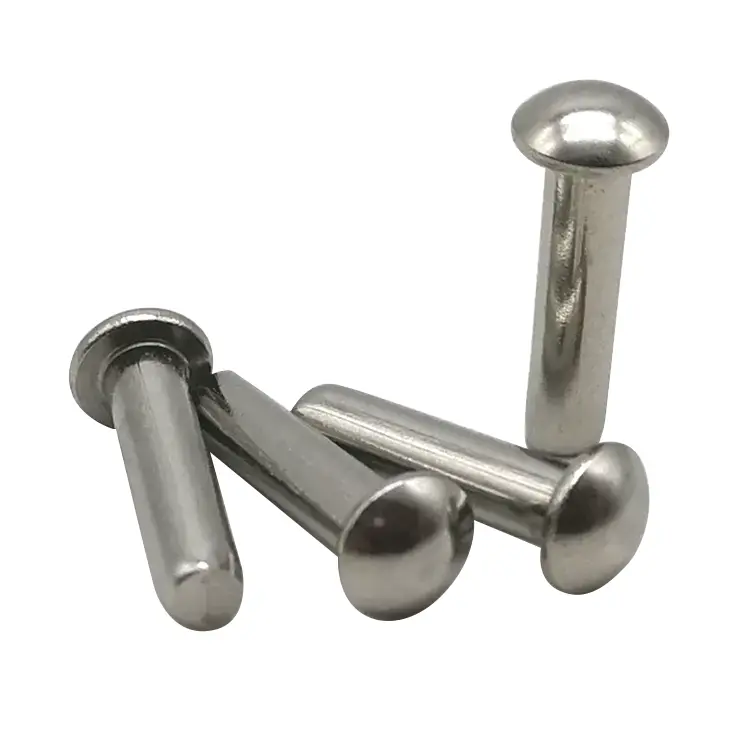
Aluminum Solid Rivets
Aluminum solid rivets from Nuote Metals – permanent, maximum‑strength fastening at one‑third the weight of steel. Available in 1100 pure aluminum and 5052/5056 alloys, 1.5–8.0mm shank diameters, six head styles. ISO 9001 certified. Free samples available. Contact us today.
Send Inquiry
Product Description
We make aluminum solid rivets for engineers who need the permanence of a solid rivet but cannot afford the weight penalty of steel. At roughly one‑third the weight of steel, they deliver the same holding power – full shank deformation, maximum shear and tensile strength – with a material that is naturally corrosion‑resistant and non‑magnetic.
When your assembly must be light, permanent, and strong – aerospace structures, automotive lightweighting, marine hardware, or portable equipment – aluminum solid rivets are the engineered answer.
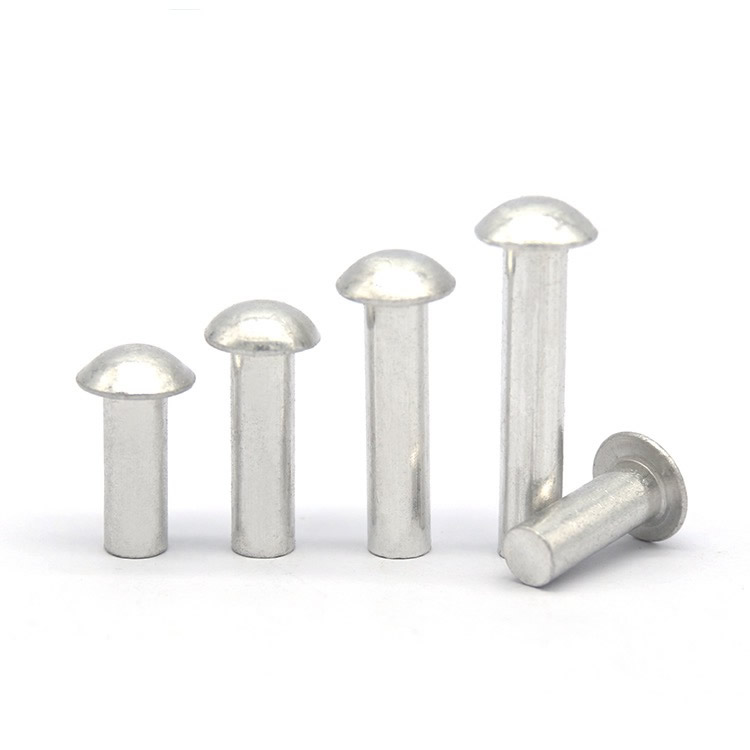
Aluminum Solid vs. Steel Solid vs. Semi‑Tubular – Where Aluminum Wins
| Feature | Aluminum Solid Rivet | Steel Solid Rivet | Aluminum Semi‑Tubular Rivet |
|---|---|---|---|
| Weight (5mm) | 0.6g | 1.8g | 0.6g |
| Strength | Maximum (100%) | Maximum (100%) | 80–90% of solid |
| Setting force | 100% | 100% | 25–30% of solid |
| Corrosion resistance | Excellent (natural oxide) | Depends on finish | Excellent |
| Magnetic | Non‑magnetic | Magnetic | Non‑magnetic |
| Best for | Lightweight structural, load‑bearing, permanent | Heavy‑duty structural, cost‑sensitive | High‑volume, weight‑sensitive, moderate load |
Choose aluminum solid when:
- You need maximum shear and tensile strength
- The joint must be permanent – no loosening over time
- Weight reduction is critical
- The assembly is exposed to moisture or outdoor conditions
Materials & Head Styles – What We Offer
Alloy Options
| Alloy | Tensile Strength | Corrosion Resistance | Key Characteristics | Best For |
|---|---|---|---|---|
| 1100 (Pure Aluminum) | 90 – 130 MPa | Excellent | Highest ductility, excellent formability, softest | Non‑structural, decorative, low‑load applications |
| 5052 | 220 – 280 MPa | Good | Good strength, excellent corrosion resistance | General purpose, moderate load |
| 5056 | 280 – 350 MPa | Excellent (marine‑grade) | Highest strength, superior corrosion resistance | High‑strength, marine, outdoor, structural |
1100 Pure Aluminum – The softest and most ductile of the aluminum alloys. Offers excellent corrosion resistance and formability. Choose this for non‑structural applications, decorative trim, and assemblies where the rivet must be easy to set with minimal force.
5052 – The workhorse alloy. Good strength, excellent corrosion resistance, widely available. Choose this for most general‑purpose applications where weight and corrosion resistance matter but loads are moderate.
5056 – The high‑strength option. Higher magnesium content delivers increased tensile strength and superior corrosion resistance. Choose this for marine environments, high‑stress assemblies, and structural applications where every bit of strength counts.
Head Styles Available
| Head Style | Head Diameter / Shank Ratio | Profile | Best For |
|---|---|---|---|
| Round | 1.6 – 1.8 : 1 | Tall dome | Visible joints, maximum head strength, traditional appearance |
| Flat | 2.0 – 2.5 : 1 | Low, flat top | Clearance‑limited, sliding surfaces |
| Oval | 1.8 – 2.0 : 1 | Smooth, slightly raised | Decorative, smooth appearance |
| Countersunk | 1.8 – 2.0 : 1 | Tapered, flush fit | Flush surfaces, zero protrusion |
| Truss | 2.2 – 2.8 : 1 | Extra‑wide, low dome | Soft materials, oversized holes, wide bearing surface |
| Mushroom | 2.2 – 2.5 : 1 | Wide, low, smooth radius | Leather, fabric, soft materials, skin‑contact applications |
Surface Finishes
Aluminum naturally forms a protective oxide layer. For enhanced protection, we offer:
- Plain (as‑formed) – Natural oxide layer, sufficient for most indoor applications
- Clear anodized – Thickened oxide layer, enhanced corrosion protection
- Color anodized – Available in multiple colors for identification or aesthetics
One Real Application – Drone Motor Mount Assembly
An industrial drone manufacturer needed a permanent, high‑strength fastener for motor mounts. The motor mounts carried significant dynamic loads during flight – vibration, torque, and impact forces. The original steel solid rivets provided the strength but added nearly 180g to each drone, reducing flight time.
The customer needed the same permanent holding power but could not afford the weight penalty. Semi‑tubular aluminum rivets were considered, but the shear strength was insufficient for the motor mount application.
We supplied 5056 aluminum aluminum solid rivets – 4.0mm shank, 7.0mm round head, 14.0mm overall length, clear anodized finish. The solid construction delivered maximum shear and tensile strength – matching steel solid rivet performance. The 5056 alloy provided marine‑grade corrosion resistance for outdoor drone operations. The weight saving per drone was 120g – extending flight time by approximately 1.5 minutes.
The customer tested 1,000 rivets across 200 drones. After 500 flight hours and vibration testing, zero loosening, zero failures. They now order our rivets in batches of 150,000 pieces annually.
How Rivets Are Specified – What We Need From You
They are custom‑produced to your exact requirements.
The dimensions we need:
- Shank diameter – 1.5mm to 8.0mm
- Overall length – from the underside of the head to the end of the shank. We calculate this from your material stack thickness.
- Head style – round, flat, oval, countersunk, truss, or mushroom
- Head diameter – matched to your bearing surface requirement
The choices you make:
- Alloy – 1100, 5052, or 5056
- Finish – plain, clear anodized, or color anodized
Selecting the correct overall length for solid rivets:
For solid rivets, the overall length must leave 1.2–1.5 times the shank diameter protruding past your material stack after insertion. This protruding material forms the second head during setting.
Example: If you are joining two 2mm sheets (total 4mm) with a 5mm shank, you need 1.2 × 5mm = 6mm of shank protruding. Total length = 4mm (stack) + 6mm (protrusion) = 10mm.
If you are not sure about length: Send us your material stack thickness. We will calculate the exact length. We do not charge for engineering advice.
Sample lead time: 5–10 days for standard specifications. Custom tooling: 15–20 days.
From Raw Material to Finished Rivet – Our Production Workflow
Aluminum solid rivets are formed through cold heading – a process that shapes metal at room temperature using high‑speed presses and precision dies. Aluminum is the most forgiving material for cold heading, allowing us to achieve consistent results across all diameters and alloys.
Material Procurement – We purchase certified aluminum wire (1100, 5052, or 5056) from approved mills. Each coil comes with a mill test certificate and heat number for full traceability.
Incoming Material Inspection – Every coil is checked for diameter (laser micrometer, ±0.02mm) and hardness (Rockwell tester). Spectrometer verifies alloy composition. Any coil outside specification is rejected.
Cold Heading – The wire feeds into a multi‑station cold header. In a single continuous sequence:
- Wire is drawn to exact shank diameter
- Cut to precise blank length
- First blow squares the blank
- Second blow forms the head (round, flat, oval, countersunk, truss, or mushroom)
Trimming – Flash around the head edge is removed.
Tumbling – Micro‑burrs are eliminated and surface is prepared for anodizing.
Anodizing (if specified) – Clear or color anodizing applied to enhance corrosion protection.
Final Inspection – 100% optical sorting for critical dimensions. AQL sample manually verified. Dimensional report and certificate issued with every batch.
Quality Control – What We Check, Why It Matters
| Check | Tolerance | Risk If Missed |
|---|---|---|
| Shank diameter | ±0.05mm | Rivet doesn't fit your hole |
| Head diameter | ±0.15mm | Pull‑through or uneven bearing |
| Head height | ±0.15mm | Inconsistent appearance |
| Overall length | ±0.15mm | Weak clinch or buckled barrel |
| Alloy composition | Verified by spectrometer | Incorrect strength, corrosion resistance |
| Anodizing thickness (if specified) | Verified | Inadequate corrosion protection |
| Hardness | Verified | Incorrect strength |
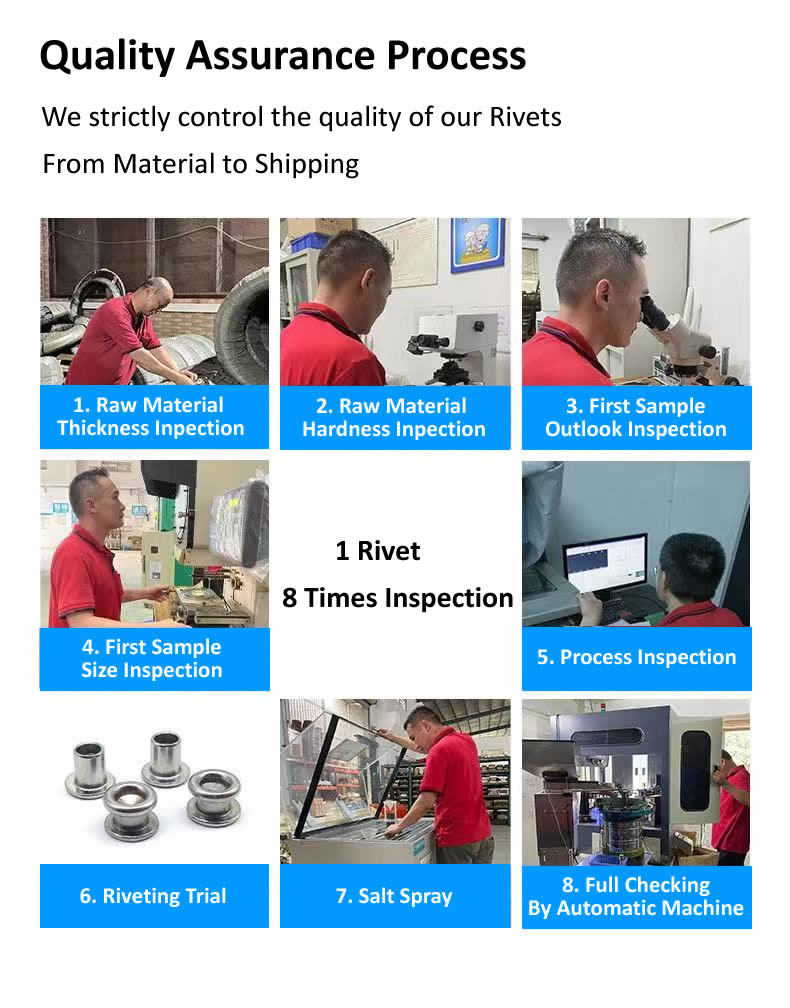
Our inspection process:
- Incoming wire – Diameter, hardness, and alloy composition checked before production.
- First article – 10 rivets measured on optical comparator. Every dimension verified.
- In‑process – 5 rivets every 500 pieces. Critical dimensions checked. Any drift stops the press.
- Setting test – Every 2,000 pieces, set into sample material. Clinch inspected for symmetry and tightness.
- Final sorting – 100% optical inspection. AQL sample manually verified.
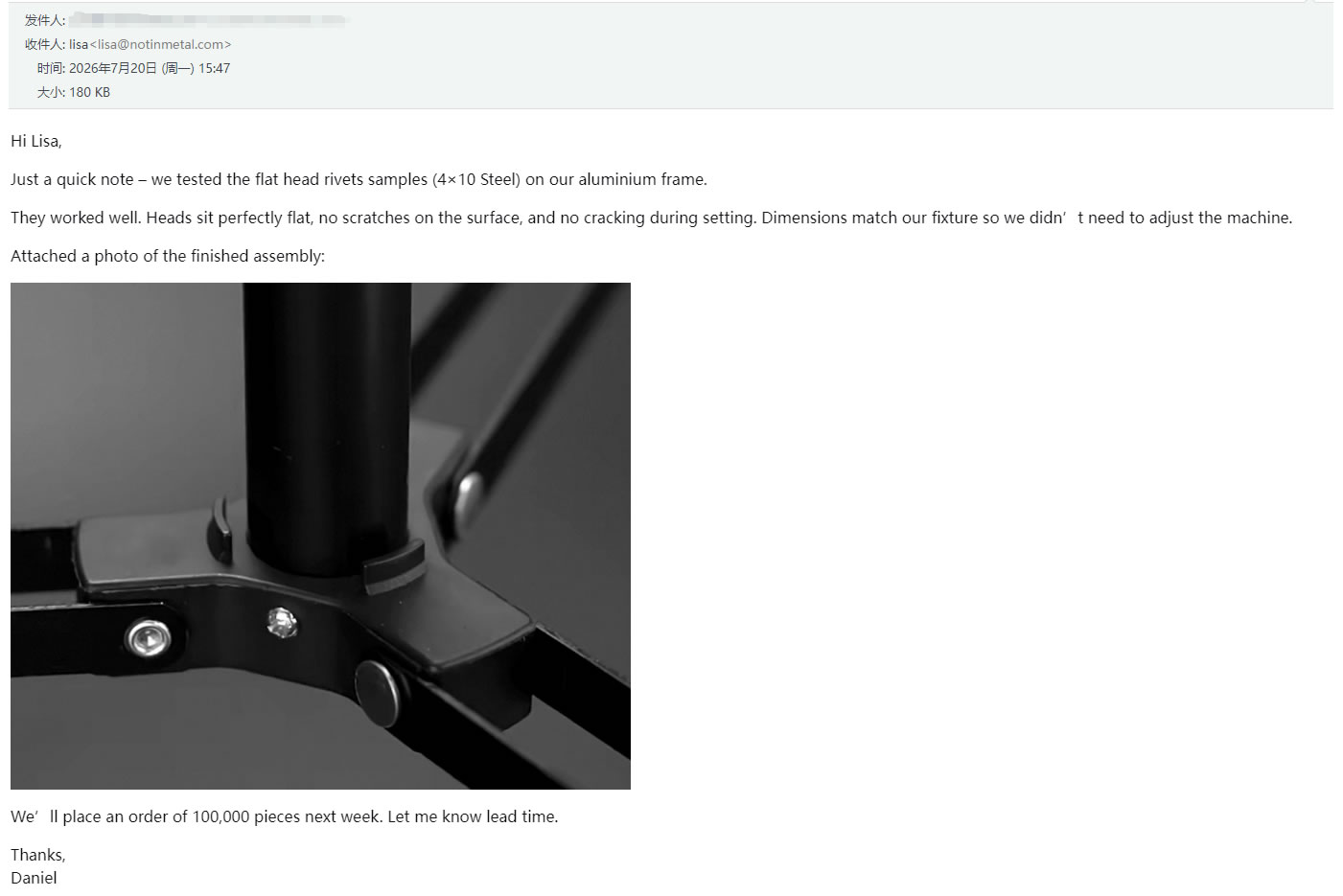
What Our Customers Say – Real Feedback
Your Order – What We Send You
When your aluminum solid rivets arrive, you receive a complete record of what was produced and how it was verified.
What you will find in the box:
- Rivets in sealed poly bags – Labeled with part number, batch number, and quantity
- Material certificate – Chemical composition and mechanical properties from the original coil
- Dimensional inspection report – Actual measurements of 10 rivets from the batch
- Anodizing certificate – Thickness verification (if applicable)
- Certificate of Conformance – Signed by our QA manager, batch‑traceable
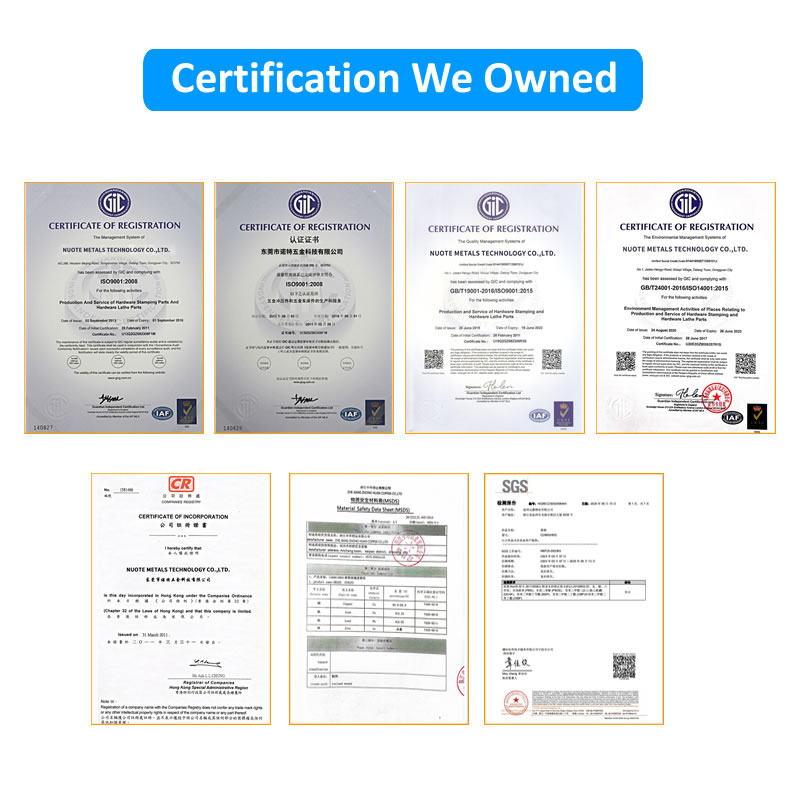
Certified to: ISO 9001:2015, RoHS, REACH
Where They Are Used
- Aerospace – Interior panels, seat components, non‑structural and semi‑structural assemblies
- Automotive lightweighting – Body panels, chassis components, suspension parts
- Drones and UAVs – Motor mounts, frame assemblies, structural connections
- Marine – Deck hardware, structural connections, boat fittings
- Portable equipment – Medical devices, camping gear, lightweight tools
- Renewable energy – Solar panel mounting, wind turbine components
- Decorative and non‑structural – Trim, nameplates, lightweight enclosures (1100 alloy)
- General manufacturing – Any assembly where weight reduction is critical and the joint must be permanent
Three Questions We Answer Often
Q: "What is the difference between 1100, 5052, and 5056 aluminum solid rivets?"
A: The difference is alloy composition and resulting properties. 1100 is pure aluminum (99%+) – softest, most ductile, excellent corrosion resistance. Use for non‑structural, decorative, and low‑load applications where easy setting is important. 5052 is a general‑purpose alloy with good strength and corrosion resistance – suitable for most applications. 5056 contains higher magnesium, giving it the highest tensile strength (280–350 MPa) and superior corrosion resistance – ideal for marine, structural, and high‑stress applications. For the drone case above, the customer chose 5056 because the motor mounts required maximum strength in a lightweight assembly.
Q: "Can aluminum solid rivets be used in place of steel solid rivets?"
A: Yes – for applications where the load requirements are within aluminum's strength range. they deliver the same permanent, maximum‑strength fastening as steel, at one‑third the weight. However, aluminum has lower tensile strength than steel. If your application requires the absolute maximum strength that steel provides, steel is still the right choice. For most lightweight structural applications – aerospace, automotive, drones, marine – they provide more than enough strength while significantly reducing weight.
Q: "Do aluminum solid rivets corrode? How do I prevent it?"
A: Aluminum forms a natural oxide layer that protects against corrosion. For most indoor and outdoor applications, this natural protection is sufficient. For enhanced protection, we recommend clear anodized finish – it thickens the oxide layer and provides additional corrosion resistance. For marine or continuous saltwater exposure, choose 5056 alloy with anodized finish for maximum protection. If you are joining aluminum to dissimilar metals (e.g., steel), we recommend isolating washers or coatings to prevent galvanic corrosion.
Hot Tags: Aluminum Solid Rivets,China Solid Rivets,Aluminum Solid Rivets Manufacturer
Product Tag
Related Categories
Send Inquiry
Please feel free to fill your inquiry in the form below. We will reply you in 24 hours.



X
We use cookies to offer you a better browsing experience, analyze site traffic and personalize content. By using this site, you agree to our use of cookies.
Privacy Policy