
Products
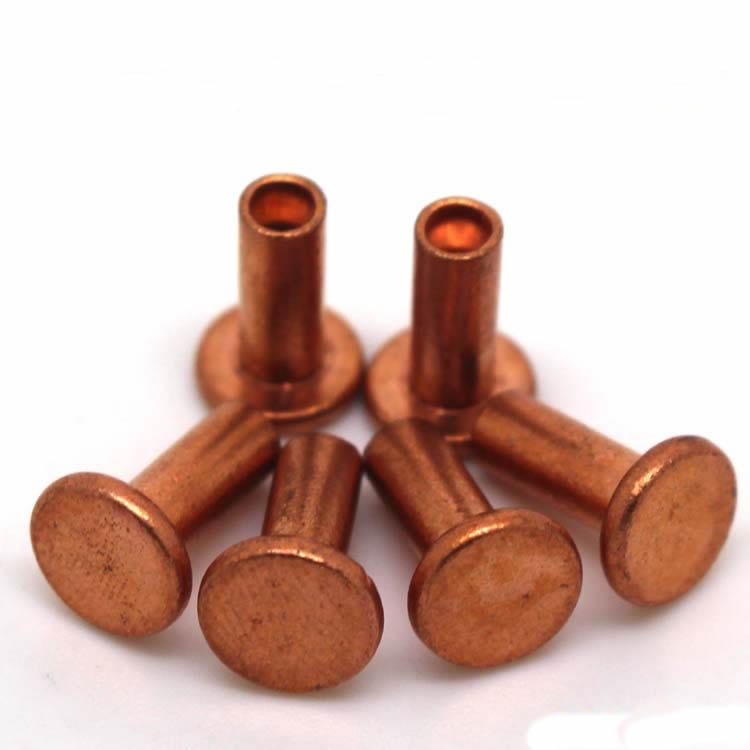
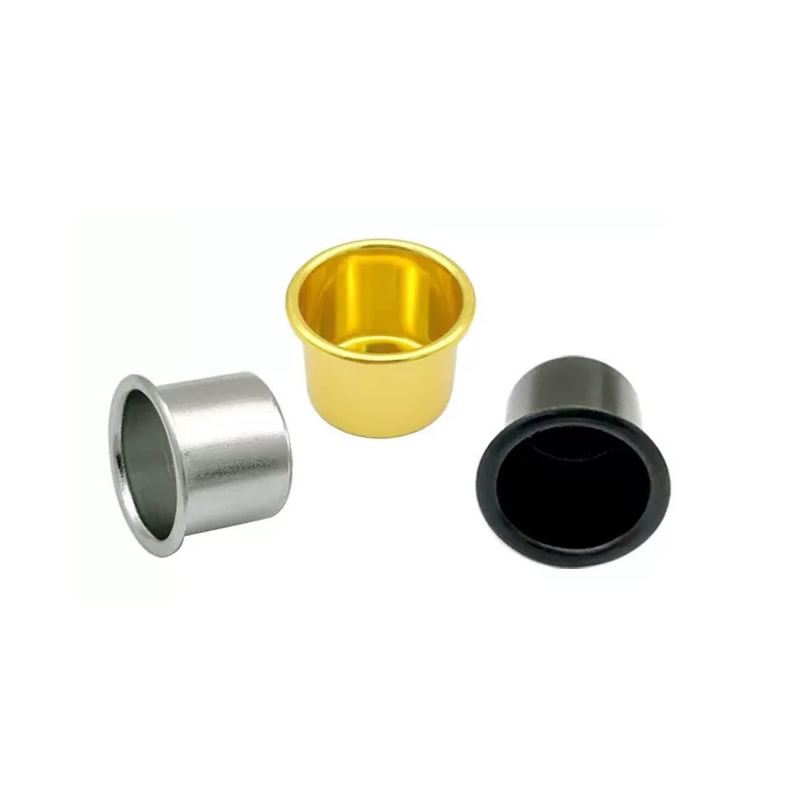
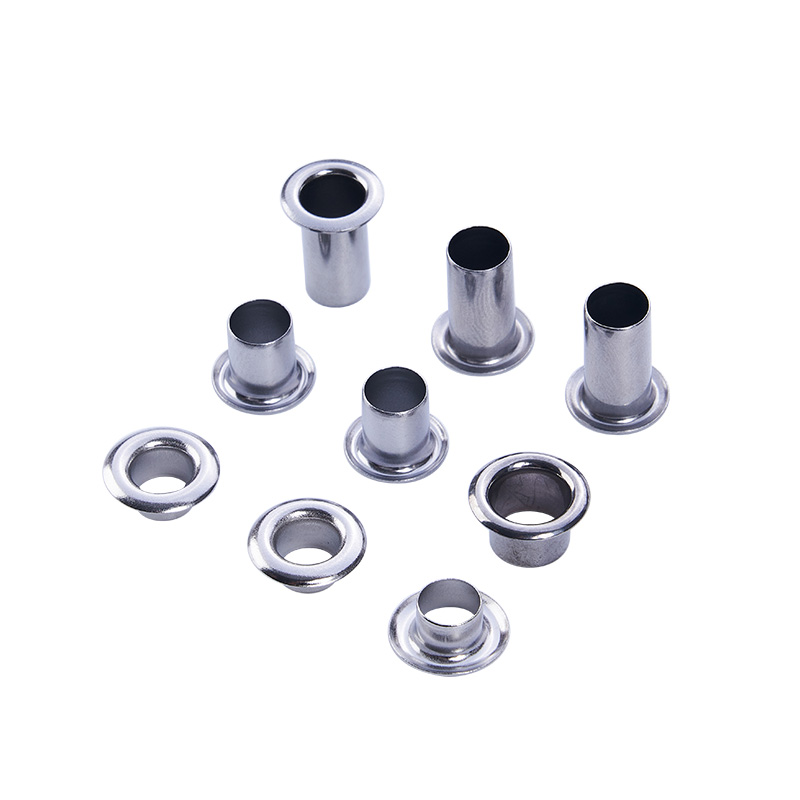
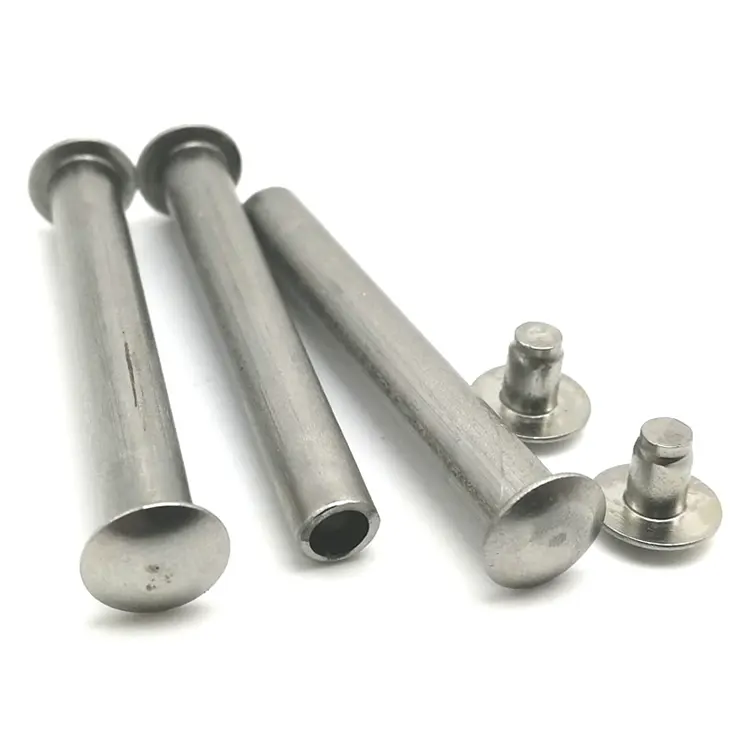
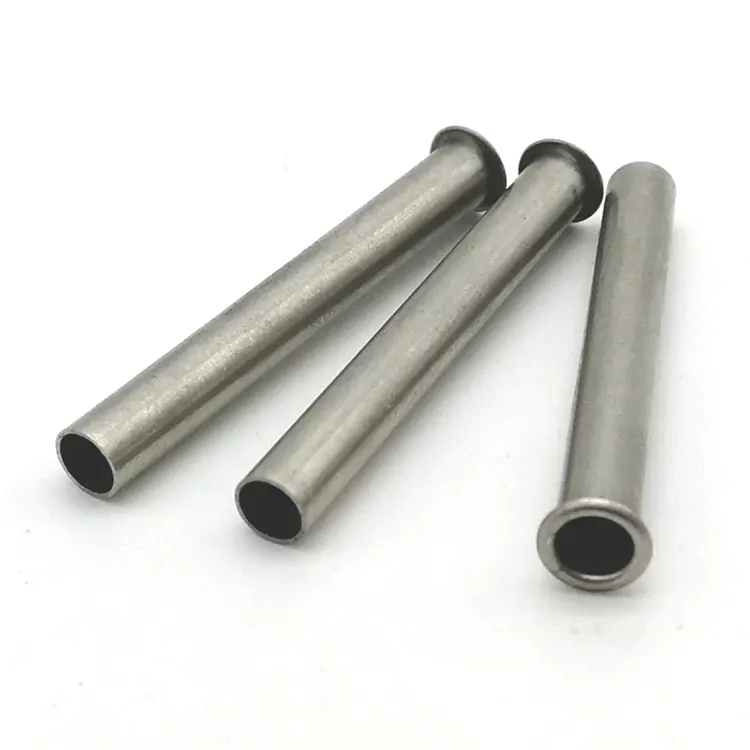
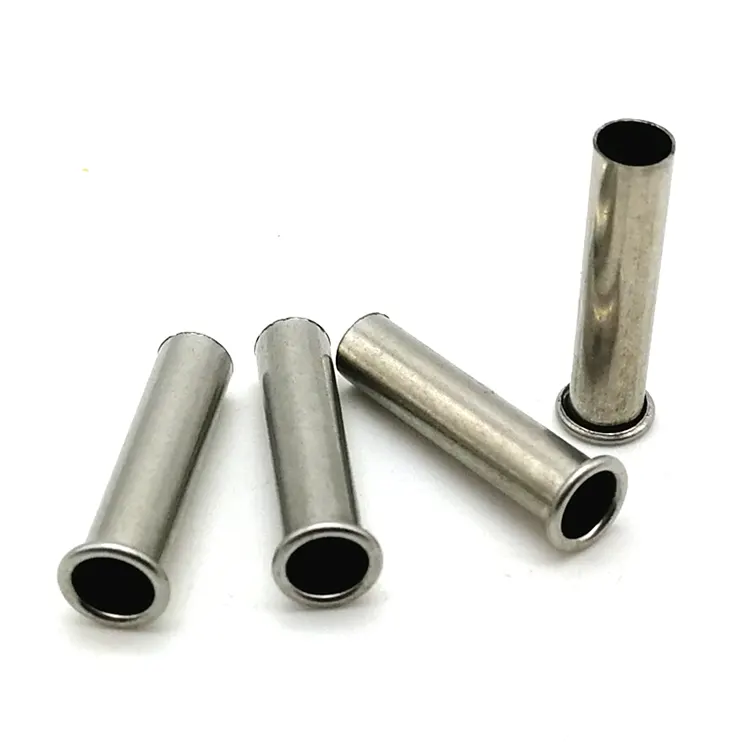
Stainless Steel Pipe Rivets
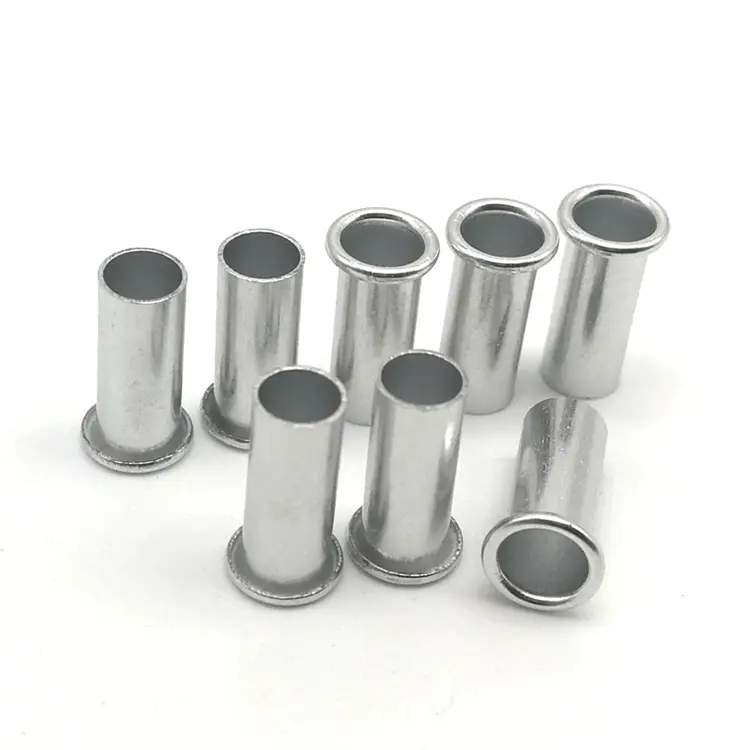
Nuote Metals supplies stainless steel pipe rivets – hollow fasteners made from genuine 304 or 316 stainless tube stock, cut to length with a head formed on one end. Also commonly called stainless steel hollow rivets. Permanent corrosion resistance without plating – the material itself is rust‑proof. Available in 1.0–10mm shank diameters, passivated finish.
Send Inquiry
Product Description
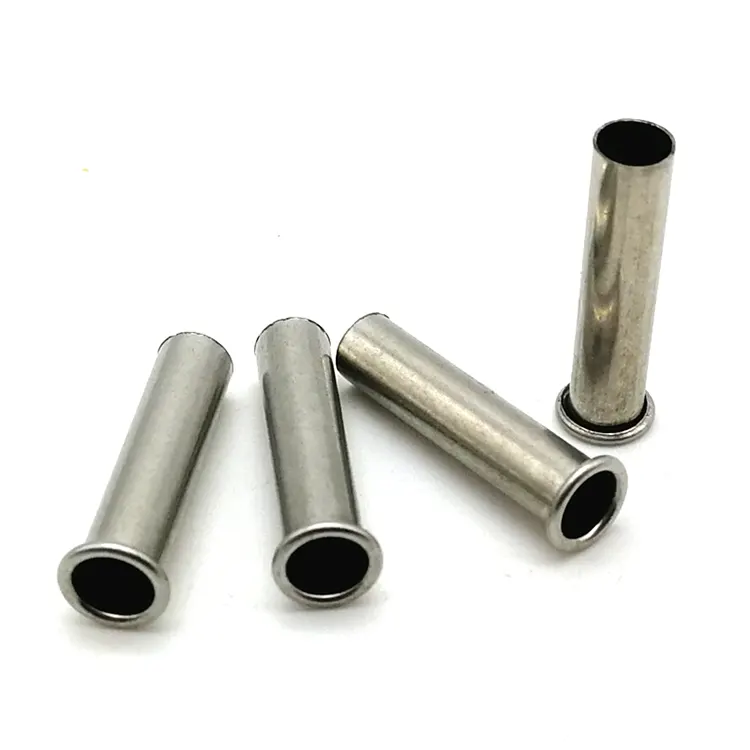
Stainless steel pipe rivets – also commonly called stainless steel hollow rivets – are hollow fasteners made from actual stainless tube stock. Same product. Two names. We make the same reliable fastener regardless of what you call it.
If you need a hollow fastener that will not rust – no plating to wear off, no coating to fail – they are the answer. The chromium oxide layer is self‑healing. Scratches do not expose bare metal to corrosion. When the application involves moisture, chemicals, or outdoor exposure, stainless steel pipe rivets deliver permanent protection.
304 vs. 316 – Which Grade Do You Need?
| Grade | Key Alloy | Salt Spray Resistance | Best For |
|---|---|---|---|
| 304 | 18% Cr, 8% Ni | 200 – 500 hours | General outdoor, rain, humidity, food contact |
| 316 | 16% Cr, 10% Ni, 2% Mo | 1,000+ hours | Marine, coastal, saltwater, chemical, acidic environments |
Choose 304 for general outdoor applications, food processing equipment, and industrial assemblies where salt exposure is limited.
Choose 316 for marine environments, coastal installations, chemical plants, and any application where chlorides or acids are present.
Stainless Steel Pipe Rivet vs. Semi‑Tubular vs. Solid – Where It Fits
| Feature | Stainless Steel Pipe Rivet (Hollow) | Stainless Steel Semi‑Tubular Rivet | Stainless Steel Solid Rivet |
|---|---|---|---|
| Shaft design | Fully hollow (tube stock) | Partially hollow (45–55% of length) | Fully solid |
| Setting force | 15–20% of solid | 25–30% of solid | 100% |
| Wall thickness | Thin, uniform | Moderate, uniform | Solid |
| Through‑hole | Open all the way through | Blocked at bottom | No passage |
| Corrosion resistance | Excellent (material itself) | Excellent (material itself) | Excellent (material itself) |
| Best for | Lacing, wiring, soft materials, outdoor assemblies | General purpose, moderate loads | Structural, maximum strength |
Available Finishes
Stainless steel pipe rivets are typically supplied with passivated finish as standard:
| Finish | Appearance | Best For |
|---|---|---|
| Passivated (standard) | Natural silver | All applications – restores oxide layer, prevents staining |
| Bead blasted | Matte silver | Anti‑glare, industrial |
| Electropolished | Bright, mirror‑like | Medical, food, high‑end decorative |
Passivation is included at no extra charge. It removes free iron particles from the surface that could otherwise cause rust staining.
One Real Application – Outdoor Advertising Display Frame
A manufacturer of outdoor retail display stands needed a corrosion‑resistant fastener for assembling powder‑coated steel frames. The stands were used outdoors year‑round – rain, humidity, and temperature changes were constant. The previous zinc‑plated carbon steel pipe rivets showed rust after one season. The customer needed a fastener that would not rust and would match the display's clean appearance.
We supplied 304 stainless steel pipe rivets – 4.0mm shank, 7.5mm round head, 6.0mm barrel length, passivated finish. The 304 stainless provided 200–500 hours of salt spray resistance – more than enough for outdoor displays. The passivated surface matched the powder‑coated frames. The hollow design flared with minimal force – no distortion to the thin frame material. The customer tested 500 rivets across 100 stands. After 18 months of outdoor exposure, zero rust, zero failures. They now order our pipe rivets in batches of 150,000 pieces annually.
How We Make Them – And Keep Them Stainless
Stainless steel pipe rivets start as genuine stainless tube stock – but stainless is harder to work with than carbon steel. It work‑hardens quickly and puts more stress on tooling. Our process is designed specifically for stainless.
Tube cutting – Stainless tube is cut to precise blank length. ±0.02mm tolerance. Carbide blades prevent work‑hardening at the cut edge.
Heading – A carbide die forms the head (round, flat, or countersunk) on one end. Controlled forming speed prevents cracking.
Trimming & tumbling – Flash is removed, micro‑burrs eliminated.
Passivation – Free iron particles are removed, and the chromium oxide layer is restored. Included at no extra charge.
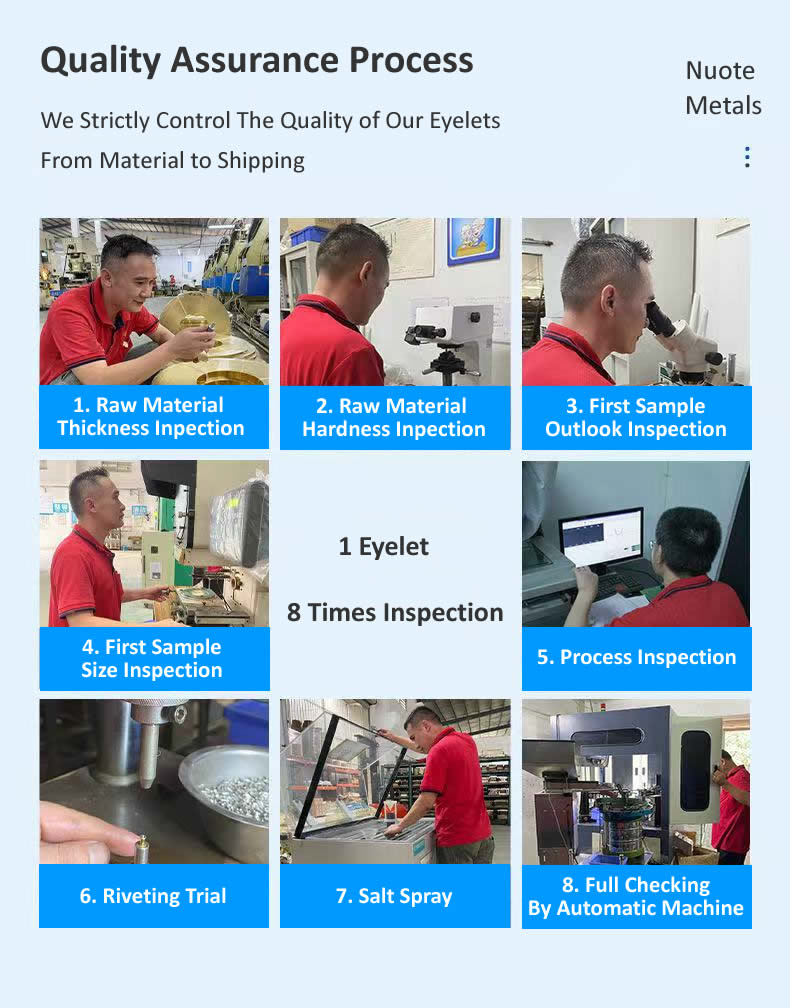
Before we cut – Incoming tube stock is verified for outside diameter, wall thickness, and material composition. Spectrometer confirms 304 or 316 grade. No out‑of‑spec material enters the cutting room.
After we head – The first 10 rivets from each tooling setup are measured on an optical comparator. Inner diameter, outer flange, barrel length, wall thickness – all verified before the press runs at speed.
During the run – Operators pull 5 rivets every 500 pieces. Any drift beyond tolerance stops the press.
Before we ship – Every 2,000 pieces, we set 3 rivets into a sample of your actual material. We check the clinch for symmetry and tightness, confirm the bore remains open, and inspect for cracks. Every rivet then passes through optical sorting. A random AQL sample is manually verified.
We keep records for five years. If a field issue ever occurs, we can trace the batch and pull the full file.
Sample lead time: 5–7 days standard; custom tooling: 15–20 days.
What Our Customers Say – Real Feedback
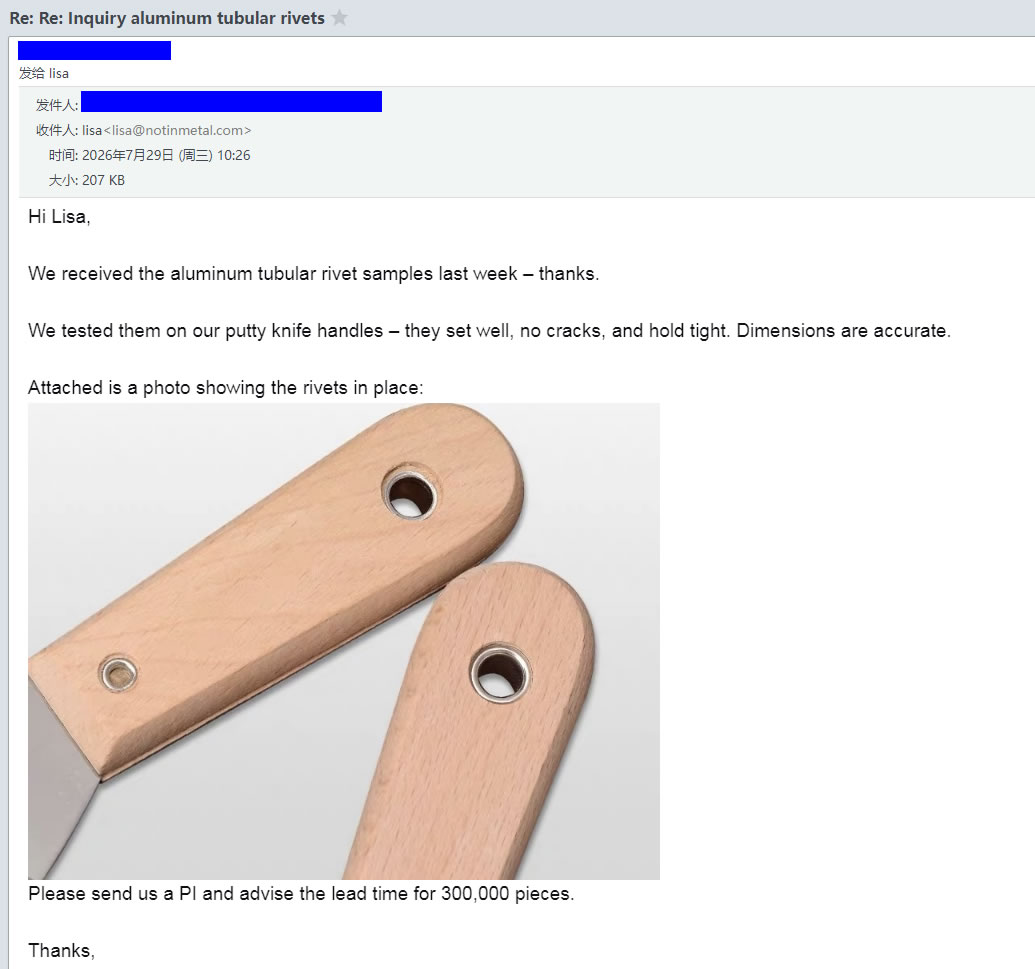
We let our customers speak for us. The images above show real feedback from manufacturers who have used our pipe rivets in their production lines – from outdoor display builders to marine equipment suppliers to food processing equipment manufacturers.
They come back to us for the same reasons:
Permanent corrosion resistance – No plating to wear off, no rust, no stains
Uniform quality – Consistent wall thickness and inside diameter, batch after batch
Reliable delivery – Samples ship in 5–7 days, production on schedule
Three Questions We Answer Often
Q: "Can I get samples before ordering production quantities?"
A: Yes – we offer samples for all our products. For standard existing specifications, samples are provided free of charge – you only pay the shipping cost. For custom sizes or custom tooling, sample availability and lead time depend on the specific requirements. Please contact our sales team with your drawing or specification, and they will advise on sample cost and delivery timeline.
Q: "Do stainless steel pipe rivets need passivation? Why does it matter?"
A: Passivation is recommended – and we include it at no extra charge. Stainless steel does not rust, but microscopic particles of free iron can transfer from tooling onto the surface during manufacturing. These particles can rust, creating red stains on your product – even though the rivet itself is stainless. Passivation removes these particles and restores the true corrosion‑resistant surface. Without it, your "stainless" rivets may still show rust stains. We passivate every batch as standard.
Q: "Can stainless steel pipe rivets be used outdoors without rusting?"
A: Yes – that is exactly what they are designed for. Stainless steel pipe rivets are corrosion‑resistant by nature, with no plating to wear off or fail over time. The chromium content forms a passive oxide layer on the surface that is self‑healing – if the surface is scratched, the chromium reacts with oxygen to reform the protective barrier.
For outdoor use, we recommend:
304 stainless – Suitable for most outdoor applications (rain, humidity, temperature changes). 200–500 hours salt spray resistance.
316 stainless – Recommended for coastal, marine, or saltwater exposure. 1,000+ hours salt spray resistance, with molybdenum for extra protection against chlorides.
For the outdoor display case above, 304 stainless was the right choice – it provided more than enough corrosion resistance for year‑round outdoor exposure without the premium cost of 316.
Hot Tags: Stainless Steel Pipe Rivets Supplier, Corrosion Resistant Pipe Rivets, Custom Pipe Rivets Manufacturer
Related Categories
Send Inquiry
Please feel free to fill your inquiry in the form below. We will reply you in 24 hours.



X
We use cookies to offer you a better browsing experience, analyze site traffic and personalize content. By using this site, you agree to our use of cookies.
Privacy Policy